
The Alabama Homestead Tax Exemption offers homeowners significant property tax relief by reducing the assessed value of their primary residence, and this comprehensive guide covers everything from basic eligibility requirements to advanced options for seniors and disabled residents, ensuring you understand how to maximize savings through the Alabama Homestead Tax Exemption. A homestead is legally defined as a single-family, owner-occupied dwelling plus up to 160 acres of surrounding land, and qualification requires that you live in the property as your primary residence on January 1st of the tax year you’re claiming. Alabama provides multiple exemption tiers including a standard $4,000 state exemption for all qualifying homeowners, enhanced county-level reductions up to $5,000 for seniors meeting income limits, and full ad valorem tax exemptions for those 65+ with federal taxable income under $12,000 or permanent total disability regardless of age. These benefits apply across state, county, and sometimes city taxes but exclude school taxes unless specific conditions are met, making the Alabama Homestead Tax Exemption one of the most valuable property tax breaks available to residents.
Basic Eligibility Requirements
To qualify for any Alabama Homestead Tax Exemption, you must own and occupy a single-family home as your primary residence on January 1st of the tax year. The property cannot exceed 160 acres total, though most urban homeowners easily meet this limit since it includes both house and land. All owners listed on the deed must typically sign the application, and mobile homes qualify if you own both the home and the land underneath it. Unlike some states, Alabama’s exemption doesn’t require annual renewal once approved, but it doesn’t transfer automatically to new owners—you must reapply when buying property.
Standard Homestead Exemptions
Alabama’s baseline homestead exemption provides $4,000 off the assessed value for state property taxes to all qualifying homeowners under age 65 without additional requirements. County exemptions add another layer with $2,000 reductions that often apply to school taxes as well, creating immediate savings for basic applicants. These standard credits typically save homeowners $100-300 annually depending on local millage rates and property values, making them accessible entry-level tax relief for first-time buyers and long-term residents alike.
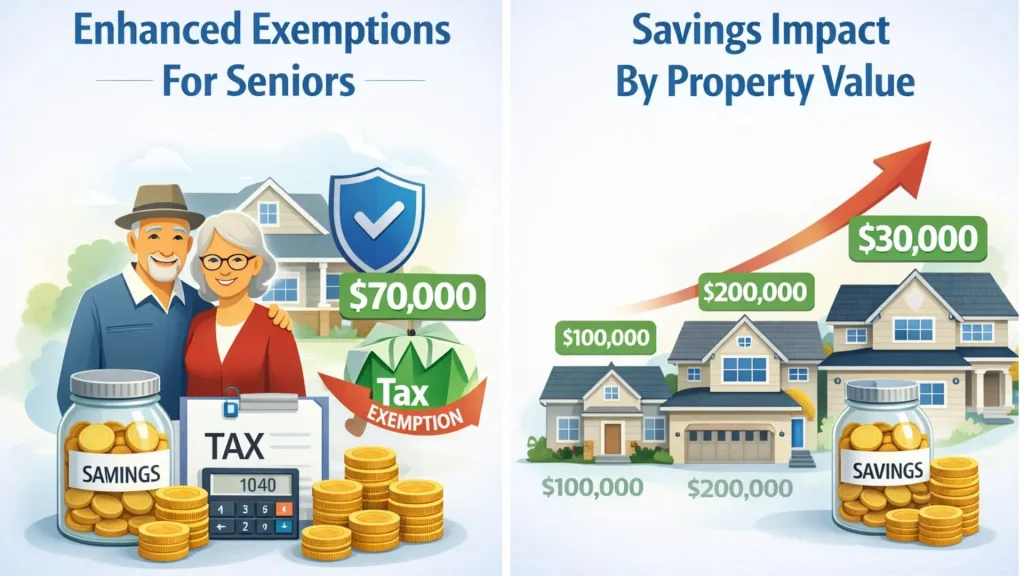
Enhanced Exemptions For Seniors
Homeowners age 65 and older unlock progressively better Alabama Homestead Tax Exemption benefits based on income levels and tax return documentation. Those with Alabama adjusted gross income over $12,000 still get state exemptions plus $2,000 county credit (H-4 classification), while under-$12,000 federal filers qualify for H-3 status with full ad valorem exemption across state, county, and city taxes excluding school portions in many cases. H-2 provides $5,000 county credit plus full state exemption for qualifying seniors or permanently disabled retirees regardless of age, often eliminating most property tax liability entirely.
Disability And Special Exemptions
Permanently and totally disabled residents qualify for maximum homestead exemptions regardless of age, typically receiving full state ad valorem exemption plus substantial county credits without income caps. Blind homeowners access similar benefits with up to $5,000 county exemptions, and physician affidavits verify disability claims when tax returns alone don’t suffice. These categories ensure broader access to tax relief for health-related circumstances beyond just chronological age requirements.
Application Process Explained
Apply for Alabama Homestead Tax Exemption between October 1st and December 31st at your county revenue commissioner’s office, though some accept mail or online submissions year-round for new owners. Required documents include proof of residency (driver’s license), property ownership (deed or tax bill), Social Security number, and a notarized affidavit signed by all owners. Processing typically takes effect the following tax year, so timely filing prevents missed savings—many counties provide forms directly on their websites for convenience.
Common Application Mistakes
Many miss Alabama Homestead Tax Exemption opportunities by applying after December 31st, failing to notarize affidavits, or omitting all owners’ signatures from multi-owner deeds. Using out-of-state IDs instead of Alabama licenses creates residency disputes, while forgetting mobile home land ownership documentation blocks qualification. Seniors often submit wrong tax return lines—federal Form 1040 combined income for H-3, Alabama state AGI for H-2/H-4—which delays approval until corrected.
Savings Impact By Property Value
A $200,000 home typically sees $180-250 annual savings from basic exemptions at Alabama’s average 0.41% effective rate, scaling higher for enhanced senior/disabled credits. Higher-value properties benefit proportionally more since exemptions reduce assessed value before millage calculation, while rural 160-acre parcels maximize land coverage benefits. School tax exclusions vary by county policy, so checking local schedules reveals true bottom-line impact beyond state-level estimates.
Recent Changes And 2026 Updates
Alabama’s homestead exemption framework remains stable under Act 2013-295 classifications (H-1 through H-4), with no major 2026 alterations announced beyond standard inflation adjustments to income thresholds. Counties occasionally expand school tax relief or streamline digital applications, so checking revenue commissioner sites ensures current procedures match published guides. The $12,000 income caps adjust minimally year-to-year based on tax return definitions rather than CPI indexing.

Frequently Asked Questions
Who qualifies for Alabama homestead exemption?
Owners occupying single-family primary residences up to 160 acres on January 1st, with enhanced benefits for age 65+, disability, or low income.
When is the homestead exemption deadline?
October 1st through December 31st annually, though new owners may apply year-round in some counties.
Do I need to renew homestead exemption yearly?
No, approval is permanent unless ownership changes or residency status shifts.
Can mobile homes get homestead exemption?
Yes, if you own both the home and underlying land where it’s situated.