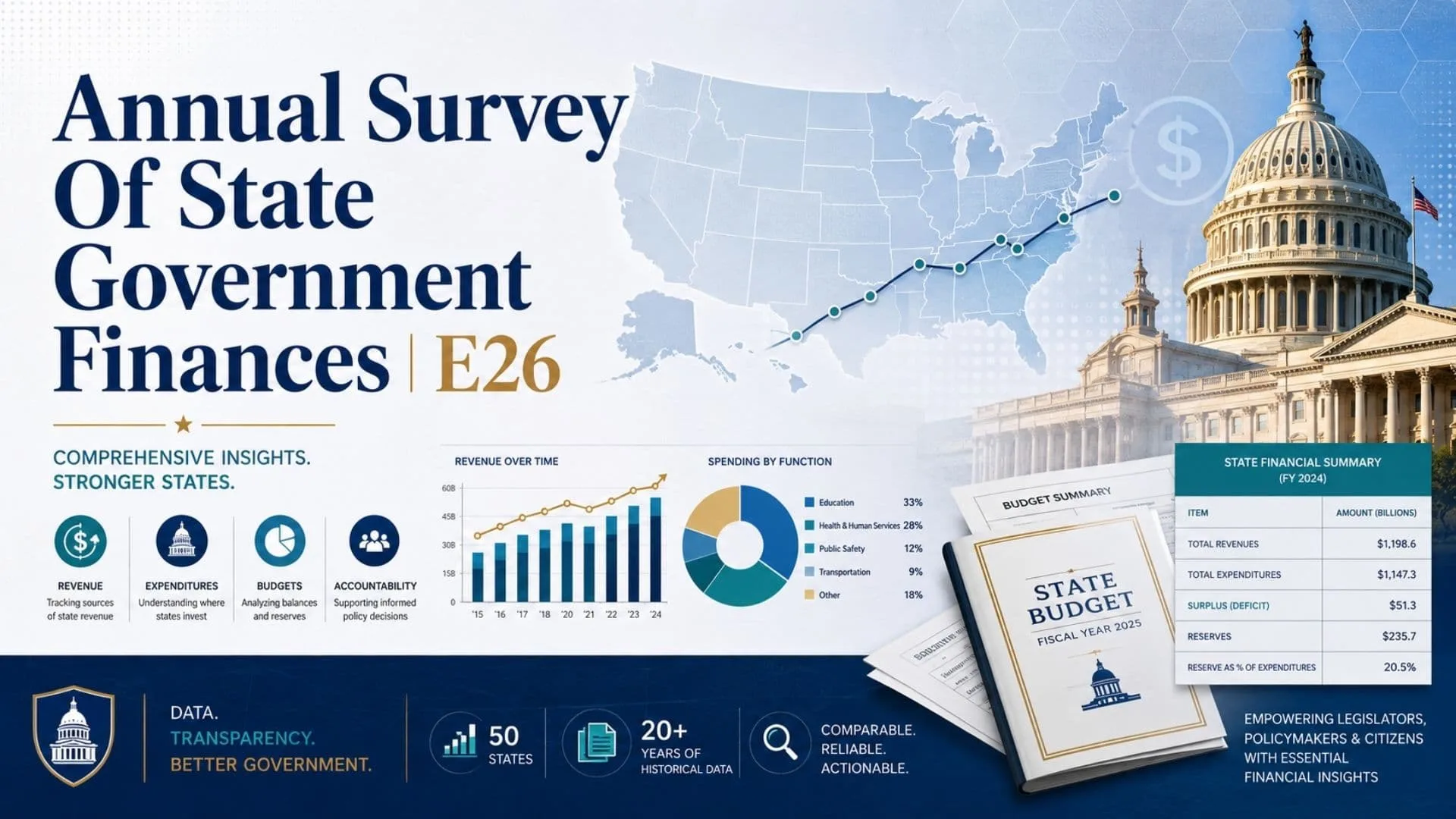
The Annual Survey Of State Government Finances E26 is a useful topic for anyone trying to understand state government finances, Census Bureau finance data, public spending, government revenue, expenditure categories, debt statistics, fiscal year reports, state budget analysis, and legislative services costs in the United States. The Annual Survey of State Government Finances, also known as ASFIN, is run by the U.S. Census Bureau and gives a detailed look at how state governments collect money, spend money, manage debt, and report assets. In this context, E26 is best understood as a finance classification code connected with legislative current operations, which helps researchers find and compare spending tied to legislative services across states. That may sound dry at first, but it is actually a handy way to answer practical questions, like how much states spend on running legislatures, how public money is categorized, and how those figures fit inside wider state finance tables. The Census Bureau says the Annual Survey of State Government Finances provides a comprehensive summary of annual survey findings for state governments and data for individual states, making it one of the main sources for comparing public finance activity across the 50 states and Washington, D.C.
What Is The Annual Survey Of State Government Finances?
The Annual Survey of State Government Finances is a Census Bureau program that collects and publishes state-level financial statistics. It looks at major areas such as revenue, expenditures, debt, and assets. These categories help show how state governments raise funds and where those funds go.
Unlike a single state budget document, ASFIN is built for comparison. It uses common definitions and classifications so data users can look across states without getting lost in different accounting styles. A state may use one label in its own budget report, while the Census Bureau may place that activity into a standardized category for national comparison.
The 2017 technical documentation says the survey covers all state governments in the United States and includes the full range of government finance activities, including revenue, expenditure, debt, and assets.
What Does E26 Mean?
E26 is a Census finance code linked to legislative services under current operations. In plain words, it helps identify operating spending related to legislative activities.
A Census government finance classification manual lists E26 under the legislative portion of general control and connects it with current operations, while related codes such as F26 and G26 are tied to other types of spending within the same function.
This matters because researchers, journalists, policy teams, students, and budget analysts often need more than a broad spending number. They may want to isolate a specific function. E26 helps them focus on legislative operating costs rather than mixing those costs with highways, hospitals, welfare, public safety, or education.
Why E26 Data Matters
E26 may look like a small code, but it can tell a bigger story. Legislative spending supports the work of state lawmakers, committees, staff, offices, research, and day-to-day legislative functions. These costs are part of the machinery that keeps state government running.
When analysts compare E26 data across states, they can study differences in legislative structure, staffing, workload, and public administration style. A larger state may have more complex needs, while a smaller state may spend less in total but more per resident or per lawmaker. The value of the code is not just the number. The value comes from what the number helps explain.
It can also support discussions about transparency. Citizens often hear about big budget areas like schools, roads, and healthcare. Legislative operations are smaller, but they still matter because they fund the decision-making process behind those larger spending choices.
What Kind Of Data Does ASFIN Include?
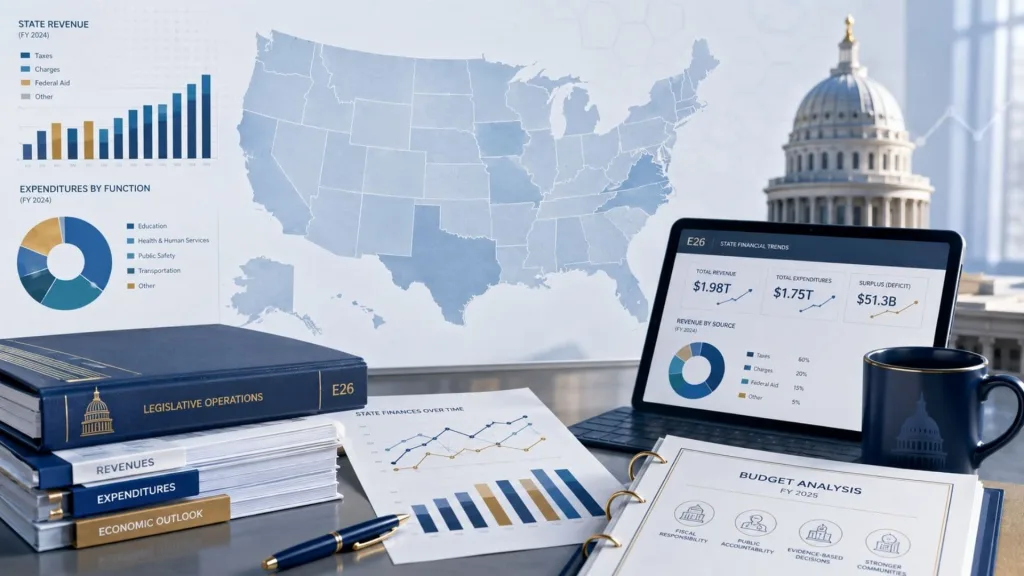
ASFIN data is broad. It covers taxes, charges, federal intergovernmental revenue, insurance trust systems, current operations, capital outlay, debt, and cash and security holdings. The exact tables may vary by release, but the goal is to make state finance activity easier to compare and study.
The Census Bureau released new Annual Survey of State Government Finances tables on March 5, 2026, covering fiscal year 2024. The release says the tables include data for each state, with detailed information on revenue sources, spending, and debt.
That makes the survey useful for many types of readers. A student may use it for a public finance paper. A local reporter may use it to compare state spending trends. A policy analyst may use it to study how legislative costs move over time. A taxpayer may use it to better understand where public money goes.
How To Read E26 In A Practical Way
The first step is to remember that E26 is not the whole survey. It is one code inside a much larger classification system. Do not treat it like a complete picture of state finances. Treat it like a small but focused window into legislative operating spending.
The second step is to compare carefully. A raw total can be helpful, but it may not be fair by itself. Population size, state income, legislative session length, staff levels, and state responsibilities can all affect spending. A better approach is to compare E26 data with other measures, such as per capita spending or spending as a share of total state expenditure.
The third step is to check the year. State finance data is reported by fiscal year, and fiscal years do not always match calendar years. When using the Annual Survey of State Government Finances, always confirm the release year and the fiscal year being measured.
Who Uses This Data?
Many groups use ASFIN and E26-related data. Researchers use it to study state institutions. Government agencies use it for planning and reporting. Budget offices may use it to compare spending patterns. Journalists use it to explain public finance topics in a way readers can understand.
It is also valuable for civic education. People often feel disconnected from government budgets because the documents are long and technical. Standardized data makes the numbers easier to search, compare, and explain.
Common Mistakes To Avoid
One common mistake is assuming E26 means the same thing as the entire legislative budget shown in a state document. Census classifications may group and define items differently from state accounting systems.
Another mistake is comparing states without context. A state with higher E26 spending is not automatically wasteful, and a state with lower spending is not automatically efficient. The number needs interpretation.
A third mistake is mixing survey years. If you compare fiscal year 2024 data with fiscal year 2021 data without noting the time gap, the result may be misleading.
FAQs
What Is E26 In State Government Finances?
E26 is a Census finance classification code connected with current operations for legislative services.
Who Publishes The Annual Survey Of State Government Finances?
The U.S. Census Bureau publishes it as part of its government finance data program.
What Does ASFIN Track?
It tracks state revenue, expenditures, debt, and assets.
Why Is E26 Useful?
It helps users study legislative operating spending in a more focused way.
Is E26 The Same As A Full State Budget?
No. It is one classification code inside a larger finance reporting system.