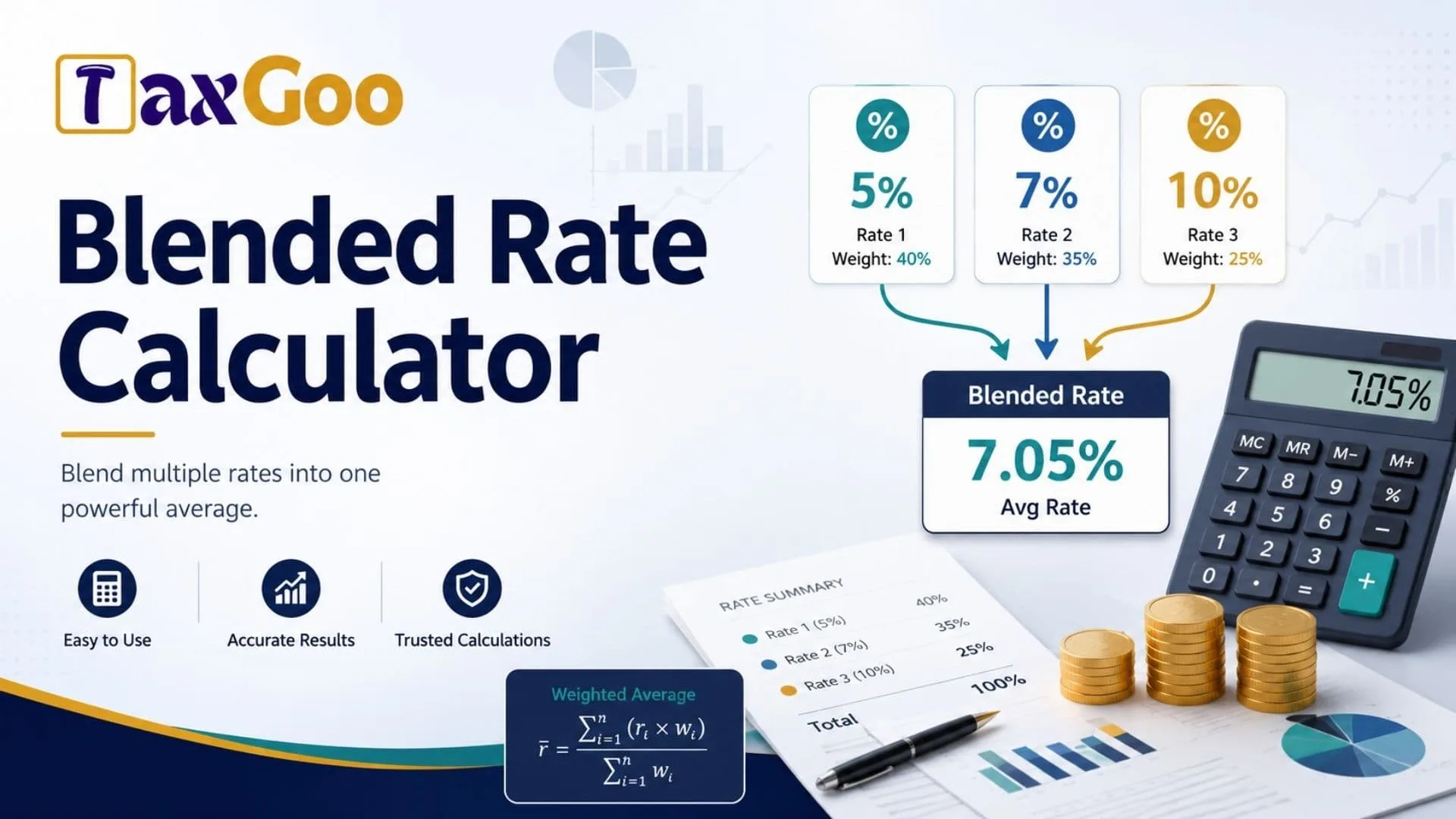
A Blended Rate Calculator is a simple tool that helps you find the average effective rate when different portions of money, time, debt, income, or cost are charged at different rates. Instead of guessing what your overall rate is, a blended rate calculator uses a weighted average formula to combine each rate based on how much it applies to. This is useful for blended tax rate calculations, loan interest comparisons, mortgage rate analysis, employee labor cost planning, overtime pay review, investment return estimates, contractor pricing, and business cost forecasting. For example, if part of your income is taxed at one rate and another part is taxed at a higher rate, your blended tax rate is not just the highest rate. It is the average rate after considering how much income falls into each level. The same idea applies if you have two loans, one at 5% and one at 8%, or if a business pays employees different hourly rates across a project. A blended rate gives you one clear percentage that reflects the true overall cost or return.
What Is A Blended Rate?
A blended rate is a weighted average of two or more rates. It shows the combined effect of different rates based on the amount connected to each one.
The key word is “weighted.” A simple average treats every rate equally, but a blended rate gives more importance to the rate connected to the larger amount. That makes the result more accurate.
For example, if you borrow $90,000 at 6% and $10,000 at 12%, your blended rate will be much closer to 6% than 12% because most of the debt is at the lower rate.
How A Blended Rate Calculator Works
A blended rate calculator usually needs two pieces of information for each item:
Amount
Rate
The amount could be income, loan balance, hours worked, project cost, investment value, or another measurable number. The rate could be a tax rate, interest rate, hourly rate, return rate, or fee rate.
The calculator multiplies each amount by its rate, adds those results together, and then divides the total by the combined amount.
Blended Rate Calculator
This tool helps you calculate the effective combined interest rate when you have multiple loans or financial products, each with its own principal amount and interest rate. Enter the details for each of your debts below.
Blended Rate Formula
The basic blended rate formula is:
Blended Rate = Total Weighted Cost ÷ Total Amount
Or written another way:
Blended Rate = (Amount 1 × Rate 1 + Amount 2 × Rate 2 + Amount 3 × Rate 3) ÷ Total Amount
This formula can work with two rates or many rates. The more rates you add, the more helpful the calculator becomes because doing it manually can get messy.
Simple Blended Rate Example
Let’s say you have two loan balances:
Loan 1: $40,000 at 5%
Loan 2: $60,000 at 8%
First, multiply each amount by its rate:
$40,000 × 5% = $2,000
$60,000 × 8% = $4,800
Then add the weighted costs:
$2,000 + $4,800 = $6,800
Now add the total loan amount:
$40,000 + $60,000 = $100,000
Finally, divide:
$6,800 ÷ $100,000 = 6.8%
So the blended rate is 6.8%. Even though one loan has an 8% rate, your overall combined rate is lower because part of the balance is charged at 5%.
Blended Tax Rate Meaning
A blended tax rate shows your average tax rate across different taxable income levels. It is different from your marginal tax rate.
Your marginal tax rate is the rate applied to your next dollar of taxable income. Your blended tax rate, also called your effective tax rate in many tax discussions, shows your overall tax as a percentage of income.
For example, if some income is taxed at a low rate and some income is taxed at a higher rate, your blended tax rate lands somewhere in the middle. This can help taxpayers understand the real impact of deductions, income increases, retirement withdrawals, bonuses, and business profits.
Blended Rate For Loans
A blended rate is very helpful when comparing loans. If you have multiple debts with different interest rates, the blended rate shows your average borrowing cost.
This can help answer questions like:
Is refinancing worth it?
Should I consolidate my loans?
Which debt should I pay first?
How much interest am I really paying overall?
A blended loan rate gives a clearer picture than looking at each loan separately.
Blended Rate For Labor Costs
Businesses often use blended rates when employees with different pay rates work on the same project. For example, a project may include senior staff, junior staff, contractors, and overtime hours.
Instead of pricing the project using only one hourly rate, the business can calculate a blended labor rate. This helps with quoting, budgeting, project profitability, and client billing.
A blended labor rate is especially useful for agencies, construction companies, consultants, repair businesses, law firms, accounting firms, and service teams.
Blended Rate For Investments
Investors can also use a blended rate to estimate combined returns. If one investment earns 4%, another earns 7%, and another earns 10%, the blended return depends on how much money is placed in each investment.
This helps investors understand portfolio performance more clearly. A large investment with a modest return may affect the total more than a small investment with a high return.
Why A Blended Rate Matters
A blended rate gives you a realistic number. It helps you avoid overestimating or underestimating costs, taxes, returns, or savings.
It is especially helpful when making decisions. If you only look at the highest rate, the situation may seem worse than it really is. If you only look at the lowest rate, you may underestimate the cost. The blended rate gives a balanced view.
Common Mistakes To Avoid
One mistake is using a simple average instead of a weighted average. If one amount is much larger than another, a simple average can give a misleading result.
Another mistake is mixing different types of rates. For example, do not combine annual interest rates with monthly rates unless they are converted to the same time period.
A third mistake is forgetting to include all amounts. A blended rate is only accurate when every relevant amount and rate is included.
Final Thoughts
A blended rate calculator is useful because it makes complex rate situations easier to understand. Whether you are reviewing taxes, loans, labor costs, pricing, or investments, it turns multiple rates into one practical number.
The main benefit is clarity. Once you know your blended rate, you can compare choices, plan smarter, and make decisions with fewer surprises.
Related Keywords
blended rate calculator, blended rate formula, blended tax rate, blended interest rate, weighted average rate, effective tax rate calculator, average interest rate calculator, loan blended rate, blended labor rate, blended hourly rate, blended mortgage rate, weighted average cost, combined rate calculator, tax rate calculator, effective rate calculation

FAQs
What Is A Blended Rate?
A blended rate is a weighted average of multiple rates based on the amount tied to each rate.
How Do You Calculate A Blended Rate?
Multiply each amount by its rate, add the results, then divide by the total amount.
Is Blended Rate The Same As Average Rate?
It is a weighted average rate, not a simple average.
Why Use A Blended Rate Calculator?
It gives a more accurate overall rate when different amounts have different rates.
Can A Blended Rate Apply To Taxes?
Yes. It can help estimate the average tax rate across different income levels.