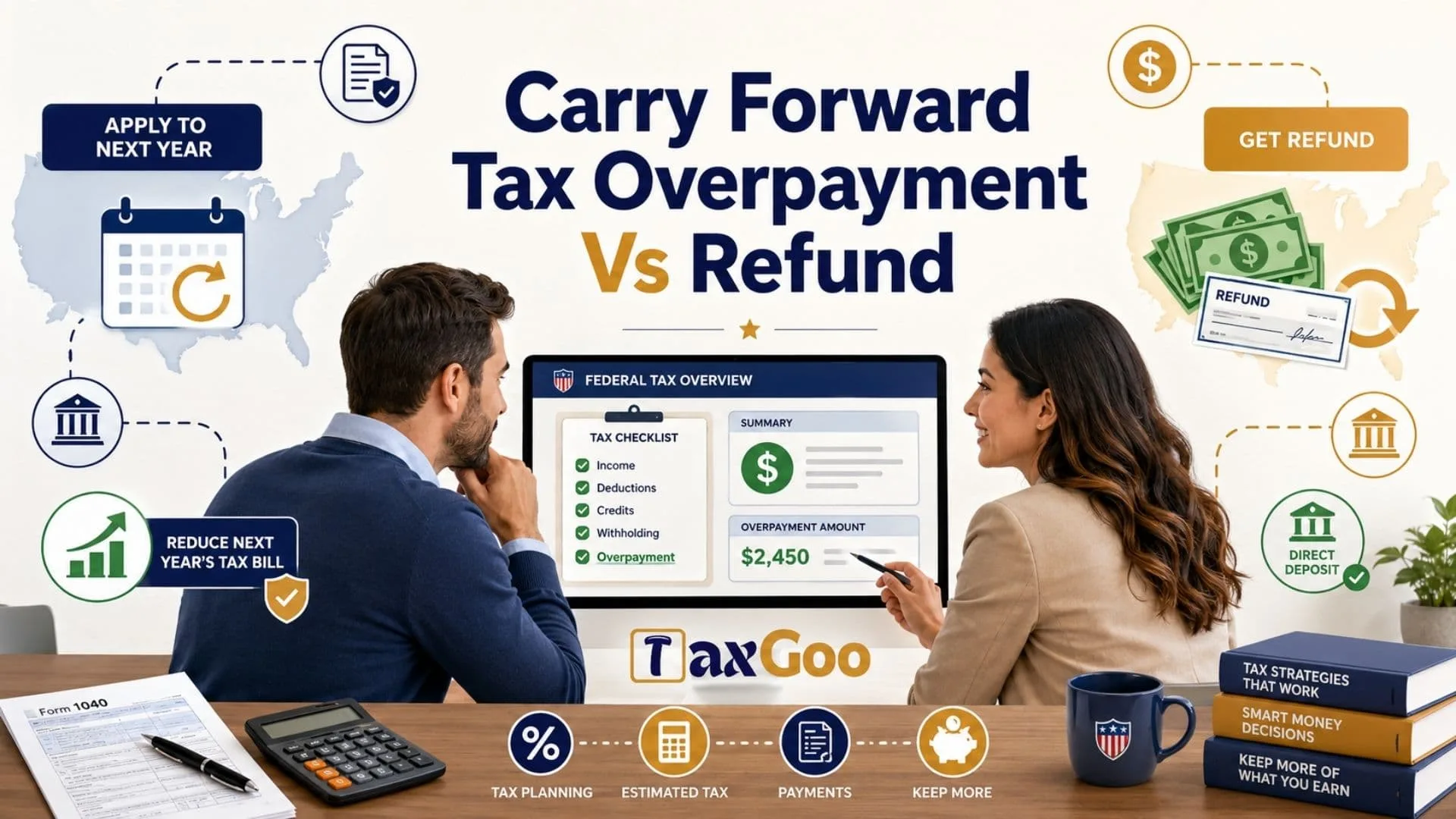
Carry forward tax overpayment vs refund is a decision many U.S. taxpayers face when their federal income tax payments, withholding, refundable credits, or estimated tax payments exceed the total tax shown on Form 1040. In everyday language, carrying the overpayment forward means asking the IRS to apply some or all of the extra amount to the following year’s estimated federal tax instead of sending it to you. Requesting a refund means receiving the available money by direct deposit or another approved refund method, after any applicable adjustments or debt offsets. Both choices use the same tax overpayment, but they serve different financial goals. Applying the overpayment forward may simplify quarterly estimated taxes for self-employed workers, freelancers, independent contractors, landlords, investors, and business owners. Taking the refund may provide immediate cash for bills, savings, debt, emergencies, or business expenses. You can also divide the overpayment, receiving part as a refund and applying the rest to next year’s estimated tax. The important part is understanding that the IRS generally treats the decision to apply an amount forward as a lasting election, so you should review your expected tax liability before submitting the return.
What Is A Federal Tax Overpayment?
A federal tax overpayment happens when the total amount credited to your tax return is greater than your final federal income tax liability.
The extra amount may come from:
- Federal income tax withheld from wages
- Estimated tax payments
- An overpayment applied from the previous year
- Tax withheld from retirement distributions
- Backup withholding
- Excess Social Security tax in qualifying situations
- Refundable tax credits
- Payments submitted with an extension
- Other eligible payments and credits
For example, suppose your total federal tax liability is $8,000, but your withholding, estimated payments, and refundable credits total $10,500. You have overpaid by $2,500.
That $2,500 does not automatically have to be returned entirely as a refund. You may request the full refund, apply the full amount to the following year’s estimated tax, or divide it between the two choices.
What Does Carrying Forward A Tax Overpayment Mean?
In the U.S. federal tax system, “carrying forward” an overpayment usually means applying it to your estimated tax for the next tax year.
For a 2025 federal individual income tax return filed in 2026, Form 1040 shows the overpayment on line 34. The amount requested as a refund is reported on line 35a, while the amount applied to 2026 estimated tax is entered on line 36.
The IRS does not send the amount entered on line 36 to your bank. Instead, it credits the money toward your estimated federal income tax for the following year.
For example, imagine that you have a $3,000 overpayment and decide to apply $2,000 to next year’s estimated taxes. You could request the remaining $1,000 as a refund. The $2,000 would remain with the IRS as an estimated tax payment for the following tax year.
Applying an overpayment forward does not reduce the tax rate or create a new deduction. It is simply an advance payment made with money you have already sent to the IRS.
What Does Taking A Tax Refund Mean?
Taking a refund means asking the IRS to return the available overpayment instead of applying it to your next year’s estimated tax.
Most taxpayers request direct deposit because it is generally faster and avoids the risk of a paper check being delayed, lost, or returned. Depending on the available filing options, a taxpayer may also be able to divide a direct deposit among qualifying accounts.
The IRS reports that refunds from accurately prepared electronically filed returns are commonly issued within about three weeks. Refunds connected to paper returns generally take longer, and returns requiring corrections, identity verification, additional review, or missing information may face delays.
Once you receive the refund, you control how it is used. However, receiving the money does not eliminate any estimated tax payments you may need to make during the new tax year.
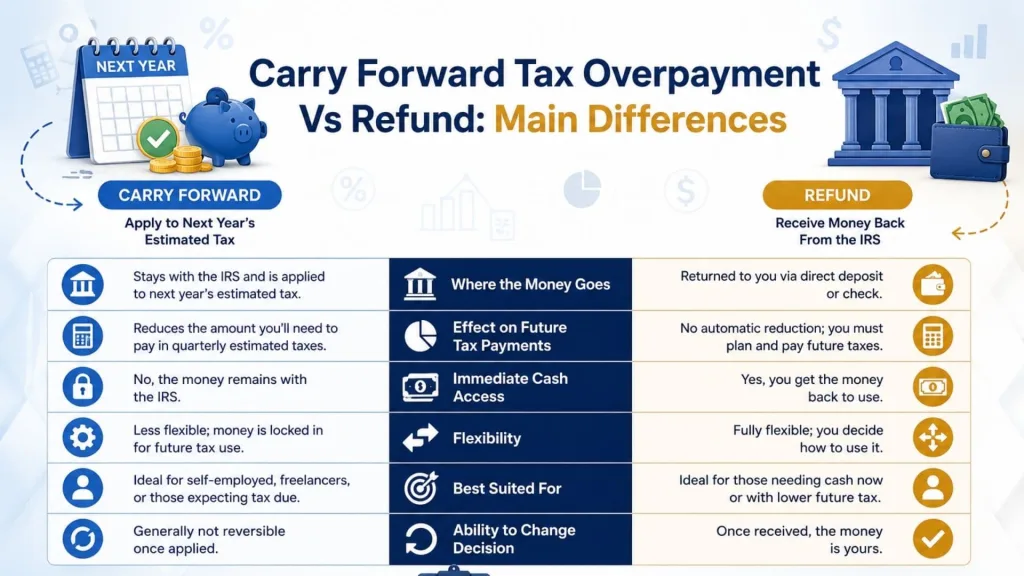
Carry Forward Tax Overpayment Vs Refund: Main Differences
| Consideration | Apply Overpayment Forward | Receive A Refund |
|---|---|---|
| Where the money goes | Toward next year’s estimated federal tax | To you |
| Immediate cash access | No | Yes |
| Effect on future estimated payments | Reduces the amount still needed | No automatic reduction |
| Flexibility | Money remains committed to federal taxes | Money can be used for any purpose |
| Budgeting | Makes future tax saving easier | Requires you to manage the money |
| Best for | Taxpayers expecting estimated tax obligations | Taxpayers who need cash or do not expect a large future liability |
| Ability to reverse the decision | Generally cannot be changed later | Money remains under your control after payment |
| Risk | Applying more than you need | Spending money needed for future taxes |
The choice is less about which option creates more money and more about where you want the money held.
When Applying The Overpayment Forward May Be Better
Applying a federal tax overpayment to the following year can be practical when you expect to owe quarterly estimated taxes.
You Are Self-Employed
Self-employed taxpayers normally do not have an employer withholding enough federal income tax and self-employment tax from their earnings. They may need to make estimated payments during the year.
Applying an overpayment forward can give you an early start on those payments.
Your Income Is Not Subject To Withholding
Freelance income, rental income, investment income, capital gains, business profits, and some retirement income may create a tax obligation without sufficient automatic withholding.
Using the overpayment as an estimated payment can help cover part of that expected liability.
You Want Simpler Tax Budgeting
Leaving part of the money with the IRS may help if you find it difficult to maintain a separate tax savings account.
The applied amount cannot be accidentally spent on vacations, shopping, or ordinary household costs. It is already reserved for federal taxes.
You Expect Similar Or Higher Income
Applying the overpayment forward may make sense when you expect the next year’s taxable income to remain stable or increase.
For example, a consultant with growing revenue may reasonably expect another substantial federal tax bill. Applying a refund toward estimated taxes can reduce the amount that must be paid from future cash flow.
You Want To Reduce Underpayment Risk
An applied overpayment counts toward the following year’s estimated tax. It may help you meet your required payments and lower the possibility of an estimated tax underpayment penalty.
It does not automatically guarantee that you have paid enough. Your final obligation depends on your income, deductions, credits, withholding, payment amounts, and payment timing.
When Receiving A Refund May Be Better
A refund may be more useful when access to the money matters more than prepaying next year’s taxes.
You Need Cash Now
A refund can help cover rent, medical expenses, home repairs, business costs, insurance, or another immediate financial need.
Applying the money forward would make it unavailable for those purposes.
You Have High-Interest Debt
Using a refund to pay down credit cards or other expensive debt could reduce interest costs. You should still make a separate plan for any estimated tax payments you expect to owe.
You Have An Emergency Fund To Build
Receiving the refund may help strengthen your savings and reduce the need to borrow during an emergency.
Your Income Is Expected To Fall
Applying a large amount forward may be unnecessary if you expect to retire, stop self-employment, take unpaid leave, close a business, or earn significantly less.
You could end up prepaying more federal tax than needed and waiting until another tax return is processed to recover the excess.
Your Employer Will Withhold Enough
A wage earner whose employer already withholds sufficient federal income tax may have little reason to apply a large overpayment toward estimated taxes.
Updating Form W-4 may also be more appropriate when regular overpayments are caused by excessive paycheck withholding.
You Can Manage Tax Savings Yourself
Some taxpayers prefer to receive the refund, place the future tax portion in a high-yield savings account, and make estimated payments by the appropriate deadlines.
This approach offers more flexibility, but it requires discipline and accurate recordkeeping.
Can You Split The Overpayment?
Yes. You do not have to choose between applying the entire overpayment forward and receiving the entire amount as a refund.
Suppose your return shows a $4,500 overpayment. You could:
- Receive all $4,500 as a refund
- Apply all $4,500 to next year’s estimated tax
- Receive $2,500 and apply $2,000 forward
- Choose another division that fits your situation
Splitting the amount may be a balanced option when you need some immediate cash but also want to prepare for future estimated payments.
Your tax preparation software will usually ask how much of the overpayment you want refunded and how much you want applied to the following year.
Is The Carry-Forward Election Reversible?
The decision to apply part or all of a federal tax overpayment to the following year’s estimated tax generally cannot be changed later.
This rule deserves careful attention. Do not apply money forward simply because your tax software presents the option or because you received a large refund last year.
Before making the election, estimate your income and tax obligations for the new year. Consider expected business profits, wages, investments, retirement distributions, deductions, credits, and withholding.
A taxpayer who urgently needs the money several months later may not be able to ask the IRS to return an amount that was deliberately applied to estimated taxes.
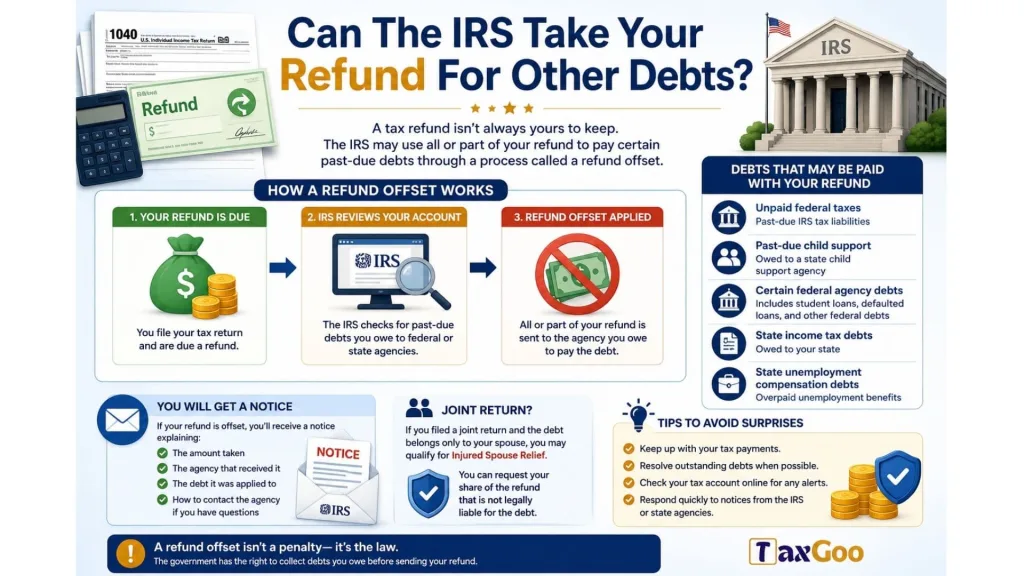
Can The IRS Take Your Refund For Other Debts?
Yes. A tax return may show an overpayment, but that does not always mean you will receive the full requested refund.
Some or all of a federal tax refund may be used to pay eligible past-due debts, including:
- Unpaid federal taxes
- Past-due child support
- Certain federal agency debts
- State income tax obligations
- Certain state unemployment compensation debts
This process is commonly called a refund offset.
The IRS or the Treasury Department’s Bureau of the Fiscal Service generally sends a notice explaining the amount taken and the agency that received it. If you filed a joint return and the debt belongs only to your spouse, you may qualify to request your share through injured spouse relief.
Choosing to apply an overpayment forward should not be treated as a guaranteed way to avoid valid federal or state debt collection. Review outstanding debts before relying on the full overpayment for either purpose.
Example Of Applying An Overpayment Forward
Marcus works as an independent graphic designer. His federal return shows a $6,000 overpayment because his estimated payments were based on a year when his income was higher.
Marcus expects business to improve during the new year. He estimates that he will need to pay at least $8,000 in federal estimated taxes.
He decides to apply $4,000 of the overpayment to the new tax year and receive $2,000 as a refund.
The $4,000 gives him a head start on estimated taxes. The $2,000 gives him cash for new equipment and business insurance.
Marcus must still calculate whether additional estimated payments are required. The carried-forward amount is a payment, not a complete estimate of his new tax bill.
Example Of Choosing The Refund
Alicia had extra federal tax withheld from every paycheck and has a $3,200 overpayment.
She expects to remain in the same job, but she plans to correct her withholding by submitting an updated Form W-4. She does not expect to owe quarterly estimated taxes.
Alicia chooses the full refund. She uses part of it to build her emergency fund and keeps the rest for necessary home repairs.
In this situation, applying the money to next year’s estimated taxes would offer little benefit because her paycheck withholding is expected to cover her federal tax liability.
How To Make The Right Choice
Review your financial situation before completing the refund section of your federal return.
Consider the following questions:
- Will you have self-employment, investment, rental, or other income without withholding?
- Do you expect your income to increase or decrease?
- How much federal tax will your employer withhold?
- Will you need to make quarterly estimated payments?
- Do you have high-interest debt or urgent expenses?
- Can you keep refunded money reserved for taxes?
- Are you comfortable making payments by the deadlines?
- Could the refund be reduced by an outstanding debt?
- How much emergency savings do you currently have?
- Are you confident in your estimated tax calculation?
Apply the overpayment forward when you expect a real estimated tax obligation and want the IRS to hold the money for that purpose. Request the refund when immediate access and financial flexibility are more valuable, provided you have another plan for future taxes.
Common Mistakes To Avoid
One common mistake is applying the entire overpayment forward without estimating the next year’s tax. This can leave too much money tied up with the IRS.
Another mistake is taking the full refund and spending it even though quarterly estimated taxes are approaching.
Do not assume a large refund is a bonus from the government. In many cases, it represents your own earnings that were overpaid through withholding or estimated payments.
Also avoid confusing an overpayment election with tax attributes such as capital losses, net operating losses, unused credits, or charitable contribution carryovers. Those items follow separate rules. Applying an overpayment forward simply moves money from one tax year to the next as an estimated tax payment.
How To Prevent A Large Overpayment Next Year
A large refund may feel satisfying, but it can also mean too much money was paid during the year.
Employees can review paycheck withholding and use the IRS Tax Withholding Estimator when appropriate. A new Form W-4 can help an employer adjust future federal withholding.
Self-employed taxpayers can update estimated payment calculations when income or expenses change. Review business results throughout the year rather than relying only on the previous year’s numbers.
Good tax planning aims for enough payment to avoid an unexpected balance and penalties without creating a needlessly large overpayment.
Final Thoughts
The best choice in the carry forward tax overpayment vs refund decision depends on what you expect to owe and how you need to use the money. Applying the overpayment to next year’s estimated tax can make sense for self-employed people, investors, landlords, and others with income not covered by withholding. A refund may be more suitable when cash flow, debt repayment, savings, or declining future income is the greater concern.
You can also divide the overpayment between the two options. Calculate your expected federal tax carefully before filing because an election to apply money to the following year generally cannot be reversed. For a large overpayment, complicated income, amended return, debt offset, or uncertain estimated tax obligation, consider consulting a qualified U.S. tax professional.

Frequently Asked Questions
What Does Carry Forward A Tax Overpayment Mean?
It means applying some or all of your federal overpayment to the following year’s estimated income tax instead of receiving that amount as a refund.
Is It Better To Apply An Overpayment Or Get A Refund?
Applying it may be better when you expect estimated tax obligations. A refund may be better when you need cash or do not expect to owe estimated taxes.
Can I Receive Part Of My Refund And Apply The Rest?
Yes. You can generally divide the overpayment between a refund and the following year’s estimated tax.
Can I Change My Mind After Applying The Overpayment Forward?
Generally, no. The IRS instructions state that the election cannot be changed later.
Does Applying A Refund Forward Lower My Taxes?
No. It does not reduce your taxable income or tax rate. It acts as an advance payment toward the next tax year.
Does A Carried-Forward Overpayment Replace Quarterly Payments?
Not always. It reduces the remaining amount you need to pay, but you must still calculate your total estimated tax obligation.
Why Was My Federal Refund Reduced?
The IRS may adjust the return, or the refund may be offset to pay eligible past-due federal, state, child support, or agency debts.
Is A State Tax Overpayment Handled The Same Way?
Not necessarily. Each state has its own return, rules, forms, and refund procedures.