
If you have ever looked at a receipt for new lenses, frames, or an eye exam and wondered, “Do Prescription Glasses Count as a Medical Expense?”, the short answer is yes in many cases, but the tax benefit depends on several rules tied to medical expense deductions, IRS guidance, itemized deductions, unreimbursed healthcare costs, prescription eyewear, vision expenses, and adjusted gross income. Prescription glasses are generally considered a qualified medical expense when they are used to correct vision problems such as nearsightedness, farsightedness, astigmatism, or presbyopia, which makes them different from ordinary fashion accessories or non-prescription eyewear. That said, counting as a medical expense is not the same as automatically reducing your taxes, because you generally must itemize deductions on Schedule A and only the amount of total qualified medical expenses above 7.5% of your adjusted gross income may be deductible. In practical terms, that means your prescription eyeglasses, contact lenses, and even eye exam costs may help your tax position if you paid out of pocket, were not reimbursed by insurance or a pre-tax account, and had enough overall eligible medical spending during the year.
Why Prescription Glasses Usually Qualify
The IRS treats medical expenses as costs related to the diagnosis, cure, mitigation, treatment, or prevention of disease, and prescription glasses generally fit that definition because they correct a vision condition. Sources discussing IRS rules consistently note that prescription eyeglasses qualify, while non-prescription glasses worn only for style usually do not.
This usually includes more than just the frames. Prescription lenses, reading glasses prescribed for vision correction, contact lenses, and eye exams connected to diagnosis or treatment are commonly treated as eligible vision-related medical expenses.
When They Actually Help On Taxes
The big catch is that qualifying as a medical expense does not guarantee a deduction. To claim the cost, you generally need to itemize your deductions rather than take the standard deduction, and only unreimbursed qualified medical expenses above 7.5% of your AGI count toward the deduction.ttlc.
For example, if your AGI is $50,000, the first $3,750 of qualified medical expenses typically does not count toward the deduction threshold. If your total eligible medical costs for the year were $5,000, only the amount above that threshold, or $1,250, would generally be deductible.
What Usually Counts And What Does Not
Here is a quick breakdown of common vision-related expenses:
| Expense | Usually Counts? |
|---|---|
| Prescription glasses | Yes |
| Prescription reading glasses | Yes |
| Eye exams | Yes |
| Contact lenses | Yes |
| Non-prescription fashion glasses | No |
| Reimbursed eyewear costs | No |
If your employer plan, insurance, FSA, or similar arrangement already reimbursed the expense, you generally cannot deduct it again. That is one reason good recordkeeping matters so much when you are sorting through medical receipts at tax time.
How To Claim The Expense
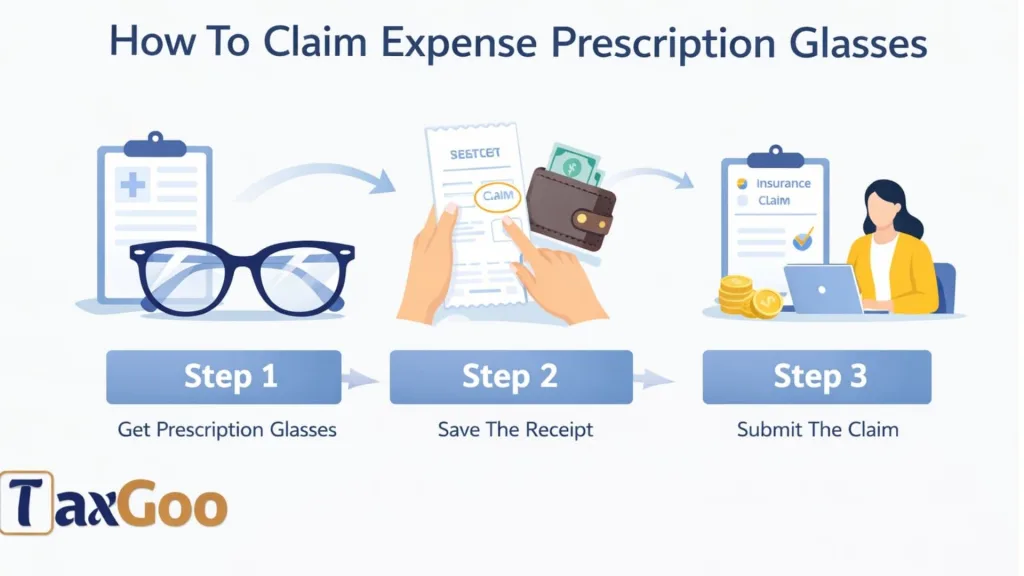
Start by saving receipts for your glasses, lenses, exams, and any related out-of-pocket vision care. Then total your qualified unreimbursed medical expenses for the year and compare them with 7.5% of your adjusted gross income.
If your qualified expenses are high enough, you would generally claim them as itemized deductions on Schedule A attached to Form 1040. Many tax guides also recommend separating reimbursed and unreimbursed costs carefully so you do not accidentally overclaim.
Common Situations People Ask About
If your glasses are prescription and medically necessary, they usually count as a medical expense even if the frames are stylish or expensive. What matters most is that the eyewear is prescribed for vision correction rather than bought only for appearance.
If you bought glasses only for screen use, blue-light filtering, or fashion without a prescription, they are less likely to qualify. If you are claiming costs for a spouse or dependent, those may also qualify if they otherwise meet the medical expense rules.
FAQs
Are Prescription Glasses Tax Deductible?
Yes, they can be tax deductible as a qualified medical expense if they are unreimbursed, you itemize deductions, and your total eligible medical expenses exceed 7.5% of your AGI.
Do Eye Exams Count Too?
Yes, eye exams related to vision care or diagnosis are generally treated as qualified medical expenses.
Do Non-Prescription Glasses Count?
Usually no, if they are only for style or general use and not prescribed for medical reasons.
Can I Deduct Glasses Paid By Insurance?
No, reimbursed costs generally cannot also be claimed as a deduction.