The question Do Sales Taxes On Guns Decrease Gun Crime sits at the center of a wider debate about firearm taxes, gun violence prevention, public safety, legal gun purchases, illegal gun markets, ammunition taxes, state excise taxes, firearm homicide, and whether price-based policies can reduce crime. In theory, higher taxes on guns and ammunition could make firearm ownership more expensive, slow down some purchases, raise money for violence prevention programs, and reduce access for people who may misuse weapons. In practice, the evidence is still limited. Researchers have not yet proved that gun sales taxes, by themselves, clearly reduce gun crime. The strongest current answer is this: gun taxes may help in narrow ways, especially by funding prevention programs, but there is not enough evidence to say they reliably decrease gun crime on their own. RAND’s review of firearm and ammunition taxes says there is “little empirical evidence” showing how taxation affects outcomes such as violent crime, suicide, self-defense, or firearm sales.
What Are Gun Sales Taxes?
A gun sales tax usually means a tax added when a firearm, ammunition, or gun-related part is sold. Some taxes are regular state or local sales taxes. Others are special excise taxes aimed only at firearms or ammunition.
The United States already has a federal firearms and ammunition excise tax. The Alcohol and Tobacco Tax and Trade Bureau lists the current federal rate as 10% of the sale price for pistols and revolvers, and 11% for other firearms and ammunition.
Some states have added their own firearm taxes. California began an 11% excise tax on gross retail sales of firearms, firearm precursor parts, and ammunition in July 2024. Colorado also began a 6.5% firearms and ammunition excise tax on April 1, 2025, after voter approval of Proposition KK.
Why People Think Gun Taxes Could Reduce Crime
The basic idea comes from public policy around harmful products. Higher taxes can reduce consumption of some goods by raising prices. The same logic is often used for cigarettes, alcohol, and sugary drinks.
Supporters of gun taxes argue that if guns and ammunition cost more, some buyers may purchase fewer firearms or less ammunition. They also argue that tax revenue can fund violence prevention, school safety, mental health services, victim support, and community programs.
That second part may be more realistic than the first. A tax may not stop every risky purchase, but it can create a funding stream for public safety programs. For example, California’s tax was created to support gun violence prevention and school safety efforts, while Colorado’s tax revenue is intended for services connected to crime victims, mental health, and safety programs.
Why The Evidence Is Not Clear
The biggest problem is that gun crime does not come from one single source. Some firearms used in crimes are bought legally. Others are stolen, trafficked, borrowed, privately transferred, or obtained outside standard retail channels. A tax on legal retail sales may not reach those informal or illegal pathways.
RAND notes that the effects of firearm or ammunition taxes depend on many factors, including how much the tax changes the final price, how sensitive buyers are to price changes, and how formal and informal gun markets connect.
That makes research difficult. If gun crime falls after a tax, it may be because of the tax, or because of policing changes, economic changes, other gun laws, demographic shifts, local violence prevention programs, or many other factors. If gun crime rises after a tax, that also does not prove the tax failed. Crime trends are noisy and influenced by many moving parts.
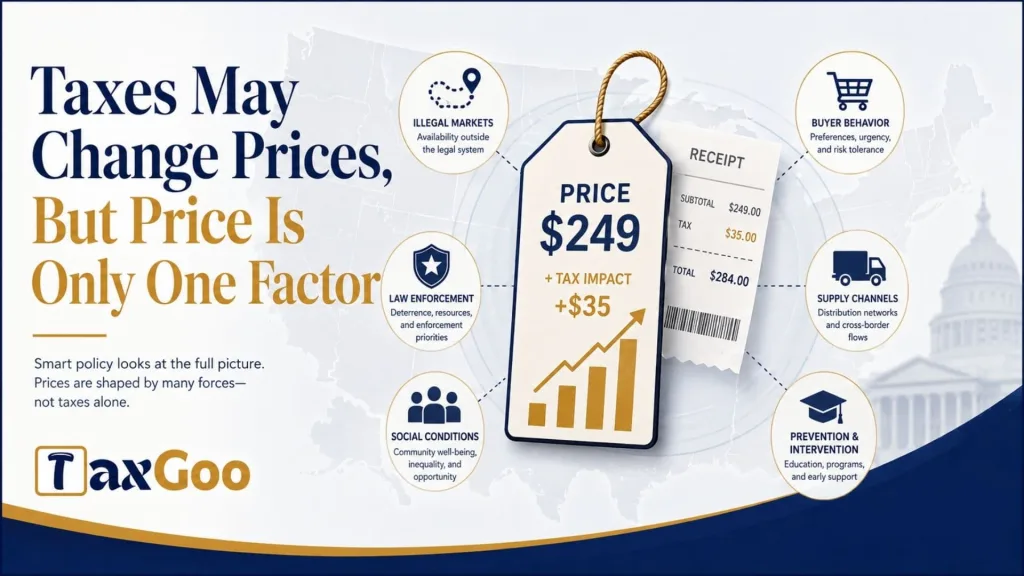
Taxes May Change Prices, But Price Is Only One Factor
A newer study on California’s firearm excise tax found that the 11% tax was almost fully passed on to consumers, with California gun prices rising by about 10% after the tax.
That matters because a tax cannot change buyer behavior unless it actually raises the price paid by buyers. Still, a price increase does not automatically mean gun crime will fall. Some buyers may absorb the cost. Some may buy before the tax starts. Some may buy fewer items. Others may turn to private or out-of-state sources where possible.
So the tax can affect the legal retail market, but the link from retail price to criminal misuse is still not simple.
Could Gun Taxes Reduce Gun Violence Indirectly?
Yes, possibly. The clearest path may be indirect, not direct.
If tax revenue funds effective violence prevention programs, community outreach, trauma services, youth intervention, safe storage campaigns, or victim services, then the tax could help reduce harm through those programs. In that case, the tax is less like a magic switch and more like a funding tool.
This matters because firearm violence is a major public safety issue. Johns Hopkins reported that in 2023, firearms were used in 79% of homicides and 55% of suicides in the United States. If tax revenue supports programs that reduce shootings, retaliation, unsafe storage, or crisis-related firearm access, it may still have value even if the tax itself does not directly stop crime.
The Main Limits Of Gun Sales Taxes
Gun sales taxes have several limits.
First, they may not affect people who already own firearms. The United States already has a large number of guns in circulation, so a tax on new purchases only reaches part of the market.
Second, they may not affect illegal gun supply. If a person obtains a firearm through theft or trafficking, a retail tax does not directly change that transaction.
Third, they may raise fairness concerns. A flat tax can affect lower-income legal buyers more heavily than wealthy buyers.
Fourth, they may face legal challenges. Firearm ownership is constitutionally protected in the United States, so special taxes on guns and ammunition can become part of Second Amendment disputes. California’s firearm tax faced legal challenges soon after passage.
So, Do Sales Taxes On Guns Decrease Gun Crime?
The honest answer is: not clearly, at least based on current evidence.
Gun sales taxes can raise prices. They can raise public revenue. They may reduce some legal purchases at the margin. They may also fund useful prevention programs. But researchers have not yet shown strong, consistent evidence that gun taxes alone reduce gun crime.
A better way to view firearm taxes is as one possible tool in a larger public safety plan. They may work best when paired with evidence-based violence prevention, background checks, safe storage efforts, targeted law enforcement against trafficking, crisis intervention, and local programs that address the people and places most at risk.

FAQs
Do Gun Taxes Directly Reduce Gun Crime?
There is no strong proof that gun taxes alone directly reduce gun crime.
Can Gun Taxes Still Help Public Safety?
Yes. They may help if the revenue funds effective violence prevention programs.
Are Gun Taxes The Same As Gun Control Laws?
No. They are tax policies, though they are often discussed as part of firearm policy.
Does The U.S. Already Tax Firearms?
Yes. Federal excise taxes apply to firearms and ammunition.
Why Is The Evidence Limited?
Gun crime involves legal markets, illegal markets, stolen guns, social factors, and local crime trends, so it is hard to isolate the effect of taxes alone.