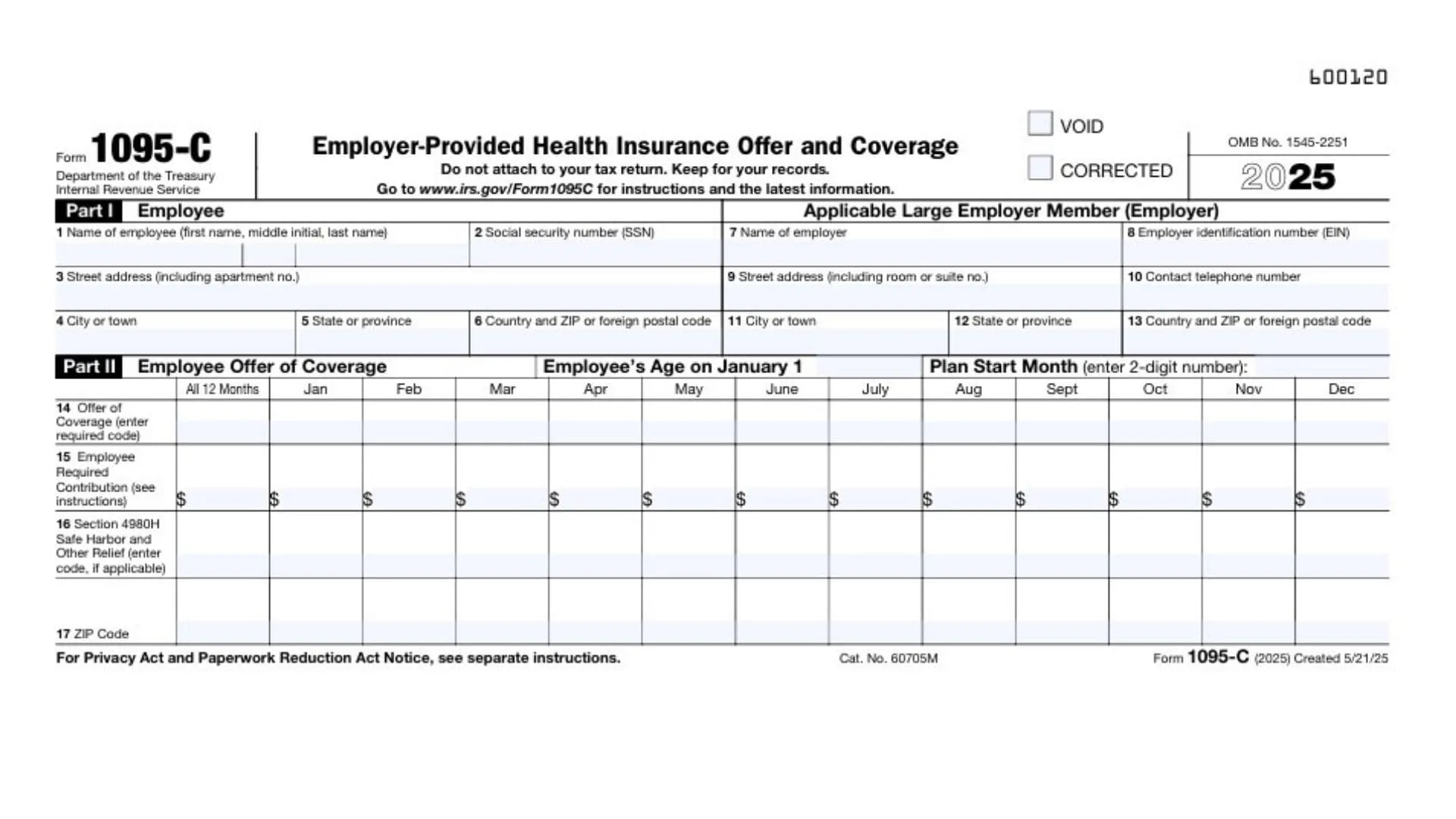
IRS Form 1095-C is the health coverage information form used by an Applicable Large Employer to report the health insurance offer made to an employee during the year and, in some cases, to report which individuals were actually covered under an employer-sponsored self-insured health plan. It is part of Affordable Care Act reporting and helps connect several important pieces of information in one place, including the employee’s identifying details, the employer’s identifying details, the type of coverage offered month by month, the employee’s required monthly contribution for the lowest-cost self-only minimum value coverage when that amount must be reported, any applicable employer reporting relief or safe harbor code, and the covered-individual details for self-insured plans. Employees generally keep this form for their records, while employers use it to meet federal information-reporting requirements. Because the form combines personal data, monthly coverage coding, affordability-related entries, and coverage reporting for enrolled individuals, it is best completed carefully and in order from top to bottom so every field matches the employee’s actual status for the year.
How To File Form 1095-C
Form 1095-C is prepared by the employer, not by the employee. The employer furnishes a copy to the employee and files the information with the IRS as part of annual ACA reporting.
Before preparing the form, the employer should gather the employee’s legal name, Social Security number, mailing address, the employer’s legal name, EIN, contact telephone number, monthly offer-of-coverage information, the employee’s required contribution amount where applicable, and covered-individual information for any self-insured plan. Since the form is built around month-by-month reporting in Part II and person-by-person reporting in Part III, it is easier to complete accurately if the employer first organizes the entire year’s data rather than filling the form out one box at a time without a plan.

How To Complete Form 1095-C
Form 1095-C has three main parts. Part I identifies the employee and employer. Part II reports the employee’s offer of coverage and related monthly details. Part III reports the individuals enrolled in employer-provided self-insured coverage, if that part applies.
At the top of the form, there are also VOID and CORRECTED checkboxes. These are only used in special cases when a form needs to be canceled or corrected. In a regular filing, they are left unchecked. The cleanest way to complete the form is to fill in Part I first, then complete Part II, and finally complete Part III if the employer offered self-insured coverage. Here are the line-by-line instructions for the IRS Form 1095-C:
Line 1: Enter the employee’s full legal name, including first name, middle initial, and last name. Use the same name that appears in payroll and tax records.
Line 2: Enter the employee’s Social Security number. This should be complete and accurate in the employer’s records.
Line 3: Enter the employee’s street address. Include an apartment number if there is one.
Line 4: Enter the employee’s city or town.
Line 5: Enter the employee’s state or province.
Line 6: Enter the employee’s country and ZIP code, or foreign postal code if the employee has a foreign address. Lines 3 through 6 together should show the employee’s full mailing address.
Line 7: Enter the legal name of the Applicable Large Employer Member reporting the form.
Line 8: Enter the employer identification number, or EIN, of the reporting employer.
Line 9: Enter the employer’s street address. Include a room or suite number if needed.
Line 10: Enter the employer’s contact telephone number. This should be a number employees can use to ask questions about the form or request corrections.
Line 11: Enter the employer’s city or town.
Line 12: Enter the employer’s state or province.
Line 13: Enter the employer’s country and ZIP code, or foreign postal code if applicable. Lines 9 through 13 together should show the employer’s complete mailing address.
Line 14: Enter the appropriate offer-of-coverage code for each month, or use the All 12 Months box if the same code applies for the full year. This line shows what kind of health coverage, if any, was offered to the employee and whether that offer also extended to a spouse, dependents, or both.
- Code 1A: Use this when minimum essential coverage providing minimum value was offered to the employee, the employee’s required contribution for self-only coverage met the qualifying affordability threshold, and minimum essential coverage was also offered to the spouse and dependents.
- Code 1B: Use this when minimum essential coverage providing minimum value was offered to the employee only, with no offer made to the spouse or dependents.
- Code 1C: Use this when minimum essential coverage providing minimum value was offered to the employee and dependents, but not to the spouse.
- Code 1D: Use this when minimum essential coverage providing minimum value was offered to the employee and spouse, but not to dependents.
- Code 1E: Use this when minimum essential coverage providing minimum value was offered to the employee, spouse, and dependents.
- Code 1F: Use this when coverage was offered, but it did not provide minimum value.
- Code 1G: Use this when the individual was not a full-time employee for any month of the year but was enrolled in self-insured employer-sponsored coverage for one or more months during the year.
- Code 1H: Use this when no offer of coverage was made, or the offer made did not count as minimum essential coverage.
- Code 1I: Reserved for future use.
- Code 1J: Use this when minimum essential coverage providing minimum value was offered to the employee, conditionally offered to the spouse, and not offered to dependents.
- Code 1K: Use this when minimum essential coverage providing minimum value was offered to the employee, conditionally offered to the spouse, and offered to dependents.
- Code 1L: Use this when an individual coverage HRA was offered to the employee only, with affordability based on the employee’s primary residence ZIP code.
- Code 1M: Use this when an individual coverage HRA was offered to the employee and dependents, but not the spouse, using the employee’s primary residence ZIP code.
- Code 1N: Use this when an individual coverage HRA was offered to the employee, spouse, and dependents using the employee’s primary residence ZIP code.
- Code 1O: Use this when an individual coverage HRA was offered to the employee only using the employee’s primary employment site ZIP code affordability safe harbor.
- Code 1P: Use this when an individual coverage HRA was offered to the employee and dependents, but not the spouse, using the employee’s primary employment site ZIP code affordability safe harbor.
- Code 1Q: Use this when an individual coverage HRA was offered to the employee, spouse, and dependents using the employee’s primary employment site ZIP code affordability safe harbor.
- Code 1R: Use this when an individual coverage HRA was offered but was not affordable.
- Code 1S: Use this when an individual coverage HRA was offered to an individual who was not a full-time employee.
- Code 1T: Use this when an individual coverage HRA was offered to the employee and spouse only, with no dependents, and affordability was determined using the employee’s primary residence ZIP code.
- Code 1U: Use this when an individual coverage HRA was offered to the employee and spouse only, with no dependents, using the employee’s primary employment site ZIP code affordability safe harbor.
- Code 1V: Reserved for future use.
- Code 1W: Reserved for future use.
- Code 1X: Reserved for future use.
- Code 1Y: Reserved for future use.
- Code 1Z: Reserved for future use.
Line 15: Enter the employee required contribution for each applicable month. This is the monthly cost to the employee for the lowest-cost self-only minimum essential coverage that provided minimum value. It is not necessarily the amount the employee actually paid if the employee chose a more expensive plan. If the lowest-cost self-only coverage had no employee cost, enter 0.00.
Line 16: Enter the applicable Section 4980H safe harbor or other relief code if one applies for the month. If no code applies, leave the space blank.
Line 17: Enter the ZIP code used to determine affordability, but only when this line applies for an individual coverage HRA entry. If the HRA affordability was determined using the employee’s primary residence, enter that ZIP code. If it was determined using the employee’s primary employment site, enter that ZIP code instead.
Line 18: If Part III applies, enter the first covered individual’s full name, SSN or other TIN, date of birth if an identifying number is not available, and either check the box for all 12 months or mark the specific months of coverage.
Line 19: Enter the second covered individual’s information in the same way.
Line 20: Enter the third covered individual’s information in the same way.
Line 21: Enter the fourth covered individual’s information in the same way.
Line 22: Enter the fifth covered individual’s information in the same way.
Line 23: Enter the sixth covered individual’s information in the same way.
Line 24: Enter the seventh covered individual’s information in the same way.
Line 25: Enter the eighth covered individual’s information in the same way.
Line 26: Enter the ninth covered individual’s information in the same way.
Line 27: Enter the tenth covered individual’s information in the same way.
Line 28: Enter the eleventh covered individual’s information in the same way.
Line 29: Enter the twelfth covered individual’s information in the same way.
Line 30: Enter the thirteenth covered individual’s information in the same way. If there are more covered individuals than available lines, use additional continuation pages as needed.
Common Mistakes To Avoid
One frequent mistake is mixing up the offer of coverage with actual enrollment. Part II is about what the employer offered to the employee. Part III is about who was actually covered under a self-insured plan. Another common error is entering the wrong amount on line 15. That line asks for the employee’s cost for the lowest-cost self-only minimum value coverage, not the premium for family coverage or the amount tied to a more expensive plan the employee selected.
It is also important not to use the All 12 Months box when the reporting details changed during the year. If the offer, contribution amount, or applicable code changed, the monthly columns should be completed separately. Employers should also avoid completing line 17 unless the form includes an individual coverage HRA situation that requires a ZIP code for affordability reporting.
FAQs
Who Receives Form 1095-C
Employees of an Applicable Large Employer who must be furnished the form receive it, and someone who worked for more than one large employer during the year may receive more than one.
Does The Employee Attach Form 1095-C To A Tax Return
No. The employee keeps it for records and does not attach it to the return.
Is Part III Required For Every Employer
No. Part III is completed only when the employer provided self-insured coverage.
What If Information Changed During The Year
If the coverage offer or related reporting details changed during the year, the employer should use the monthly entries rather than reporting one value for all 12 months.