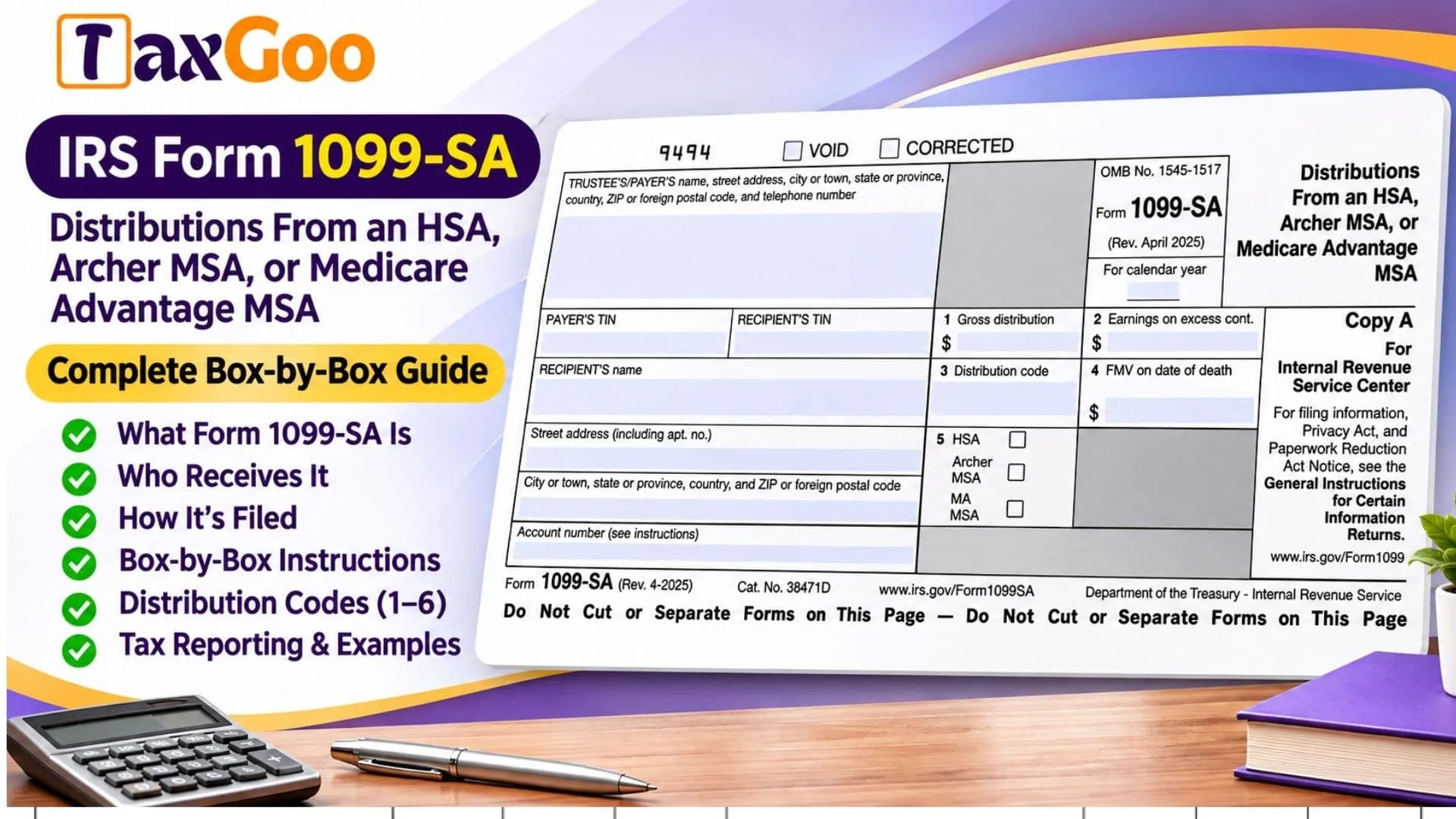
IRS Form 1099-SA, officially titled Distributions From an HSA, Archer MSA, or Medicare Advantage MSA, is a federal tax information return used to report money distributed from certain tax-advantaged medical savings accounts. These accounts include Health Savings Accounts (HSAs), Archer Medical Savings Accounts (Archer MSAs), and Medicare Advantage Medical Savings Accounts (MA MSAs). The form is generally prepared by the financial institution, trustee, or other payer responsible for administering the account and is provided to both the Internal Revenue Service (IRS) and the account recipient. It reports the total amount distributed during the calendar year, earnings associated with withdrawn excess contributions, the reason for the distribution, and the type of medical savings account involved. In certain situations, it also reports the fair market value of an account when its owner dies. Form 1099-SA is important because distributions used for qualified medical expenses may be excluded from taxable income, while distributions used for other purposes may be taxable and subject to additional taxes. Recipients generally use the information to complete IRS Form 8889 or Form 8853 when preparing their federal income tax returns. Understanding each box helps taxpayers report medical savings account withdrawals accurately, identify potential tax liabilities, and avoid incorrectly treating qualified medical expenses as taxable distributions.
Who Needs Form 1099-SA?
Form 1099-SA is generally issued to individuals who receive reportable distributions from qualifying medical savings accounts.
You may receive this form if you:
- Withdraw money from a Health Savings Account (HSA).
- Receive a payment from an Archer Medical Savings Account.
- Take a distribution from a Medicare Advantage MSA.
- Use account funds to pay eligible medical expenses directly.
- Withdraw excess HSA or Archer MSA contributions and related earnings.
- Receive a distribution because of disability.
- Inherit an HSA, Archer MSA, or MA MSA.
- Receive money from an account through a transaction that must be reported as a distribution.
Receiving Form 1099-SA does not automatically mean you owe income tax on the reported amount.
The tax treatment depends on the account type, how the money was used, and the applicable distribution rules.
How to File Form 1099-SA
Form 1099-SA is an information return generally prepared and filed by the account trustee or payer, not by the individual receiving the distribution.
The payer reports the distribution to the IRS and provides the recipient with a copy.
Filing Instructions for Trustees and Payers
The trustee or payer is responsible for preparing Form 1099-SA with the required identification and distribution information.
The filing process generally involves:
- Identifying the account recipient and the type of medical savings account.
- Determining the gross amount distributed during the calendar year.
- Reporting any earnings on excess contributions.
- Selecting the correct distribution code.
- Reporting the account’s fair market value at death when applicable.
- Filing the required information return with the IRS.
- Providing the recipient with the appropriate statement.
The payer must use the applicable IRS information return filing procedures and deadlines for the reporting year.
Filing Instructions for Recipients
If you receive Form 1099-SA, you generally do not complete and separately file the form yourself.
Instead, use the information to prepare the appropriate medical savings account reporting form.
For HSA Distributions
Complete Form 8889, Health Savings Accounts (HSAs), and file it with your Form 1040 or Form 1040-SR.
For Archer MSA Distributions
Use Form 8853, Archer MSAs and Long-Term Care Insurance Contracts, to report the distribution.
For Medicare Advantage MSA Distributions
Use Form 8853 to report the distribution and determine the applicable tax treatment.
You must generally report distributions through the appropriate form even when the money was used entirely for qualified medical expenses and no income tax is due.
Documents Needed Before Filing
Gather the following records before preparing the relevant tax return:
- Form 1099-SA received from the trustee or payer.
- Your federal Form 1040 or Form 1040-SR information.
- Medical bills, invoices, and payment receipts.
- Records of qualified medical expenses.
- HSA, Archer MSA, or MA MSA account statements.
- Documentation of excess contributions and corrective withdrawals.
- Records of any qualifying rollovers.
- Beneficiary and inheritance information, if applicable.
- Account information supporting a reported fair market value at death.
These records help determine which distributions are taxable and which qualify for tax-free treatment.

How to Complete Form 1099-SA
Form 1099-SA contains payer identification fields, recipient information, five numbered boxes, account-type checkboxes, and filing status indicators.
The trustee or payer generally completes these fields. Recipients should review them for accuracy before using the information on their income tax returns.
Form Identification and Calendar Year
Form Number: 1099-SA
This identifies the return as the IRS information statement for distributions from qualifying medical savings accounts.
Revision Date: April 2025
The form carries an April 2025 revision date. This identifies the version of the form, not necessarily the calendar year of the distribution.
Calendar Year
Enter the calendar year in which the reportable distribution occurred.
For example, if an account distribution occurred during 2025, the payer reports it for calendar year 2025.
Do not confuse the form’s revision date with the distribution year.
OMB Control Number
The form displays OMB No. 1545-1517. This is an administrative identification number and is not a taxpayer entry field.
Form Status Checkboxes
Void and Corrected Returns
VOID Checkbox
On the IRS filing copy, the payer can mark VOID when a prepared return should be disregarded under the applicable filing procedures.
This field is not used to indicate that the recipient owes no tax.
CORRECTED Checkbox
Check this box when submitting a corrected information return to replace previously reported information.
For example, a correction may be necessary if the original return contained an incorrect gross distribution amount or distribution code.
CORRECTED Checkbox on Recipient Copy
The recipient statement also provides a corrected-return indicator.
If the recipient receives a corrected Form 1099-SA, the updated information should be used when preparing or correcting the relevant income tax return.
Trustee or Payer Information
This section identifies the organization responsible for reporting the medical savings account distribution.
Trustee’s or Payer’s Name
Enter the legal name of the financial institution, trustee, or other payer responsible for the account.
Street Address
Enter the payer’s street address.
City or Town
Provide the city or town associated with the payer’s mailing address.
State or Province
Enter the appropriate state or province.
Country
Provide the country when applicable.
ZIP Code or Foreign Postal Code
Enter the appropriate postal code.
Telephone Number
Provide a contact telephone number for the trustee or payer.
Recipients can use this information to contact the payer if they believe an amount, code, or account detail is incorrect.
Taxpayer Identification Numbers
Payer’s TIN
Enter the taxpayer identification number assigned to the trustee or payer.
For a financial institution or business entity, this is generally an Employer Identification Number (EIN).
Recipient’s TIN
Enter the taxpayer identification number associated with the recipient.
Depending on the recipient, this may be a Social Security number, Individual Taxpayer Identification Number, Adoption Taxpayer Identification Number, or Employer Identification Number.
For privacy, the recipient’s copy may display only the last four digits of the identification number.
However, the payer reports the complete identification number to the IRS.
Recipient Information
Recipient’s Name
Enter the name of the person or entity receiving the reportable distribution.
The name should match the recipient’s tax identification records.
Recipient’s Street Address
Enter the recipient’s street address.
Apartment Number
Include the apartment or unit number if applicable.
Recipient’s City or Town
Enter the city or town associated with the recipient’s mailing address.
Recipient’s State or Province
Provide the appropriate state or province.
Recipient’s Country
Enter the country when applicable.
Recipient’s ZIP Code or Foreign Postal Code
Enter the correct postal code.
Account Number
Enter the account number or other unique identifier assigned by the payer, when applicable.
This field helps distinguish between accounts, particularly when the same recipient has more than one medical savings account with the payer.
The recipient should verify that the account information corresponds to the correct account.
Box-by-Box Instructions for Form 1099-SA
The five numbered boxes report the financial and classification information needed to understand the distribution.
Distribution Amounts and Earnings
Box 1: Gross Distribution
Enter the total amount distributed from the HSA, Archer MSA, or Medicare Advantage MSA during the calendar year.
This amount may include money paid directly to the recipient or payments made from the account to a medical service provider.
For example, suppose an HSA paid:
- $1,200 directly to a hospital.
- $600 to a pharmacy.
- $400 to reimburse the account holder.
The total gross distribution would be:
$1,200 + $600 + $400 = $2,200
The payer would report $2,200 in Box 1.
Box 1 reports the distribution amount, not necessarily the taxable amount.
The recipient must determine whether the distribution qualifies for tax-free treatment.
Box 2: Earnings on Excess Contributions
Enter the earnings associated with excess HSA or Archer MSA contributions withdrawn by the applicable income tax return deadline.
For example, suppose a taxpayer withdraws an excess contribution of $1,000 together with $50 in earnings.
The $50 in earnings would be reported in Box 2.
The earnings amount is also included in the gross distribution reported in Box 1, so it should not be added to Box 1 again.
The earnings must generally be included in taxable income for the year the distribution was received, even if the money was subsequently used for qualified medical expenses.
Report the taxable earnings in the Other Income section of the federal income tax return as applicable.
Excess contributions that remain in the account may be subject to a 6% excise tax for each applicable tax year.
Form 5329 may be required to calculate additional taxes related to excess contributions.
Distribution Codes
Box 3: Distribution Code
Enter the code that identifies the type or reason for the distribution.
The form uses six distribution codes.
Code 1: Normal Distribution
Code 1 identifies an ordinary distribution from the medical savings account.
This code does not automatically mean the distribution is taxable.
The recipient must determine whether the funds were used for qualified medical expenses or otherwise qualify for tax-free treatment.
Code 2: Excess Contributions
Code 2 identifies a distribution associated with excess contributions.
The recipient should review the corrective distribution rules and determine whether any related earnings must be included in income.
Code 3: Disability
Code 3 identifies a distribution associated with disability.
Special rules may affect whether an additional tax applies to a distribution that is otherwise taxable.
Code 4: Death Distribution
Code 4 identifies a distribution related to the account holder’s death, other than a distribution reported using Code 6.
The recipient must apply the applicable beneficiary and inheritance rules.
Code 5: Prohibited Transaction
Code 5 identifies a distribution involving a prohibited transaction.
Such transactions may result in special tax consequences.
Code 6: Death Distribution After the Year of Death to a Nonspouse Beneficiary
Code 6 identifies a distribution made after the year of the account holder’s death to a beneficiary who was not the deceased account holder’s spouse.
Special inheritance reporting rules apply.
Fair Market Value at Death
Box 4: Fair Market Value on Date of Death
Enter the fair market value of the medical savings account as of the account holder’s date of death when applicable.
For example, if the account was worth $18,000 when the owner died, Box 4 may report $18,000.
This amount is particularly important for determining the tax treatment of inherited accounts.
For certain nonspouse beneficiaries, the fair market value at death is included in income for the year the account holder died.
The tax treatment depends on the type of account and the beneficiary’s relationship to the deceased account holder.
Medical Savings Account Type
Box 5: Account Type
Select the checkbox identifying the type of medical savings account from which the distribution was made.
HSA Checkbox
Check this box if the distribution came from a Health Savings Account.
Archer MSA Checkbox
Check this box if the distribution came from an Archer Medical Savings Account.
MA MSA Checkbox
Check this box if the distribution came from a Medicare Advantage Medical Savings Account.
The correct account type is important because different reporting forms and tax rules apply.
Understanding the Tax Treatment of Form 1099-SA Distributions
The amount reported in Box 1 is not automatically taxable. The recipient must determine how much was used for qualified medical expenses, whether a qualifying rollover occurred, and whether special tax rules apply.
Tax-Free HSA Distributions
An HSA distribution is generally tax-free when the money is used for qualified medical expenses of the account holder, spouse, or eligible family member.
For example, suppose Box 1 reports $3,500 in HSA distributions. If the entire amount was used for eligible medical expenses, the distribution may be excluded from taxable income.
Keep receipts and other records supporting the expenses.
Tax-Free Archer MSA Distributions
Archer MSA distributions may also qualify for tax-free treatment when used for qualified medical expenses of the account holder or eligible family members.
A qualifying rollover from an Archer MSA to another Archer MSA or an HSA may also receive tax-free treatment.
Tax-Free Medicare Advantage MSA Distributions
Medicare Advantage MSA distributions generally qualify for tax-free treatment when used for qualified medical expenses of the account holder.
Unlike HSA and Archer MSA distributions, the qualified medical expense treatment described for an MA MSA applies to the account holder’s expenses rather than those of family members.
Taxable Medical Savings Account Distributions
If a distribution is not used for qualified medical expenses and does not qualify for other tax-free treatment, the taxable portion generally must be included in income.
Additional taxes may also apply.
For example, suppose an HSA recipient withdraws $4,000 but uses only $2,500 for qualified medical expenses.
The basic calculation is:
$4,000 − $2,500 = $1,500
Assuming no rollover, exception, or other adjustment applies, the remaining $1,500 would generally be taxable.
The recipient should use the appropriate tax reporting form to calculate the taxable amount and any additional tax.
How to Report Form 1099-SA on Your Tax Return
The reporting process depends on the type of account identified in Box 5.
Reporting HSA Distributions on Form 8889
If Box 5 identifies an HSA, use Form 8889 to report the distribution.
Gross HSA Distributions
Begin with the applicable gross distribution amount reported in Box 1.
Qualified Medical Expenses
Determine how much of the distribution was used for eligible medical expenses.
Taxable HSA Distribution
Calculate the amount that does not qualify for tax-free treatment after applying the relevant rules.
Additional Tax
Determine whether an additional tax applies to the taxable portion.
An additional 20% tax may apply to nonqualified HSA distributions. Exceptions include distributions made after the account holder becomes disabled, reaches age 65, or dies.
Attach Form 8889 to your Form 1040 or Form 1040-SR.
Reporting Archer MSA Distributions on Form 8853
If Box 5 identifies an Archer MSA, use Form 8853.
Gross Archer MSA Distribution
Enter the applicable distribution amount using the information from Form 1099-SA.
Qualified Medical Expenses
Determine the amount used for qualifying medical expenses.
Taxable Archer MSA Distribution
Calculate any amount that must be included in taxable income.
Additional Tax
Determine whether an additional tax applies. Nonqualified Archer MSA distributions may be subject to an additional 20% tax unless an exception applies.
Attach Form 8853 to your federal income tax return.
Reporting Medicare Advantage MSA Distributions on Form 8853
Medicare Advantage MSA distributions are also reported using Form 8853.
Gross MA MSA Distribution
Use the applicable amount reported in Box 1.
Qualified Medical Expenses
Determine how much was used for the account holder’s qualifying medical expenses.
Taxable MA MSA Distribution
Calculate the amount that does not qualify for tax-free treatment.
Additional Tax
Determine whether the taxable distribution is subject to an additional tax. Special MA MSA rules apply, including a potentially higher additional tax than the one used for HSAs.
Special Rules for Inherited Medical Savings Accounts
The tax treatment of an inherited HSA, Archer MSA, or MA MSA depends on whether the beneficiary is the surviving spouse, another individual, or the deceased account holder’s estate.
Spouse Beneficiary
Inherited HSA
If the surviving spouse is the designated beneficiary, the HSA generally becomes the spouse’s HSA.
The spouse can continue to use the account under the applicable HSA rules.
Inherited Archer MSA
If the surviving spouse inherits an Archer MSA, special rules generally allow the spouse to become the account holder.
Inherited Medicare Advantage MSA
When a spouse inherits an MA MSA, the account is generally treated as an Archer MSA of the spouse for distribution purposes.
The recipient should follow the applicable rules when reporting future distributions.
Nonspouse Beneficiary
Fair Market Value at Death
If an individual inherits an HSA, Archer MSA, or MA MSA from someone who was not their spouse, the account’s fair market value at the date of death generally must be included in the beneficiary’s income for the year the account holder died.
This applies even when the beneficiary receives the actual distribution in a later year.
Earnings After Death
Any earnings attributable to the period after the account holder’s death are taxable.
The recipient instructions identify the earnings calculation as:
Post-Death Earnings = Box 1 − Box 4
Use this calculation where applicable to the reported death distribution, taking account of the relevant inheritance rules and adjustments.
Report the taxable earnings as Other Income on the federal income tax return.
Estate Beneficiary
Account Value Included in Final Return
If the account holder’s estate is the beneficiary, the fair market value of the HSA, Archer MSA, or MA MSA on the date of death is generally included in the deceased account holder’s gross income.
Report the amount on the account holder’s final federal income tax return.
Distribution Codes for Inherited Accounts
Code 4: Death Distribution
This code generally identifies a death-related distribution other than the specific nonspouse distribution described by Code 6.
Code 6: Distribution After Year of Death
This code identifies a distribution after the account holder’s year of death to a nonspouse beneficiary other than an estate.
The recipient should review the year of death, beneficiary relationship, and fair market value information before determining the tax treatment.
Correcting a Mistaken HSA Distribution
An HSA account holder may sometimes receive a distribution because of a reasonable mistake.
For example, the account holder may have believed that a particular expense qualified for tax-free HSA reimbursement but later discovered that it did not.
Mistaken Distribution Repayment
If the HSA trustee permits repayment, the account holder may return the mistaken distribution by the due date of the income tax return, without extensions, following the first year the account holder knew or should have known about the mistake.
The trustee is not required to accept the repayment.
When the applicable requirements are satisfied, the mistaken distribution is generally not included in gross income and is not subject to the additional 20% tax.
Contact the HSA trustee before attempting to correct the distribution.
Understanding Excess Contributions and Form 5329
Excess contributions occur when amounts contributed to an HSA or Archer MSA exceed the applicable contribution limits or otherwise fail to satisfy the contribution rules.
Excess Contributions Withdrawn
If excess contributions and their earnings are withdrawn under the applicable corrective distribution rules, the payer may report the transaction using Code 2.
Earnings on Excess Contributions
The earnings are reported in Box 2 and included in Box 1.
These earnings generally must be reported as income in the year received.
Excess Contributions Remaining in the Account
A 6% excise tax may apply for each tax year in which excess contributions remain uncorrected, subject to the applicable rules.
Form 5329 may be required to calculate the excise tax.
Understanding the Different Copies of Form 1099-SA
Form 1099-SA contains separate copies for IRS reporting and recipient records.
Copy A: IRS Filing Copy
Copy A
This copy is intended for submission to the Internal Revenue Service.
It includes the payer’s information, recipient details, account identification, distribution amounts, and account type.
VOID Checkbox
The IRS filing copy includes a VOID checkbox for use under the applicable information return procedures.
CORRECTED Checkbox
The payer uses this indicator when filing a correction to previously submitted information.
Form Identifier 9494
The printed number 9494 appears near the top of Copy A as a form-processing identifier. It is not a taxpayer identification number or a distribution amount.
Copy B: Recipient Copy
Copy B
This copy is provided to the person or entity receiving the distribution.
The recipient should use it when completing the appropriate federal income tax forms.
CORRECTED Indicator
If the form is marked corrected, review the updated information and use it instead of the superseded figures.
Recipient Recordkeeping
Keep Copy B with your tax records, together with receipts and other documents supporting the tax treatment of the distributions.
Common Form 1099-SA Mistakes to Avoid
Treating Every Distribution as Taxable
Box 1 reports the gross distribution. It does not establish how much of that distribution is taxable.
Failing to Report Tax-Free Distributions
Even if all distributions were used for qualified medical expenses, the recipient generally must report them using Form 8889 or Form 8853.
Adding Box 2 to Box 1 Again
Box 2 earnings are already included in Box 1. Adding them again would overstate the gross distribution.
Using the Wrong Distribution Code
An incorrect Code 1, 2, 3, 4, 5, or 6 can affect how the recipient interprets the transaction.
Selecting the Wrong Account Type
HSAs, Archer MSAs, and MA MSAs have different reporting requirements. Check Box 5 carefully.
Failing to Keep Medical Expense Records
Recipients should retain records showing that distributions were used for qualified medical expenses.
Ignoring Corrected Forms
A corrected Form 1099-SA may change information needed for the federal tax return.
Incorrectly Reporting Inherited Accounts
Beneficiary status and the date-of-death account value can substantially affect the tax treatment of an inherited account.
Form 1099-SA Box Summary
| Field or Box | Information Reported |
|---|---|
| Calendar Year | Year in which the distribution occurred |
| VOID | Indicates a return to be disregarded under filing procedures |
| CORRECTED | Identifies corrected reporting |
| Trustee/Payer Information | Name, address, and telephone number |
| Payer’s TIN | Payer’s taxpayer identification number |
| Recipient’s TIN | Recipient’s taxpayer identification number |
| Recipient’s Name and Address | Identification and mailing information |
| Account Number | Unique account identifier |
| Box 1 | Gross distributions |
| Box 2 | Earnings on withdrawn excess contributions |
| Box 3 | Distribution code, 1 through 6 |
| Box 4 | Fair market value on the account holder’s date of death |
| Box 5 | HSA, Archer MSA, or MA MSA account type |
Final Review Before Filing
Before filing Form 1099-SA as a payer or using it to prepare your federal income tax return as a recipient, verify the following information.
- Confirm the correct calendar year is shown.
- Verify the trustee’s or payer’s legal name and contact information.
- Check the payer’s taxpayer identification number.
- Confirm the recipient’s name and taxpayer identification number.
- Review the recipient’s mailing address.
- Verify the account number when applicable.
- Confirm the gross distribution in Box 1.
- Check whether Box 2 includes earnings from excess contributions.
- Make sure Box 2 earnings are not added to Box 1 twice.
- Verify the distribution code in Box 3.
- Review the date-of-death fair market value in Box 4, if applicable.
- Confirm the correct account type is selected in Box 5.
- Check the VOID or CORRECTED indicator when applicable.
- Keep records of qualified medical expenses and eligible rollovers.
- Determine whether any distribution must be included in taxable income.
- Review whether an additional tax or excess contribution excise tax applies.
- Check beneficiary reporting rules for inherited accounts.
- Complete Form 8889 for HSA distributions or Form 8853 for Archer MSA and MA MSA distributions.
- Attach the appropriate reporting form to Form 1040 or Form 1040-SR.
- Keep the recipient copy and supporting records for future tax questions.
- If you are the payer, submit the required information return and provide the recipient statement by the applicable deadlines.
IRS Form 1099-SA provides essential information about distributions from tax-advantaged medical savings accounts. Although the trustee or payer generally prepares the form, recipients are responsible for determining the tax treatment of their distributions. By reviewing each box, understanding the distribution codes, maintaining accurate medical expense records, and completing the appropriate supporting tax form, taxpayers can report their HSA, Archer MSA, or Medicare Advantage MSA distributions more accurately and avoid common filing errors.