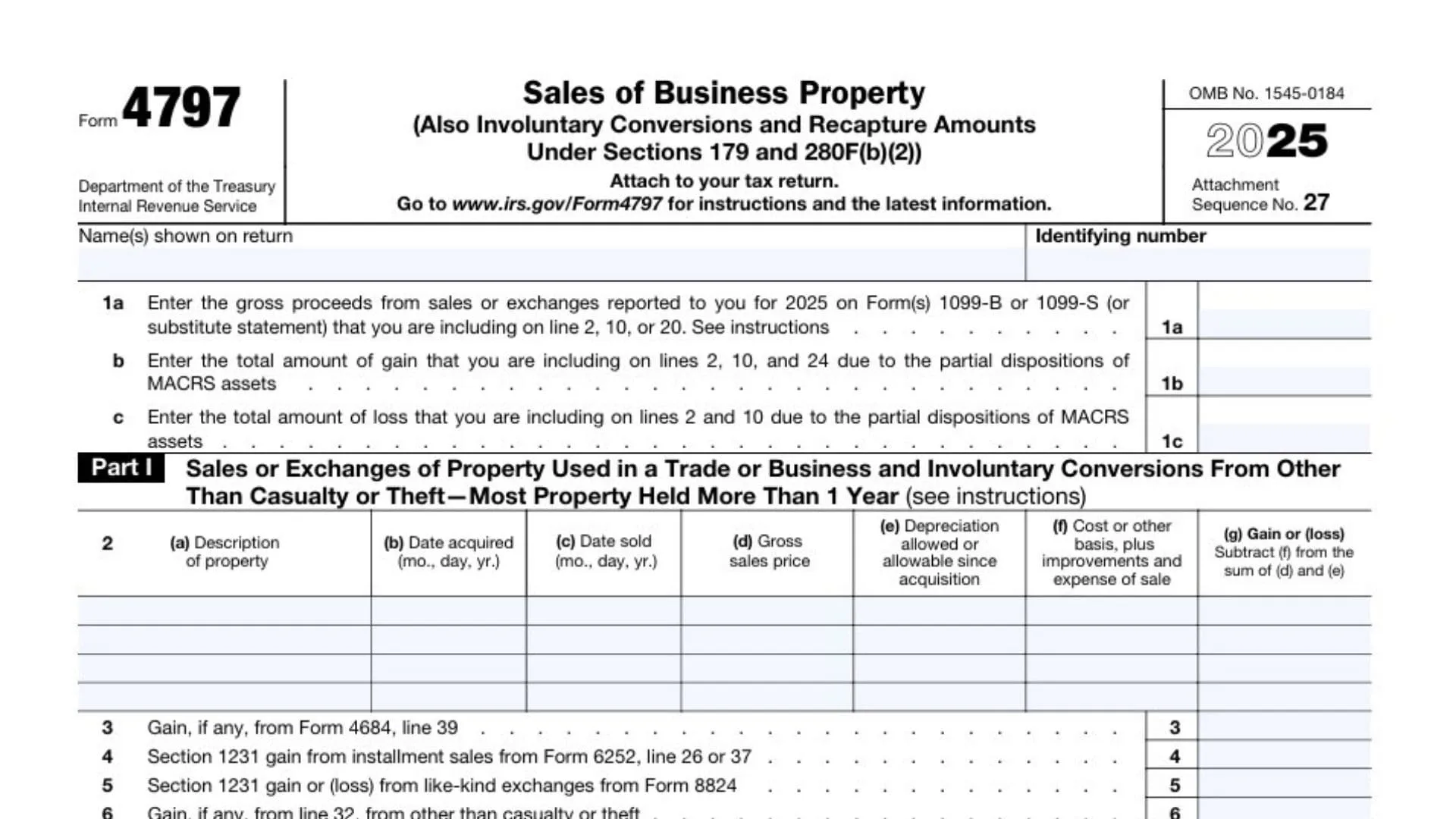
Form 4797 is an official tax document used by individuals, partnerships, and corporations to report the financial gains and losses resulting from the sale, exchange, or involuntary conversion of property used in a trade or business. This encompasses a wide range of business assets, including real estate, depreciable tangible property, amortizable assets, farmland, and certain mineral rights. Furthermore, this document is essential for calculating and reporting depreciation recapture, which happens when a business asset is sold for a gain after previously claiming depreciation deductions on that property over the years. It also addresses situations where the business use of certain listed properties or assets drops to fifty percent or less, triggering specific recapture amounts. By capturing all of these different transaction types, the form helps the government accurately classify your business property dispositions as either ordinary income or capital gains, ensuring that your tax liability is calculated correctly in compliance with current tax regulations.
How To File Form 4797
You must file this document as an attachment alongside your primary federal income tax return, such as your individual return, partnership return, or corporate return. Depending on the method you choose to submit your main taxes, you can file it electronically through an approved e-filing software or tax professional, or you can print a physical copy and mail it with your complete tax package to the designated processing center for your area. Be sure to include any other required schedules or forms that tie into these calculations, such as Schedule D for reporting capital gains or Form 4684 if your transactions involved casualties or thefts.

How To Complete Form 4797
Line 1a: Enter the gross proceeds from sales or exchanges that were reported to you for the year on your 1099-B or 1099-S statements, provided you are including these transactions on lines 2, 10, or 20.
Line 1b: Provide the total amount of gain you are including on lines 2, 10, and 24 that specifically resulted from partial dispositions of MACRS assets.
Line 1c: Provide the total amount of loss you are including on lines 2 and 10 that specifically resulted from partial dispositions of MACRS assets.
Line 2: Record the details of the property sold or exchanged, filling out the description in column (a), dates acquired and sold in columns (b) and (c), the gross sales price in column (d), the allowed depreciation in column (e), the cost or basis plus sale expenses in column (f), and the final calculated gain or loss in column (g).
Line 3: Enter the gain, if there is any, transferred from line 39 of Form 4684.
Line 4: Enter the Section 1231 gain resulting from installment sales, pulling the amount from line 26 or 37 of Form 6252.
Line 5: Provide the Section 1231 gain or loss stemming from like-kind exchanges, as calculated on Form 8824.
Line 6: Record the gain, if any, from line 32 of this document, ensuring it is from events other than casualty or theft.
Line 7: Combine the amounts recorded on lines 2 through 6 to determine your total gain or loss, and transfer this figure to the appropriate line or schedule based on your entity type.
Line 8: Enter any nonrecaptured net Section 1231 losses carried over from previous tax years.
Line 9: Subtract the figure on line 8 from the figure on line 7, and if the result is greater than zero, enter the amount from line 8 on line 12 and the gain from line 9 on your Schedule D.
Line 10: Detail your ordinary gains and losses for property held one year or less, using the same column format as line 2 to list the description, dates, price, depreciation, basis, and total gain or loss.
Line 11: Transfer the loss, if any, that you calculated on line 7.
Line 12: Transfer the gain, if any, from line 7, or the applicable amount from line 8.
Line 13: Enter the gain, if any, transferred directly from line 31 of this document.
Line 14: Provide the net gain or loss calculated on Form 4684, specifically pulling from lines 31 and 38a.
Line 15: Record the ordinary gain from installment sales as reported on line 25 or 36 of Form 6252.
Line 16: Enter the ordinary gain or loss resulting from like-kind exchanges found on Form 8824.
Line 17: Combine the amounts from lines 10 through 16 to determine your total ordinary gains and losses.
Line 18a: For individual filers, if the loss on line 11 includes a loss from Form 4684, enter that specific portion here and report it as instructed on your Schedule A.
Line 18b: For individual filers, redetermine the gain or loss from line 17 by excluding the loss entered on line 18a, and report this final amount here and on your Schedule 1.
Line 19: Provide a description, date acquired, and date sold for up to four specific properties in columns A through D that fall under Sections 1245, 1250, 1252, 1254, or 1255.
Line 20: Enter the gross sales price for each individual property listed in columns A through D.
Line 21: Record the cost or other basis plus any expenses related to the sale for each property.
Line 22: Input the total depreciation or depletion allowed or allowable for each property.
Line 23: Subtract the amount on line 22 from the amount on line 21 to find the adjusted basis for each property.
Line 24: Subtract the adjusted basis on line 23 from the gross sales price on line 20 to determine the total gain for each property.
Line 25a: For Section 1245 property, enter the depreciation allowed or allowable from line 22.
Line 25b: Enter the smaller of the amount on line 24 or line 25a.
Line 26a: For Section 1250 property, calculate and enter the additional depreciation taken after 1975.
Line 26b: Multiply the applicable percentage by the smaller of line 24 or line 26a.
Line 26c: Subtract the amount on line 26a from line 24.
Line 26d: Enter the additional depreciation taken after 1969 and before 1976.
Line 26e: Enter the smaller of the amount on line 26c or line 26d.
Line 26f: For corporations only, enter the Section 291 amount.
Line 26g: Add the amounts from lines 26b, 26e, and 26f to determine the total recapture for Section 1250 property.
Line 27a: For Section 1252 property, enter the soil, water, and land clearing expenses.
Line 27b: Multiply the amount on line 27a by the applicable percentage.
Line 27c: Enter the smaller of the amount on line 24 or line 27b.
Line 28a: For Section 1254 property, enter the intangible drilling and development costs, mining exploration costs, and depletion.
Line 28b: Enter the smaller of the amount on line 24 or line 28a.
Line 29a: For Section 1255 property, enter the applicable percentage of payments excluded from income under Section 126.
Line 29b: Enter the smaller of the amount on line 24 or line 29a.
Line 30: Add the total gains from line 24 across all property columns to get your combined total gain.
Line 31: Add the calculated recapture amounts from lines 25b, 26g, 27c, 28b, and 29b for all property columns, and enter this total here and on line 13.
Line 32: Subtract the amount on line 31 from the amount on line 30, and allocate the portions to Form 4684 or line 6 of this form based on whether they involve casualties or thefts.
Line 33: Enter the Section 179 expense deduction or depreciation allowable in prior years for assets whose business use dropped to fifty percent or less.
Line 34: Enter the recomputed depreciation amount.
Line 35: Subtract the amount on line 34 from the amount on line 33 to calculate your total recapture amount.