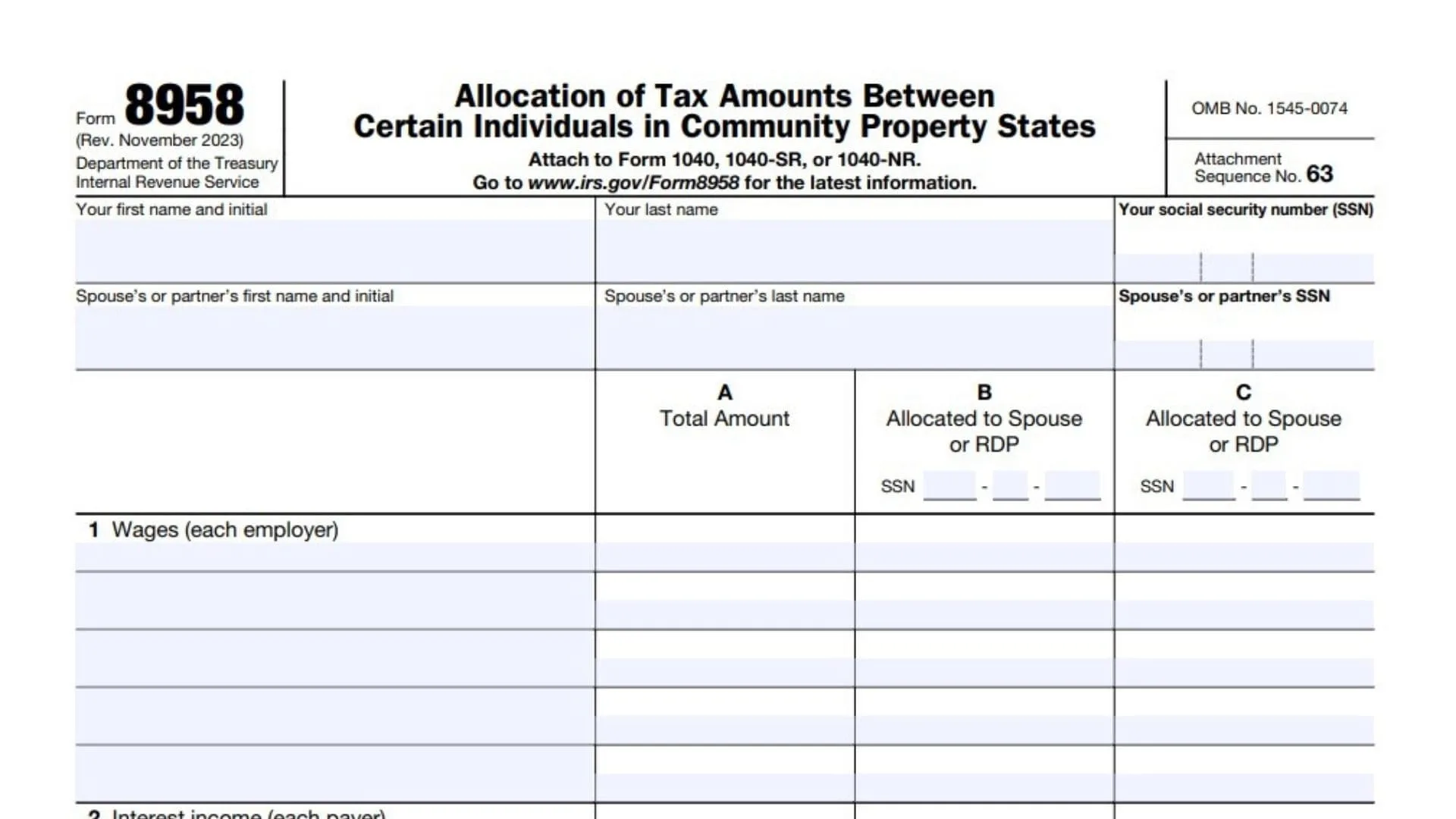
Form 8958 is used to divide income, deductions, credits, taxes, and other tax-related amounts between spouses or registered domestic partners who are subject to community property rules and file separate federal income tax returns. In plain terms, this form helps show how shared and separate tax items should be split between two people when community property law applies. It is especially important in situations where income was earned during the marriage or registered domestic partnership and the law treats that income as belonging to both individuals, even if only one person received the payment directly. The form gives the IRS a clear breakdown of the total amount for each item and how much of that amount belongs to each person. This makes separate tax returns more accurate and reduces confusion when reporting wages, interest, dividends, self-employment income, pensions, taxes withheld, and other items that may need to be divided under community property rules. If there is not enough room on the form, additional statements can be attached, but the entries still need to be organized in a way that clearly identifies the source of each amount and how it is allocated between both parties.
Who Should File Form 8958
You generally use this form if both of the following apply:
- You are subject to community property laws.
- You and your spouse or registered domestic partner are filing separate federal income tax returns.
This form is meant to support separate filing when community property rules affect how income and deductions must be reported. If you live in a community property state or another place where those rules apply, you may need this form to show the proper split.
How To File Form 8958
Form 8958 is filed together with your separate federal income tax return. It is not usually sent by itself. Its purpose is to support the numbers reported on your return by showing the full amount of each item and the amount allocated to each spouse or registered domestic partner.
Before filing, gather all records that show the source of each tax item, such as wage statements, interest statements, dividend reports, self-employment records, pension documents, and withholding information. Then identify which amounts are community items and which are separate items under the law that applies to your situation.
When you complete the form, place the total amount for each item in Column A. Then divide that amount between Column B and Column C based on how it should be allocated. The combined amounts in Column B and Column C should always equal the amount in Column A.
If you need more space, add a separate statement that lists the item source, the total amount, and each person’s allocated share. Include your identifying information on any added statement and attach it to the end of the return.

How To Complete Form 8958
The form is designed to organize tax items by category. You enter the total amount of each item in one column, then show how much belongs to each person in the next two columns. The goal is to present a complete and easy-to-follow split of all relevant income, deductions, credits, taxes, and other reportable amounts.
Complete the form carefully, item by item. Keep entries separated by payer, entity, or source whenever the form calls for separate lines. This makes the allocation easier to follow and helps avoid mismatches between the form and the tax return.
Line 1: Enter wages separately for each payer. Put the full amount from that payer in Column A, then divide that amount between Column B and Column C based on the correct allocation between the spouses or registered domestic partners.
Line 2: List interest income separately by payer. For each source of interest, enter the full amount in Column A and then assign each person’s share in Columns B and C.
Line 3: Report dividends by payer on separate lines. Enter the total dividend amount from each payer in Column A, then split that total between Columns B and C.
Line 4: Enter each state income tax refund on its own line by payer. Show the full refund amount in Column A and divide it between both individuals in Columns B and C as appropriate.
Line 5: Report self-employment income separately for each business or entity. Put the total amount from each entity in Column A, then allocate the amount between Columns B and C according to the proper ownership or community property treatment.
Line 6: Enter each gain or loss by entity or source. Show the total gain or loss in Column A, then split the amount between Columns B and C based on whether the item is community or separate in nature.
Line 7: List pension income separately for each payer. Enter the total pension amount in Column A and then allocate the correct share to each person in Columns B and C.
Line 8: Report rent, royalty, partnership, estate, or trust items on separate lines. For each item, enter the total in Column A and divide that amount between Columns B and C.
Line 9: Enter the deductible portion of self-employment tax separately for each entity. Put the full deductible amount in Column A and allocate it between Columns B and C.
Line 10: Report self-employment tax separately by entity. Enter the total self-employment tax in Column A, then assign the allocated shares in Columns B and C.
Line 11: List taxes withheld separately by payer or entity. Enter the total amount withheld in Column A and divide it between Columns B and C according to the correct allocation.
Line 12: Use this line for any item not already entered on earlier lines. This can include items such as Social Security benefits, unemployment compensation, deductions, credits, and other tax-related amounts. Enter each item on a separate line, show the total in Column A, and then allocate the amount between Columns B and C.
Important Rules To Keep In Mind
Community income is generally split between both individuals, while separate income is usually reported by the person to whom it belongs. Which items are community or separate often depends on the law of the state where you are domiciled, so classification matters just as much as the math.
Some items follow special rules. For example, certain retirement distributions may remain fully taxable to the account holder, and some deductions must be claimed separately rather than split. Self-employment tax can also require special handling depending on whether the filer is a spouse filing separately or a registered domestic partner.
Tips To Avoid Mistakes
- Keep each payer or entity on its own line when required.
- Make sure Columns B and C always add up to Column A.
- Separate community items from separate items before filling in the form.
- Match your entries to the amounts reported on your tax return.
- Use an additional statement if the form does not provide enough space.
- Review withholding, self-employment amounts, and pension allocations closely, since these are common areas for mistakes.