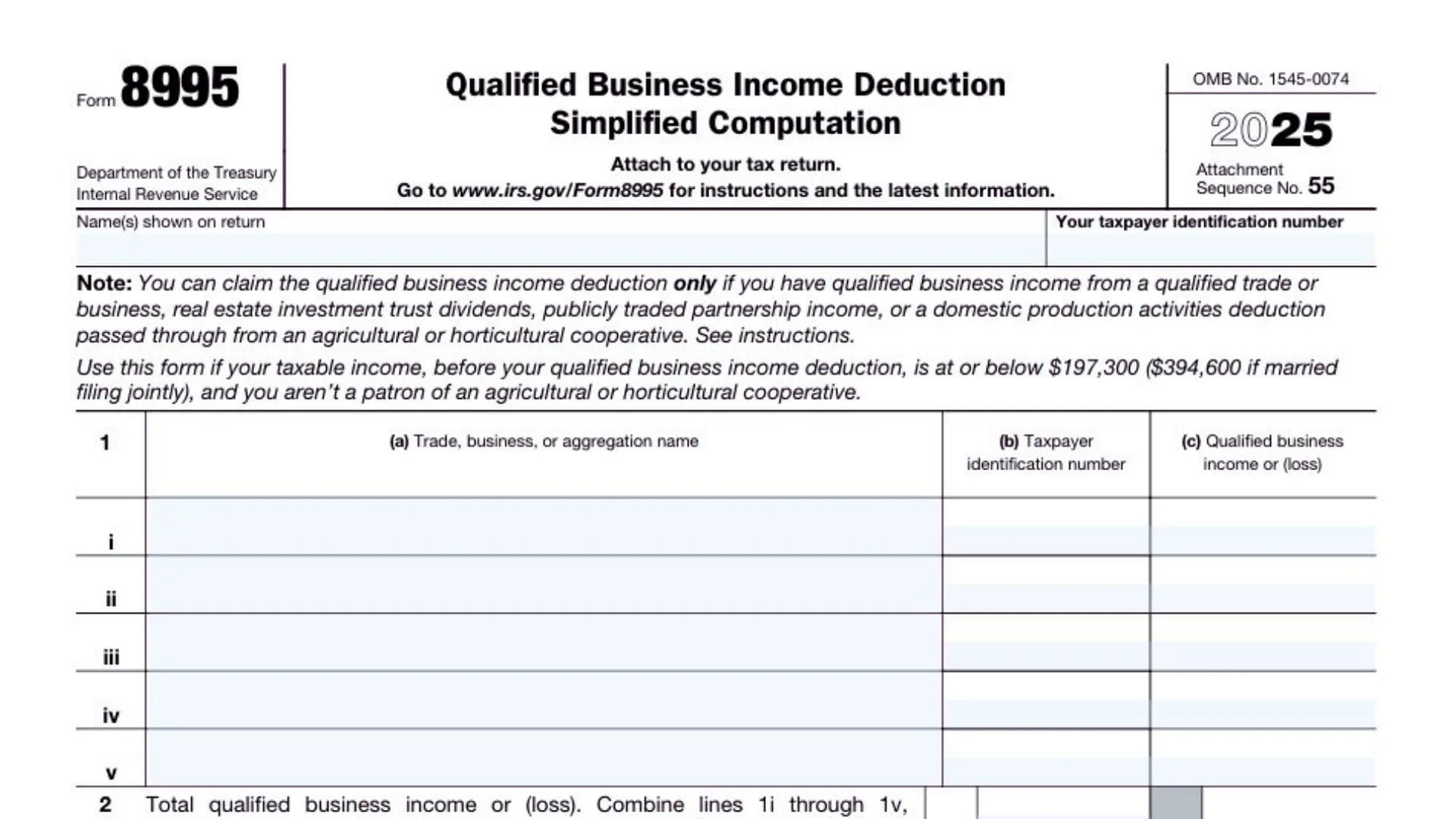
Form 8995, officially known as the Qualified Business Income Deduction Simplified Computation, is a crucial tax document used by eligible individuals, estates, and trusts to claim a deduction of up to 20% on their qualified business income. Introduced to provide significant tax relief for owners of pass-through entities such as sole proprietorships, partnerships, S corporations, and some limited liability companies, this form simplifies the deduction process. You can only claim this deduction if you have qualified business income from a recognized trade or business, real estate investment trust dividends, publicly traded partnership income, or specific domestic production activities passed through from agricultural or horticultural cooperatives. To use this simplified version rather than the more complex alternative, your taxable income before the deduction must fall at or below $197,300 for single filers or $394,600 if you are married filing jointly. It is an essential tool for small business owners and investors looking to lower their overall tax liability by accurately calculating the deduction based on their eligible net income.

How to Complete Form 8995
Line 1: List the details of your qualified trades or businesses by providing the name in column (a), the specific taxpayer identification number in column (b), and the amount of qualified business income or loss in column (c) for up to five separate businesses.
Line 2: Calculate your total qualified business income or loss by adding together all the amounts you entered in column (c) from lines 1i through 1v.
Line 3: Enter your qualified business net loss carryforward from the previous tax year, which represents past losses you must account for in the current calculation.
Line 4: Combine the amounts from line 2 and line 3 to determine your total qualified business income, and if the resulting number is zero or less, enter -0-.
Line 5: Determine your qualified business income component by multiplying the amount on line 4 by 20%.
Line 6: Enter the total amount of your qualified real estate investment trust dividends and publicly traded partnership income or loss for the current year.
Line 7: Record any qualified real estate investment trust dividends and qualified publicly traded partnership loss carryforward from the previous tax year.
Line 8: Calculate your total qualified real estate investment trust dividends and publicly traded partnership income by combining the amounts from line 6 and line 7, entering -0- if the total is zero or less.
Line 9: Find your real estate investment trust and publicly traded partnership component by multiplying the amount on line 8 by 20%.
Line 10: Calculate your qualified business income deduction before the income limitation by adding the amount from line 5 and the amount from line 9.
Line 11: Enter your total taxable income before applying the qualified business income deduction.
Line 12: Record your net capital gain, if you have any, and increase that amount by any qualified dividends you received during the tax year.
Line 13: Subtract the amount on line 12 from the amount on line 11, entering -0- if the resulting calculation is zero or less.
Line 14: Determine your income limitation by multiplying the amount on line 13 by 20%.
Line 15: Determine your final qualified business income deduction by comparing the amount on line 10 with the amount on line 14, entering the smaller of the two numbers, and then transferring this final amount to the applicable line on your main tax return.
Line 16: Calculate your total qualified business loss carryforward for future years by combining line 2 and line 3, entering -0- if the combined amount is greater than zero, or recording the negative number as the loss to carry forward.
Line 17: Calculate your total qualified real estate investment trust dividends and publicly traded partnership loss carryforward by combining line 6 and line 7, entering -0- if the result is greater than zero, or recording the negative amount to carry forward to your next tax return.