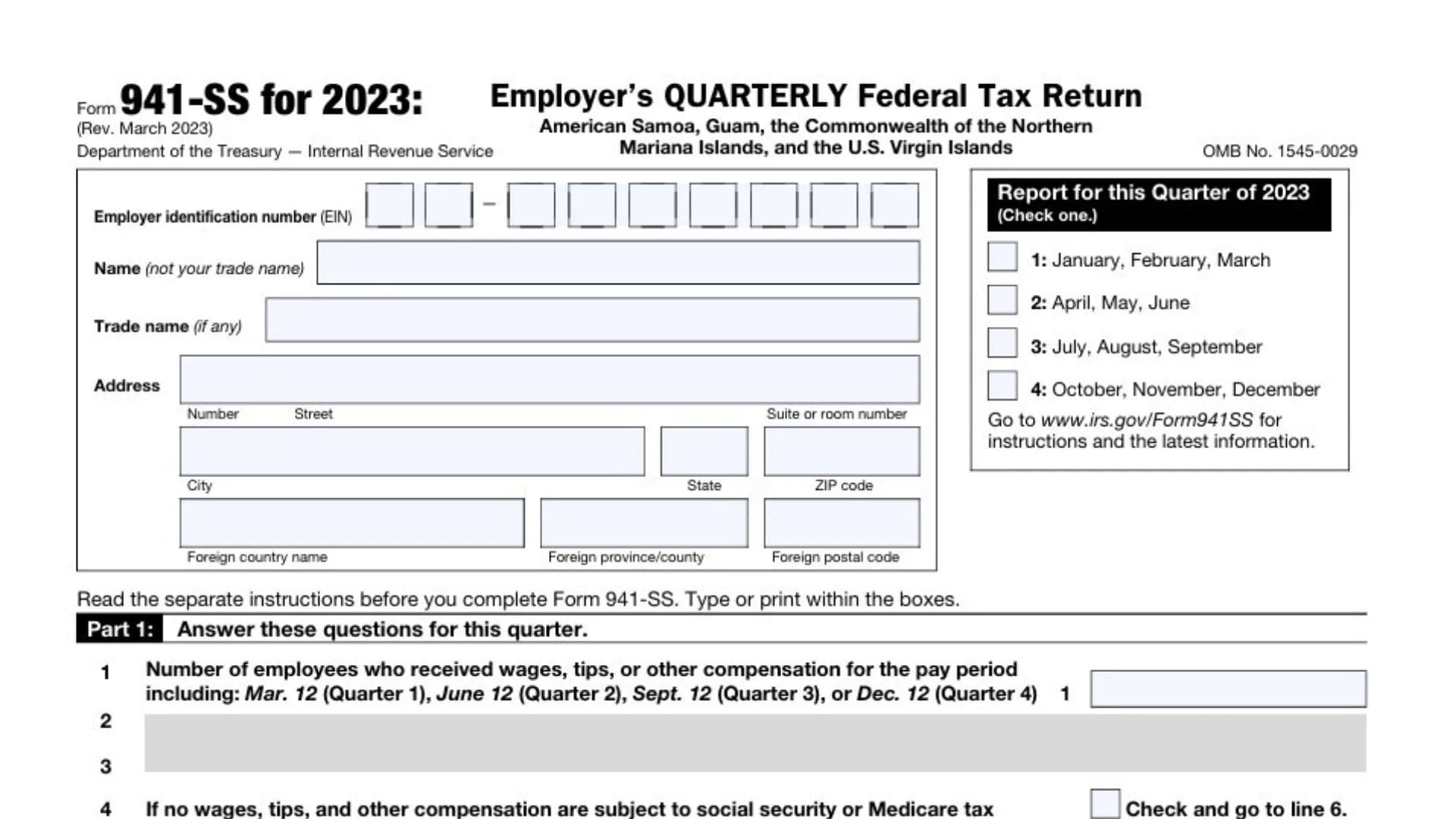
Form 941-SS is the Employer’s Quarterly Federal Tax Return used specifically by employers in American Samoa, Guam, the Commonwealth of the Northern Mariana Islands, and the U.S. Virgin Islands. This crucial tax document allows businesses in these territories to accurately report social security and Medicare taxes withheld from their employees’ paychecks, as well as the employer’s matching portion of these taxes. Unlike the standard Form 941 used in the mainland United States, which includes reporting for federal income tax withholding, Form 941-SS focuses exclusively on social security and Medicare liabilities, as well as certain payroll tax credits for qualified sick and family leave or research activities. Employers must file this form every quarter to maintain compliance with federal tax laws, calculate their total tax liability, declare their deposit schedules, and ensure they are neither underpaying nor overpaying their employment taxes.
How To File Form 941-SS
Before diving into the numbers, you must fill out the entity information at the top of the first page. Enter your Employer Identification Number (EIN), your legal name (and trade name, if applicable), and your complete mailing address. If your address is outside the United States, provide the foreign country name, province or county, and the postal code. You must also check one of the four boxes to indicate which quarter of the year you are reporting: January-March, April-June, July-September, or October-December.
When you have completed all three pages and signed the document, you will mail it to the Internal Revenue Service. If you are making a payment with your return, you must complete and detach Form 941-V(SS) (the Payment Voucher) and include it with your check or money order. Do not staple the voucher or your payment to the return.

How to Complete Form 941-SS
Part 1: Answer These Questions For This Quarter
This section calculates your total tax liability, adjustments, and credits for the specific three-month period.
Line 1: Enter the total number of employees who received wages, tips, or other compensation for the pay period that includes the 12th day of the third month of the quarter (March 12, June 12, September 12, or December 12).
Line 2 through Line 4: If you paid no wages, tips, or other compensation subject to social security or Medicare tax during this quarter, simply check the box provided here and skip directly to Line 6.
Line 5a: Enter your total taxable social security wages in Column 1. Multiply this amount by 0.124 (the combined employer and employee rate of 12.4%) and enter the result in Column 2. Note that special rules apply for qualified sick and family leave wages, which are separated on the following sub-lines.
Line 5a(i): Enter the amount of qualified sick leave wages in Column 1. Multiply this figure by 0.062 and put the result in Column 2.
Line 5a(ii): Enter the amount of qualified family leave wages in Column 1. Multiply this figure by 0.062 and place the result in Column 2.
Line 5b: Enter your taxable social security tips in Column 1. Multiply by 0.124 and enter the total in Column 2.
Line 5c: Enter all taxable Medicare wages and tips in Column 1. Multiply this total by 0.029 (the 2.9% combined rate) and place the result in Column 2.
Line 5d: Enter the taxable wages and tips that are subject to the Additional Medicare Tax withholding in Column 1. Multiply this amount by 0.009 (0.9%) and put the result in Column 2.
Line 5e: Add all the calculated tax amounts from Column 2 (Lines 5a, 5a(i), 5a(ii), 5b, 5c, and 5d) and enter the total sum here.
Line 5f: If you received a Section 3121(q) Notice and Demand regarding tax due on unreported tips, enter that specific tax amount here.
Line 6: Add Line 5e and Line 5f to get your total taxes before any adjustments are made.
Line 7: Enter the current quarter’s adjustment for fractions of cents. This accounts for rounding differences between your payroll system and the tax calculation.
Line 8: Enter any adjustment for sick pay for the current quarter.
Line 9: Enter your current quarter’s adjustments for tips and group-term life insurance.
Line 10: Combine your total from Line 6 with the adjustments on Lines 7, 8, and 9 to determine your total taxes after adjustments.
Line 11a: If you qualify for the small business payroll tax credit for increasing research activities, enter that amount here. You must attach Form 8974 to claim this.
Line 11b: Enter the nonrefundable portion of the credit for qualified sick and family leave wages for leave taken before April 1, 2021.
Line 11c: This line is reserved for future use. Leave it blank.
Line 11d: Enter the nonrefundable portion of the credit for qualified sick and family leave wages for leave taken after March 31, 2021, and before October 1, 2021.
Lines 11e and 11f: These lines are reserved for future use. Leave them blank.
Line 11g: Add Lines 11a, 11b, and 11d together to determine your total nonrefundable credits.
Line 12: Subtract your total nonrefundable credits (Line 11g) from your total taxes after adjustments (Line 10). This is your total tax liability.
Line 13a: Enter your total deposits for this quarter. This should include any overpayment applied from a previous quarter, as well as overpayments applied from corrected forms (941-X, 944-X, or 944-X(SP)) filed in the current quarter.
Line 13b: This line is reserved for future use.
Line 13c: Enter the refundable portion of the credit for qualified sick and family leave wages for leave taken before April 1, 2021.
Line 13d: This line is reserved for future use.
Line 13e: Enter the refundable portion of the credit for qualified sick and family leave wages for leave taken after March 31, 2021, and before October 1, 2021.
Line 13f: This line is reserved for future use.
Line 13g: Add Lines 13a, 13c, and 13e together to determine your total deposits and refundable credits.
Line 13h and 13i: These lines are reserved for future use. Leave them blank.
Line 14: If your total tax liability (Line 12) is greater than your total deposits and refundable credits (Line 13g), enter the difference here. This is the balance you owe.
Line 15: If your total deposits and refundable credits (Line 13g) exceed your total tax liability (Line 12), enter the difference here. This is your overpayment. You must then check the appropriate box to either apply this overpayment to your next tax return or have it sent to you as a refund.
Part 2: Tell Us About Your Deposit Schedule And Tax Liability
This section clarifies how often you are required to deposit your taxes based on the size of your liability.
Line 16: You must select one of three checkboxes to declare your deposit schedule:
- First Box: Check this if Line 12 on this return (or the prior quarter’s return) is less than $2,500, and you did not incur a $100,000 next-day deposit obligation. If your liability jumped from under $2,500 last quarter to $100,000 or more this quarter, you must provide a record of your liability. Skip to Part 3 after checking this box.
- Second Box: Check this if you were a monthly schedule depositor for the entire quarter. You must enter your specific tax liability for Month 1, Month 2, and Month 3. Add these three months together to find your total liability for the quarter. This total must exactly match the amount you entered on Line 12.
- Third Box: Check this if you were a semiweekly schedule depositor at any point during this quarter. You must complete and attach Schedule B (Form 941), which is the Report of Tax Liability for Semiweekly Schedule Depositors.
Part 3: Tell Us About Your Business
If any question in this section does not apply to your specific business situation, leave the corresponding line blank.
Line 17: If your business has closed permanently or you have stopped paying wages entirely, check this box. You must enter the final date that you paid wages to employees, and you must attach a statement to your return detailing the closure.
Line 18: If your business operates seasonally and you are not required to file a return for every quarter of the calendar year, check this box.
Line 19: Enter the qualified health plan expenses that are allocable to qualified sick leave wages for leave taken before April 1, 2021.
Line 20: Enter the qualified health plan expenses that are allocable to qualified family leave wages for leave taken before April 1, 2021.
Lines 21 and 22: These lines are reserved for future use. Leave them blank.
Line 23: Enter the total qualified sick leave wages for leave taken after March 31, 2021, and before October 1, 2021.
Line 24: Enter the qualified health plan expenses that are allocable to the qualified sick leave wages you just reported on Line 23.
Line 25: Enter the amounts under certain collectively bargained agreements that are allocable to the qualified sick leave wages reported on Line 23.
Line 26: Enter the total qualified family leave wages for leave taken after March 31, 2021, and before October 1, 2021.
Line 27: Enter the qualified health plan expenses that are allocable to the qualified family leave wages you reported on Line 26.
Line 28: Enter the amounts under certain collectively bargained agreements that are allocable to the qualified family leave wages reported on Line 26.
Part 4: May We Speak With Your Third-Party Designee?
This section establishes whether you give the government permission to discuss this specific tax return with someone else.
Check “Yes” if you want to allow an employee, a paid tax preparer, or another trusted person to discuss the details of this return. If you check Yes, you must provide the designee’s name, their phone number, and select a 5-digit Personal Identification Number (PIN) that the designee will use to verify their identity when speaking with agents.
Check “No” if you do not want anyone else to have authorization to discuss this return.
Part 5: Sign Here
This final section makes your tax return legally binding under penalties of perjury.
You must sign your name, print your name clearly, print your official job title, enter the date, and provide your best daytime phone number. All three pages of the form must be completed before you sign.
If a paid tax preparer completed this form on your behalf, they must fill out the “Paid Preparer Use Only” section. They need to provide their name, Preparer Tax Identification Number (PTIN), signature, date, firm’s name (or their own name if self-employed), EIN, address, phone number, city, state, and ZIP code.
Payment Voucher Form 941-V(SS)
If you have a balance due on Line 14 and are authorized to pay it with your return rather than through electronic deposit, you must fill out the Payment Voucher at the end of the document.
Box 1: Enter your Employer Identification Number.
Box 2: Enter the exact dollar and cent amount of your payment.
Box 3: Darken the single circle that corresponds to the specific tax quarter you are paying for.
Box 4: Enter your business name and full address.
Make your check or money order payable to the “United States Treasury” and write your EIN, “Form 941-SS”, and the specific quarter on the payment itself. Do not send cash.