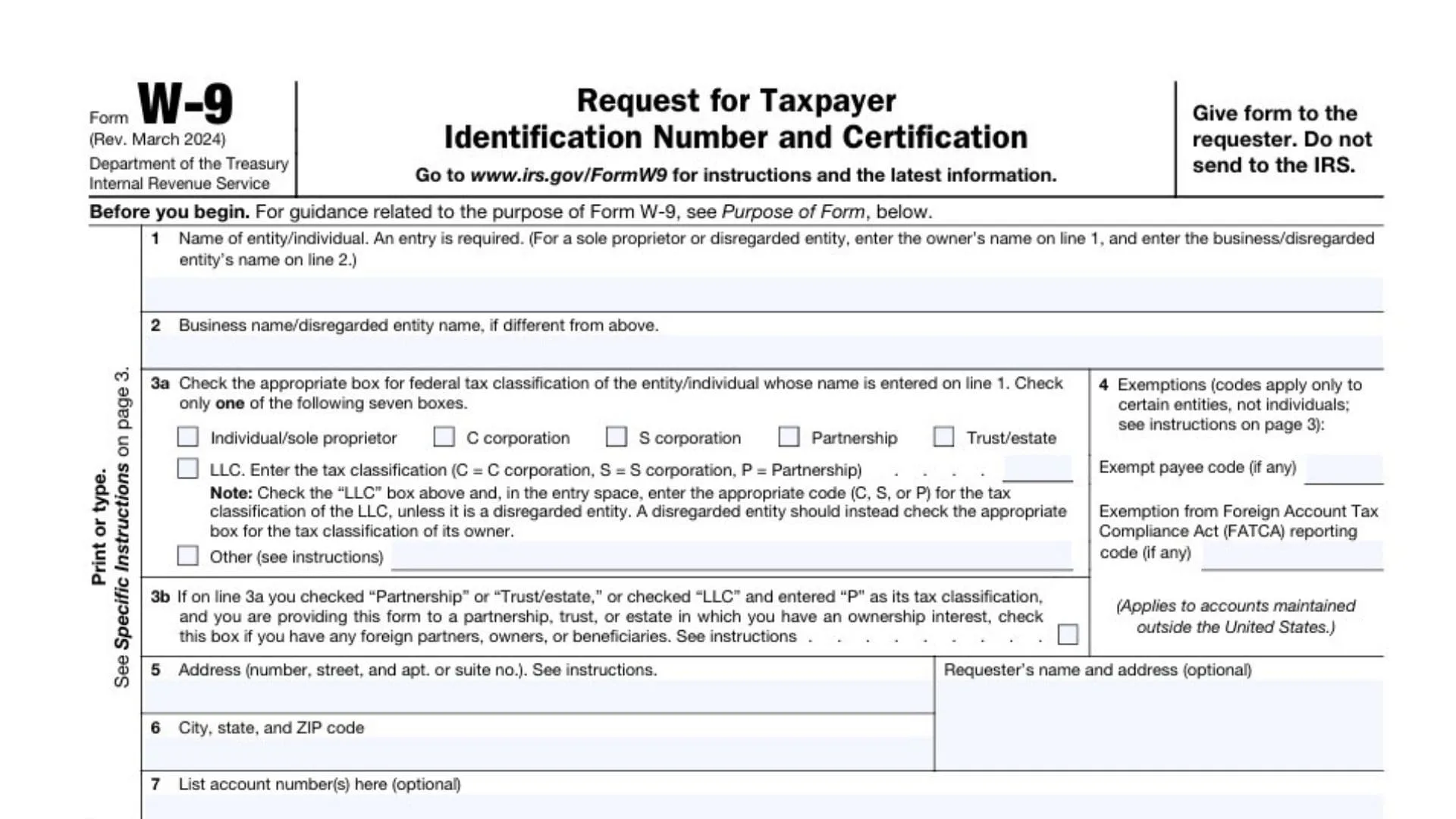
Form W-9, officially known as the Request for Taxpayer Identification Number and Certification, is a critical document utilized within the United States tax system to collect the correct tax identification details of independent workers and entities. Any business or client required to file an information return with the Internal Revenue Service must collect this form from you to accurately report amounts paid for your services, such as nonemployee compensation, real estate proceeds, dividends, or interest. By filling out this document, you are formally certifying that the Taxpayer Identification Number you provided is entirely correct and that you qualify as a U.S. person or resident alien. Additionally, signing the document verifies whether you are exempt from backup withholding, which is an enforcement mechanism where the government claims 24% of your earnings if your tax data is inaccurate or missing. It also allows qualifying entities to claim an exemption from Foreign Account Tax Compliance Act reporting. Failing to provide a completed form can result in immediate financial penalties and trigger automatic backup withholding on your hard-earned payments, making it absolutely essential for freelancers, contractors, and business owners to understand and submit this document promptly.
How To File IRS Form W-9
Once you have accurately filled out the required fields, you must hand the document directly back to the individual, client, or business entity that requested it from you. You should never send this document directly to the Internal Revenue Service. Because this paperwork contains highly sensitive personal data, such as your Social Security Number, it is highly recommended to use secure transmission methods when returning it. Hand delivery, encrypted email, or uploading to a secure client portal are the best ways to protect yourself against identity theft.

How To Complete IRS Form W-9
Line 1: Name
You must enter your exact legal name exactly as it appears on your official income tax return. This critical section cannot be left blank under any circumstances. If you operate a disregarded entity or a single-member limited liability company, you must provide the individual owner’s personal name here rather than the name of the business.
Line 2: Business Name
If your company operates under a trade name, a “doing business as” name, or if you possess a disregarded entity name, you should input that information on this specific line. If your business name is identical to your personal name provided on the very first line, you can simply leave this space blank.
Line 3a: Federal Tax Classification
You must check one—and only one—box in this section to clearly indicate how you or your company is classified for federal tax purposes. The available options include individual or sole proprietor, C corporation, S corporation, partnership, and trust or estate. If you operate a limited liability company that has not elected to be treated as a disregarded entity, you must check the LLC box and write in the corresponding letter (C, S, or P) to demonstrate your specific corporate tax classification.
Line 3b: Foreign Partners, Owners, Or Beneficiaries
This newly added box must be checked if you operate a flow-through entity, such as a partnership, that possesses foreign ownership and you are submitting this paperwork to another flow-through entity where you hold an ownership interest. Checking this box helps the requesting organization determine if they need to fulfill additional international reporting requirements regarding indirect foreign partners.
Line 4: Exemptions
The vast majority of individual taxpayers and freelancers will leave this section completely blank. However, if you represent a corporation or another specific entity structure that is legally exempt from backup withholding or Foreign Account Tax Compliance Act reporting, you must enter the exact alphanumeric exemption codes that apply to your situation here.
Line 5: Address
Provide your current street address, carefully including any necessary apartment or suite numbers. This is the exact physical location where the requesting party will eventually mail your year-end tax information documents, such as your 1099 form. If you have recently moved and this is a new address, it is a smart practice to write the word “NEW” at the top to alert the requester to update their records.
Line 6: City, State, And ZIP Code
Enter the corresponding city, state, and ZIP code that matches the street address you provided on the previous line.
Line 7: Account Numbers
This is a purely optional space where you can list specific financial account numbers associated with the requester. It is generally utilized if you maintain multiple different accounts with a single financial institution or vendor and need to explicitly specify which ones this certification applies to.
Part I: Taxpayer Identification Number
In this critical section, you must carefully enter your nine-digit tax number in the appropriate data boxes. For most standard individuals and sole proprietors, this will simply be your Social Security Number. For larger corporations, partnerships, and multi-member LLCs, you will need to enter your Employer Identification Number instead. The number you input here must directly match the legal name provided on the first line to prevent any backup withholding issues. If you do not currently possess a number but have already applied for one, you can write the phrase “Applied For” in this designated space.
Part II: Certification
This final section requires you to officially sign and date the document under penalties of perjury. By applying your signature, you are legally confirming that your provided tax number is perfectly accurate, you are not currently subject to backup withholding, you are a recognized U.S. person, and any exemption codes you claimed are valid. If the IRS has previously notified you that you are actively subject to backup withholding due to underreported interest or dividends on past returns, you must physically cross out the second item in the certification text before you sign the form.