
How do you calculate average tax rate? Start by dividing the amount of tax you owe by the income figure you want to measure, then multiply the result by 100 to convert it into a percentage. For many U.S. taxpayers, the basic average tax rate formula is federal income tax liability divided by taxable income, multiplied by 100. You may also hear this called an effective tax rate, although people sometimes use that term with adjusted gross income or total income as the denominator instead. That difference matters because taxable income, gross income, adjusted gross income, total tax, income tax, payroll tax, and self-employment tax are not interchangeable. Before calculating your percentage, decide whether you want to measure only federal income tax, your total federal tax liability, or your broader tax burden. Once you choose a consistent tax amount and income base, the calculation is simple and can help you compare tax years, understand how much of your income goes toward taxes, estimate future payments, and avoid confusing your average rate with your highest marginal tax bracket.
Average Tax Rate Formula
The standard formula is:
Average Tax Rate = Tax Liability ÷ Income Base × 100
For example, suppose your federal income tax liability is $12,000 and your taxable income is $80,000.
$12,000 ÷ $80,000 = 0.15
0.15 × 100 = 15%
Your average federal income tax rate is 15%.
This means your tax equals 15% of the taxable income used in the calculation. It does not mean that every dollar was taxed at 15%.
Which Tax Amount Should You Use?
Your result depends on what you are trying to measure.
For a basic federal income tax calculation, use your income tax liability after applicable nonrefundable credits, but do not automatically include unrelated taxes unless you want a broader measurement.
On the 2025 Form 1040:
- Line 15 shows taxable income.
- Line 22 shows tax after certain nonrefundable credits.
- Line 23 includes other taxes, such as self-employment tax.
- Line 24 shows total tax.
If you divide line 24 by taxable income, you are calculating a broader federal tax rate because total tax may include self-employment tax and other federal taxes.
If you want only an average income tax rate, use the federal income tax portion rather than total tax. Tax software or a qualified preparer can help separate the amounts when your return includes several schedules.
Which Income Number Should You Use?
There is no single denominator used in every discussion of average tax rates. Three common choices are taxable income, adjusted gross income, and total income.
Taxable Income
Taxable income is the amount left after eligible deductions. It is the income to which the federal income tax brackets generally apply.
Using taxable income answers this question:
What percentage of my taxable income became federal tax?
Adjusted Gross Income
Adjusted gross income, commonly called AGI, starts with total income and subtracts certain adjustments. It is calculated before the standard deduction or itemized deductions.
Using AGI usually produces a lower percentage because AGI is often larger than taxable income.
Total Income
Total income includes reportable income before adjustments and deductions. Using this amount gives a broader view of tax compared with income received or recognized during the year.
Always label your result clearly. A 15% rate based on taxable income is not directly comparable with a 10% rate based on total income.
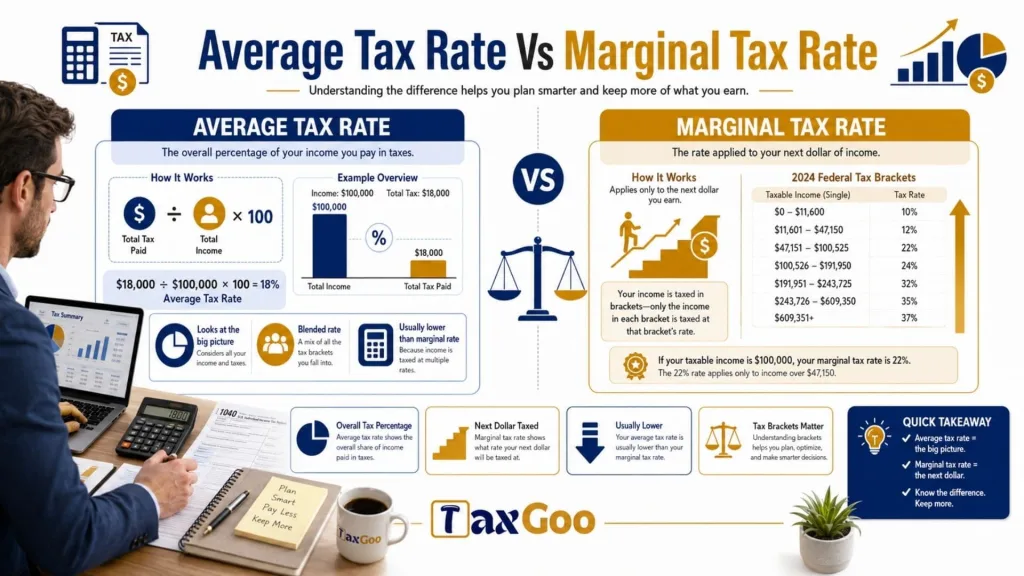
Average Tax Rate Vs Marginal Tax Rate
Your average tax rate is not the same as your marginal tax rate.
The United States uses progressive federal income tax brackets. Income is taxed in layers, and the rate increases only for the part of taxable income that enters a higher bracket.
Suppose your highest taxable dollars fall within the 22% bracket. That does not mean all your income is taxed at 22%. Earlier portions may be taxed at lower rates, which usually makes your average rate lower than your marginal rate.
Your marginal rate is the rate that generally applies to your next dollar of ordinary taxable income. Your average rate describes your overall tax as a percentage of the chosen income base.
Step-By-Step Example
Imagine that Taylor files a federal return with the following figures:
- Total income: $100,000
- Adjusted gross income: $94,000
- Taxable income: $75,000
- Federal income tax liability: $10,500
- Total tax after self-employment tax: $14,000
Taylor can calculate several useful rates.
Average Federal Income Tax Rate
$10,500 ÷ $75,000 × 100 = 14%
This compares federal income tax with taxable income.
Tax As A Percentage Of AGI
$10,500 ÷ $94,000 × 100 = 11.17%
This measures federal income tax against adjusted gross income.
Overall Federal Tax Rate
$14,000 ÷ $94,000 × 100 = 14.89%
This broader calculation includes the additional taxes contained in total tax.
All three calculations are mathematically correct. They answer different questions.
Should You Include Social Security And Medicare Taxes?
Include payroll taxes only when your goal is to calculate a wider federal tax burden.
Employees generally share Social Security and Medicare taxes with their employers. Self-employed individuals generally account for both portions through self-employment tax, subject to applicable rules and deductions.
Mixing payroll taxes into the numerator while using taxable income as the denominator can produce a confusing result. State income tax, local tax, sales tax, and property tax should also remain separate unless you intentionally want an all-in tax burden calculation.
Define the calculation before combining different taxes.
Why Your Withholding Rate Is Different
The federal tax withheld from your paycheck is not necessarily your actual tax liability.
Withholding is a prepayment based on your earnings and Form W-4 information. Your final return considers your full income, deductions, credits, payments, filing status, and additional taxes.
Dividing withholding by wages calculates a withholding rate, not your final average tax rate.
You may receive a refund because withholding exceeded your liability, or owe money because it was insufficient. Use the final tax return when calculating the completed year’s rate.
How Tax Credits Affect The Calculation
Tax credits can reduce your final tax liability and lower your average rate. Nonrefundable credits generally reduce tax down to zero, while refundable credits may also contribute to a refund.
Do not calculate your average rate by dividing your refund by income. A refund is usually the difference between payments and final liability, not the total tax you paid.
For a meaningful result, identify the tax liability before comparing it with your chosen income figure.
Common Calculation Mistakes
A frequent mistake is using the highest tax bracket as the average rate. Another is dividing the refund or balance due by income.
Other errors include:
- Using gross wages for one year and taxable income for another
- Including state tax in the numerator without labeling it
- Treating paycheck withholding as final tax
- Mixing income tax and self-employment tax unintentionally
- Forgetting that credits lower tax liability
- Comparing rates calculated with different income bases
Consistency is essential when comparing years or households.
Why Calculate Your Average Tax Rate?
Your average rate can help you review withholding, estimate quarterly payments, compare income changes, evaluate retirement withdrawals, and understand how deductions or credits affected your return.
It can also make financial planning more realistic. Instead of assuming that your entire income is taxed at your marginal bracket, you can use an average based on your actual return.
The figure is a planning tool, not a replacement for a complete tax calculation.
Final Thoughts
To answer how do you calculate average tax rate, divide the relevant tax liability by a clearly defined income amount and multiply by 100. For a straightforward federal income tax rate, many taxpayers compare federal income tax liability with taxable income.
State what you included, especially when using total tax, AGI, payroll taxes, or self-employment tax. This prevents misleading comparisons and gives you a more useful picture of your tax burden.

Frequently Asked Questions
Is Average Tax Rate The Same As Effective Tax Rate?
They are often used similarly, but the calculation may use taxable income, AGI, or total income. Check the definition being used.
Can My Average Rate Be Higher Than My Tax Bracket?
Usually not when comparing regular federal income tax with taxable income. It may appear higher if additional taxes are included.
Do I Use My Refund In The Formula?
No. Use tax liability, not the refund amount.
Should I Include State Income Tax?
Only if you are intentionally calculating a combined federal and state rate.
Is Withholding My Average Tax Rate?
No. Withholding is a tax prepayment and may differ from your final liability.
Why Is My Average Rate Lower Than My Marginal Rate?
Because lower portions of taxable income are generally taxed at lower bracket rates.