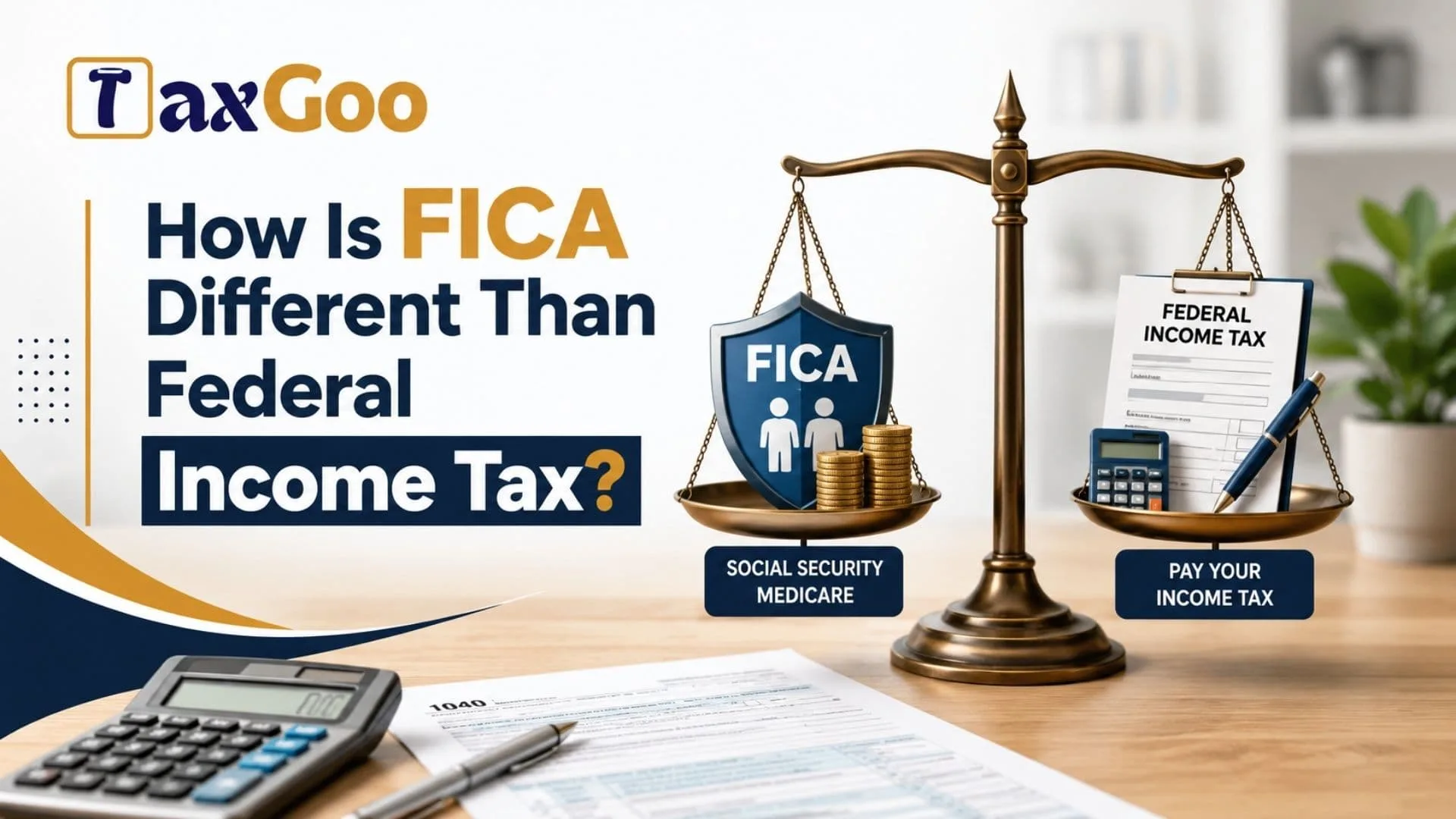
How Is FICA Different Than Federal Income Tax? In short, FICA is the payroll tax that funds Social Security and Medicare, while federal income tax is a pay as you go tax on your overall taxable income. Understanding the split matters for planning because FICA uses flat rates with specific caps and surtaxes, applies differently to wages and self-employment income, and does not allow personal deductions or credits, while federal income tax uses progressive brackets, offers the standard deduction and itemized deductions, and includes credits that can reduce or even refund your bill. In this guide, we cover FICA withholding, the Social Security wage base, Medicare rates, the Additional Medicare Tax, employer matching, self-employment tax for freelancers, federal income tax brackets, W-4 elections, pre-tax benefits like 401(k) and HSA, and how both systems land on your Form W-2 and your annual return.
What FICA Covers And How It Works
- FICA stands for the Federal Insurance Contributions Act. It funds Social Security and Medicare.
- Employee rate: 6.2 percent Social Security up to the annual wage base, plus 1.45 percent Medicare on all wages.
- Employer match: Your employer pays the same 6.2 percent and 1.45 percent.
- Additional Medicare Tax: High earners pay an extra 0.9 percent Medicare tax above certain thresholds, with no employer match.
- No deductions or personal credits reduce FICA. It is formula based on covered wages.
Federal Income Tax At A Glance
- Calculated on taxable income after the standard deduction or itemized deductions and certain adjustments.
- Uses progressive tax brackets. The first dollars are taxed at lower rates, later dollars at higher rates.
- Credits such as the Child Tax Credit, American Opportunity Tax Credit, and Earned Income Tax Credit can reduce your bill, sometimes below zero for a refund.
- Withholding is guided by your Form W-4 elections, then reconciled on your annual Form 1040.
How They Appear On Your Pay Stub And W-2
- Pay stub: You will see separate lines for Social Security, Medicare, and federal income tax withholding.
- Form W-2: Box 1 shows federal wages, which can be lower than Social Security wages in Box 3 and Medicare wages in Box 5 because some pre-tax benefits reduce income tax wages but not FICA wages.
- Typical pre-tax items that reduce Box 1 only include 401(k) and 403(b) contributions. Health insurance premiums through a cafeteria plan often reduce Box 1 and Box 5, but not Box 3, depending on plan structure.
Self-Employment And FICA’s Cousin
- Freelancers and sole proprietors do not pay FICA through payroll. They pay self-employment tax on net earnings, which covers both the employee and employer portions of Social Security and Medicare.
- You can claim an above-the-line deduction for half of the self-employment tax on your Form 1040, which does not change Schedule SE but does lower taxable income for federal income tax.
- Estimated quarterly payments usually cover both income tax and self-employment tax.

Wage Base, Surtax, And Limits
- Social Security has an annual wage base. Wages above that ceiling are not subject to the 6.2 percent Social Security portion.
- Medicare has no wage cap. All covered wages pay the 1.45 percent rate, with the Additional Medicare Tax kicking in above income thresholds.
- The wage base and surtax thresholds adjust periodically. Check current IRS and Social Security Administration figures each year.
Planning Moves That Affect Each Tax
- 401(k), 403(b), and traditional TSP contributions reduce federal income tax wages, which can lower your bracketed income and credit phaseouts. They do not reduce Social Security wages.
- Health Savings Account contributions made through payroll reduce both federal income tax and often Medicare wages if set up under a cafeteria plan. HSA contributions made directly can still reduce federal income tax on your return, but may not change payroll FICA already withheld.
- Flexible Spending Accounts for health and dependent care can reduce federal taxable wages and sometimes Medicare wages, depending on plan mechanics.
- Itemized deductions and most credits only affect federal income tax, not FICA.
Students, Interns, And Special Cases
- Many student employees of a university are exempt from FICA when enrolled at least half time, but wages are still subject to federal income tax.
- Certain nonresident aliens have treaty benefits that alter federal income tax, while FICA rules for visa holders follow separate regulations.
- Government and some nonprofit workers participate in alternative retirement systems that can change how Social Security applies. Always verify with payroll.
Why Your Refund Might Not Match Your FICA
- Federal income tax withholding is an estimate that you reconcile at filing. Overwithholding creates a refund, underwithholding creates a balance due.
- FICA is final at the time of withholding. There is no annual FICA refund simply because your income tax return shows a refund.
- Two or more jobs can cause excess Social Security withholding if combined wages exceed the wage base at different employers. You can claim the excess back on your tax return.
Simple Example
Imagine your monthly gross pay is 4,000. Your employer withholds Social Security at 6.2 percent, which is 248, and Medicare at 1.45 percent, which is 58. Your federal income tax withholding depends on your W-4, your expected annual total, and any pre-tax elections. If you contribute 400 to a traditional 401(k), your federal taxable wages drop to 3,600 for that month, which may reduce your income tax withholding, but your Social Security calculation still uses 4,000 unless your plan design alters Medicare wages.
Checklist For Paycheck Clarity
- Review W-2 Boxes 1, 3, and 5. Know why they differ.
- Confirm retirement and HSA elections, and which boxes they reduce.
- Track year to date Social Security wages to see if you reach the wage base.
- If you change jobs midyear, keep a tally to avoid surprise excess withholding.
- For freelance income, set aside funds for both income tax and self-employment tax, then pay quarterly.

FAQs
Q: Can deductions reduce FICA?
A: No. FICA is based on covered wages and ignores itemized deductions and personal credits.
Q: Why are my W-2 wages different across boxes?
A: Pre-tax benefits and plan rules can lower federal wages without lowering Social Security or Medicare wages.
Q: Do freelancers pay FICA?
A: They pay self-employment tax, which covers both the employee and employer portions of Social Security and Medicare.