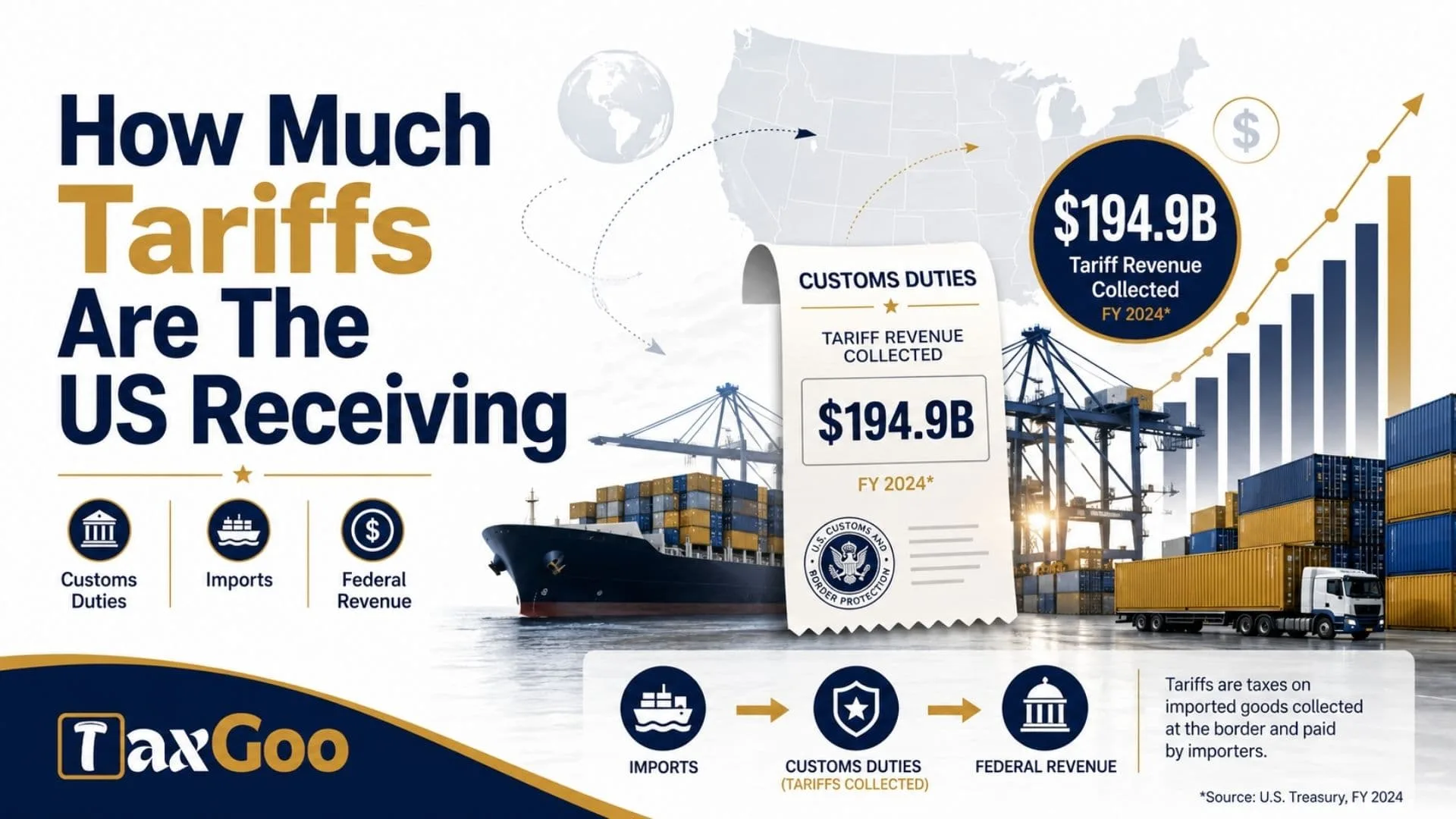
The question How Much Tariffs Are The US Receiving is really asking how much money the U.S. government collects from tariffs, customs duties, import taxes, trade taxes, border fees, and duties on imported goods. The clearest recent answer is this: the U.S. collected $194.9 billion in customs duties in fiscal year 2025, and about $188.6 billion in fiscal year 2026 through May, according to data reported from the U.S. Treasury and summarized by USAFacts. That means tariff revenue has become much larger than usual, especially compared with the years before the newer tariff increases. Still, tariffs are not the biggest source of federal money. Income taxes and payroll taxes remain much larger. Tariff revenue matters because it affects government receipts, business costs, consumer prices, imports, trade policy, and the federal deficit, but it is only one piece of the U.S. budget picture.
What Does The U.S. Count As Tariff Revenue?
In official federal budget data, tariff revenue usually appears as customs duties. These are taxes charged on imported goods when they enter the country.
A tariff can be based on the value of imported products, the country they come from, the product category, or a special trade policy. The International Trade Administration explains that “tariff” and “duty” are often used interchangeably, and that a tariff or duty is a tax levied by governments on the value of imported products.
So when people ask how much the U.S. is receiving from tariffs, the best official budget category to watch is customs duties.
How Much Did The U.S. Receive In 2025?
The U.S. collected $194.9 billion in customs duties in fiscal year 2025. That was a major jump from fiscal year 2024, when customs duties were $77.0 billion. The Treasury’s fiscal 2025 statement says customs duties increased by 153.0%, or $117.8 billion, compared with the prior fiscal year.
That increase made tariffs a much bigger part of federal revenue than usual. USAFacts reports that customs duties made up 3.7% of total federal revenue in FY 2025, and that customs duties had not exceeded 2% of federal revenue from FY 1980 through FY 2024.
In plain English, the U.S. received a record-level amount from tariffs in 2025, but tariffs still remained far smaller than individual income taxes, payroll taxes, and other major federal revenue sources.
How Much Is The U.S. Receiving In 2026 So Far?
For fiscal year 2026, the latest monthly figure available from USAFacts says the federal government had collected about $188.6 billion in customs duties through May. Since the federal fiscal year starts on October 1, that figure covers the first eight months of FY 2026.
USAFacts also notes that this was 131.7% higher than the same point in FY 2025. That shows how strongly tariff collections rose after the latest tariff changes.
However, readers should be careful with newer daily figures. Some daily trackers use “DHS Customs and Certain Excise Taxes,” which is a gross measure and may include items beyond net tariff revenue. The Bipartisan Policy Center notes that net tariff revenue is not available in real time because it comes from Monthly Treasury Statements and accounts for refunds.
Why Are Tariff Receipts Rising?
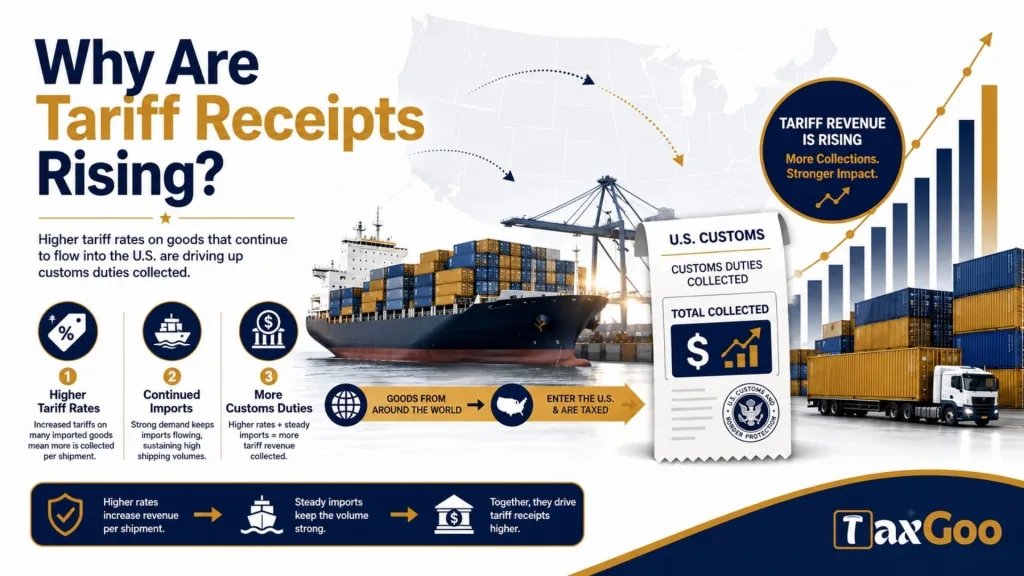
Tariff receipts rose because the U.S. increased duties on many imported goods. USAFacts says FY 2025 customs duties were elevated because of new tariffs on a broad range of imports, including goods from China, Canada, Mexico, and the European Union.
The basic math is simple. If the tariff rate goes up and imports continue, the government collects more. But there is a limit. If tariffs become too high, businesses may import less, shift suppliers, delay purchases, or pass costs to consumers. Treasury Fiscal Data explains that increasing tariffs can increase revenue, but if imports fall because prices rise, customs duty revenue could decrease overall.
So tariff revenue depends on both the rate and the amount of trade that still happens.
Who Actually Pays Tariffs?
Legally, tariffs are usually paid by the importer when goods enter the country. That importer may be a U.S. company, a customs broker acting for a business, or another importer of record.
But the economic burden can move. Importers may absorb the cost, raise prices, negotiate with foreign suppliers, change supply chains, or pass the cost to consumers. That is why tariff revenue is not “free money.” It comes from real transactions and can affect product prices, profit margins, business planning, and household costs.
Are Tariffs A Big Part Of The U.S. Budget?
Tariffs are bigger than before, but still not huge compared with the whole federal budget.
In FY 2025, total federal receipts were about $5.23 trillion, while customs duties were about $194.9 billion. That means tariffs were meaningful, but still a small share of total revenue. The largest sources remained individual income taxes and social insurance taxes.
A useful way to think about tariffs is this: they can bring in tens or hundreds of billions of dollars, but they do not replace the main tax system.
Why Gross And Net Tariff Numbers Can Differ
One reason tariff numbers can look confusing is that some sources track gross daily deposits, while others track net customs duties after refunds and adjustments.
The Bipartisan Policy Center explains that gross daily tariff-related data can include “customs and certain other excise tax revenue,” while net tariff revenue removes certain excise taxes and accounts for tariff refunds. It also notes that net data comes from Monthly Treasury Statements, not real-time daily updates.
That means one article may show a higher or faster-moving number than another. They may both be using legitimate data, but not the same measurement.

FAQs
How Much Tariff Revenue Did The U.S. Collect In 2025?
The U.S. collected about $194.9 billion in customs duties in fiscal year 2025.
How Much Has The U.S. Collected In 2026 So Far?
Through May of FY 2026, the U.S. had collected about $188.6 billion in customs duties.
Are Tariffs The Same As Customs Duties?
In common budget discussions, yes. Customs duties are the official category used for tariff revenue.
Who Pays U.S. Tariffs?
Importers usually pay tariffs when goods enter the country, though costs may be passed on to buyers.
Are Tariffs A Major Source Of U.S. Revenue?
They are larger than usual right now, but still much smaller than income taxes and payroll taxes.