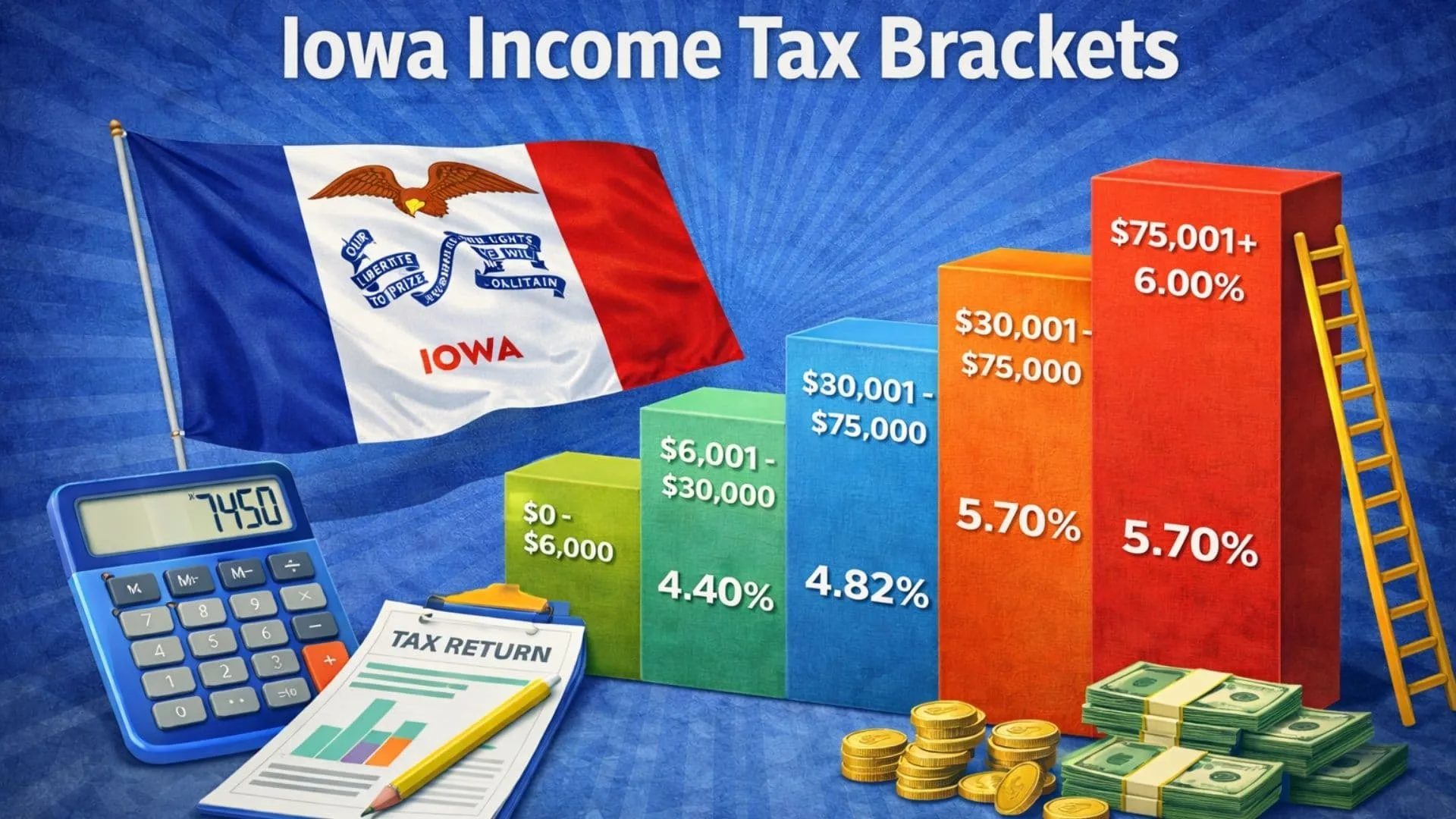
Iowa Income Tax Brackets determine how your income is taxed at the state level, and in 2026, they look very different from what many longtime residents might remember. Over the past few years, Iowa’s income tax system has undergone major simplification — shifting from a multi-tiered progressive model with numerous rates to a flatter, cleaner structure with fewer brackets and lower tax rates. Whether you’re a W‑2 employee, self-employed, or retired, understanding Iowa income tax brackets, marginal tax rates, taxable income, and available credits and deductions can help you plan smarter and avoid unpleasant surprises at filing time. In this guide, you’ll learn how the latest brackets are structured, what kind of tax reforms are still in the pipeline, and how to estimate your Iowa state income tax based on your income, filing status, and deductions. Let’s unpack how Iowa’s simplified income tax brackets are reshaping take-home pay and financial planning across the state.
Overview Of Iowa Income Tax Changes
In recent years, Iowa has followed a major tax reform plan aimed at reducing complexity and lowering rates. The goal: make the state’s tax system simpler, fairer, and more competitive. Previously, Iowa had nine income tax brackets with rates ranging from roughly 0.33% to 8.53%. Under new legislation, the state has been phasing in flatter rates — and by 2026, Iowa will move to a flat 3.9% individual income tax rate.
For tax year 2025, you’ll notice there are four income tax brackets, making it easier to understand how your taxes are calculated.
Iowa Income Tax Brackets For 2025
Here’s what the Iowa Department of Revenue has set for the 2025 tax year (for returns filed in 2026):
| Taxable Income (All Filers) | Tax Rate |
|---|---|
| Up to $6,000 | 4.40% |
| $6,001 – $30,000 | 4.82% |
| $30,001 – $75,000 | 5.70% |
| Over $75,000 | 5.70% |
(Source: Iowa Department of Revenue, 2025 income tax rate schedule)
Note: Starting in 2026, this structure will be replaced by Iowa’s new flat 3.9% rate — meaning all taxable income will be taxed evenly, regardless of income level.

How To Calculate Your Iowa State Income Tax
Iowa income tax uses your taxable income, not your total earnings. That means you start with your federal adjusted gross income (AGI), then apply Iowa-specific adjustments to reach your Iowa taxable income.
Then you simply apply the bracket formula above — for example:
Example Calculation:
If your taxable income is $50,000:
- The first $6,000 is taxed at 4.4% → $264
- The next $24,000 is taxed at 4.82% → $1,156.80
- The remaining $20,000 is taxed at 5.7% → $1,140
Total Iowa Tax = $2,560.80
Your marginal rate (top rate you pay) is 5.7%, but your effective rate (average across all income) is about 5.1%.
Filing Status Options In Iowa
Iowa recognizes several filing statuses, similar to federal categories:
- Single
- Married filing jointly
- Married filing separately on combined return
- Married filing separately on separate returns
- Head of household / qualifying widow(er)
Though the rates are uniform across statuses under the new structure, other elements — like deductions and credits — can shift depending on your status.
Deductions And Credits That Reduce Iowa Income Tax
Even with Iowa’s simplified brackets, deductions and tax credits play a major role in lowering your final bill.
Common Iowa deductions and credits include:
- Standard deduction (increased periodically)
- Federal tax deduction (partial credit for federal taxes paid — unique to Iowa)
- Earned income tax credit (EITC)
- Child and dependent care credit
- Retirement income exclusion (for certain pension and Social Security income)
- Tuition and textbook credit (for education-related expenses)
Each of these can significantly affect how much of your income gets taxed.
How The Flat Tax Will Change Things
Beginning in 2026, Iowa will transition to a flat income tax rate of 3.9%, meaning all taxable income will be taxed at the same rate, no matter how much you earn. The goal is simplicity — fewer brackets, less paperwork, and predictably lower rates for most taxpayers. However, this may lead to smaller tax savings for lower-income earners while higher-income households see larger percentage reductions.
The shift reflects Iowa’s broader tax modernization strategy, which also includes corporate rate cuts and potential sales tax adjustments.
Iowa Local Income Taxes
Unlike states such as Ohio or Pennsylvania, Iowa does not have local (city or county) income tax, which simplifies state-level filing. You’ll only deal with state income tax (plus federal, of course), although school districts and counties still receive portions of overall state revenue.
Why Understanding Iowa’s Tax Brackets Matters
Knowing your bracket helps you plan for tax withholding adjustments, estimate paychecks accurately, and make smarter year-end decisions. For example:
- Raising 401(k) or IRA contributions can lower taxable income and keep you in a lower bracket.
- Understanding when Iowa’s flat tax arrives can help plan bonus income or capital gains timing.
- Tracking deductions ensures you benefit from all available savings as the state shifts systems.
Financial literacy around Iowa’s state income tax is especially valuable for business owners, remote workers, and retirees deciding where to live or file.
Iowa Income Tax Facts For 2025
- Top individual rate: 5.70%
- Lowest rate: 4.40%
- Flat rate effective: Tax Year 2026 → 3.90%
- Filing deadline: April 30, 2026
- Department: Iowa Department of Revenue

FAQs
What Are The Iowa Income Tax Brackets For 2025?
There are four: 4.40%, 4.82%, 5.70%, and 5.70% for the highest bracket on income over $75,000.
Is Iowa Switching To A Flat Income Tax?
Yes, starting in 2026 Iowa will use a single flat rate of 3.9% for all individual income levels.
Does Iowa Have Local Income Taxes?
No. Iowa only collects income tax at the state level — cities and counties do not have separate income taxes.
When Are Iowa State Taxes Due?
The filing deadline for tax year 2025 returns is April 30, 2026.