The Low-Income Housing Tax Credit (LIHTC) is one of the most important federal programs designed to encourage the development and preservation of affordable rental housing in the United States. Established under Section 42 of the Internal Revenue Code through the Tax Reform Act of 1986, the program provides federal income tax credits to eligible property owners and investors who finance affordable rental housing projects. Unlike traditional housing assistance programs that provide direct rental payments to tenants, LIHTC encourages private investment in residential developments by offering tax incentives in exchange for maintaining income-restricted rental units. The program supports new construction, substantial rehabilitation, and the preservation of existing affordable housing properties. State housing finance agencies administer credit allocations according to federally established requirements and their individual Qualified Allocation Plans (QAPs). Developers can use these allocations to attract investors, raise project financing, and reduce the overall cost of building affordable housing. For tenants, LIHTC properties provide rental opportunities with income and rent restrictions based on applicable area median income (AMI) limits. Understanding the Low-Income Housing Tax Credit program is valuable for real estate developers, property investors, housing organizations, financial professionals, and individuals researching affordable housing opportunities. In this guide, we will explore how LIHTC works, its different credit types, eligibility requirements, application procedures, compliance rules, and the benefits it provides to communities.
1. What Is The Low-Income Housing Tax Credit Program?
The Low-Income Housing Tax Credit program is a federal tax incentive established under Section 42 of the Internal Revenue Code.
Its primary purpose is to encourage private developers and investors to create rental housing that remains affordable for qualifying households.
Rather than directly funding every housing project through government grants, the program provides tax credits that can attract private investment.
The program generally supports three major housing activities:
- New construction of affordable rental properties.
- Rehabilitation of existing residential buildings.
- Preservation of affordable housing developments.
The Internal Revenue Service establishes federal tax requirements, while designated state housing agencies manage credit allocations and monitor participating properties.
2. How Does LIHTC Work?
The LIHTC program connects property developers, investors, state housing agencies, and qualifying tenants.
Here is how the process generally works:
- A developer identifies a potential affordable housing project.
- The developer prepares a financial proposal and applies to the relevant state housing finance agency.
- The agency evaluates the application according to its Qualified Allocation Plan.
- Approved projects receive an allocation of housing tax credits.
- Developers attract investors who contribute capital in exchange for the tax benefits associated with the project.
- The development is constructed or rehabilitated and rented to income-qualified households.
- Property owners maintain affordability and comply with applicable program requirements.
This financing structure helps developers reduce the amount of traditional borrowing needed to complete affordable housing projects.
3. Understanding The 9% And 4% LIHTC Programs
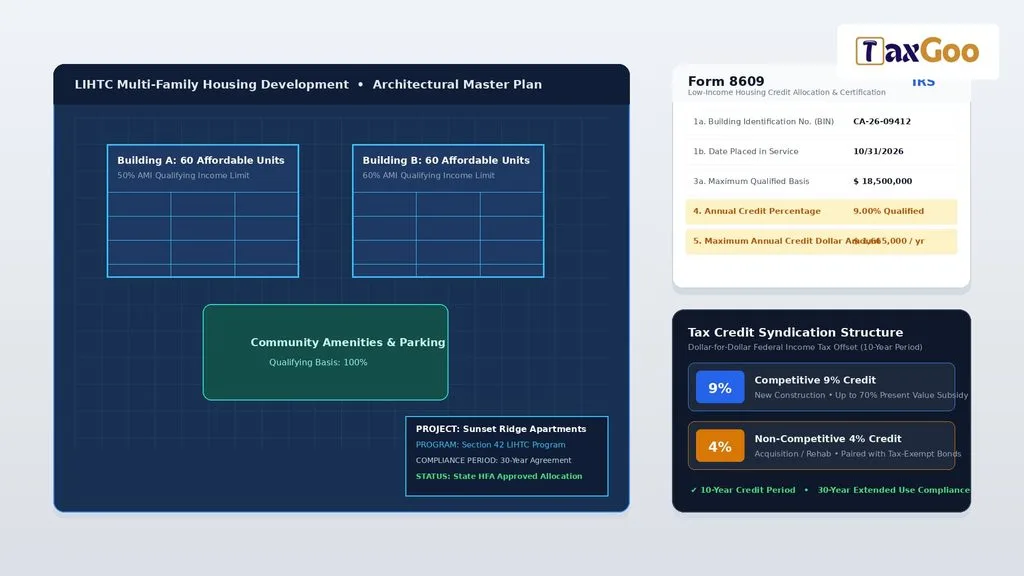
The Low-Income Housing Tax Credit program is commonly divided into two categories, known as the 9% and 4% credits.
9% LIHTC
The 9% credit is generally associated with eligible new construction and substantial rehabilitation projects. It is typically allocated through a competitive application process managed by state housing agencies.
Because demand can exceed available allocations, developers must demonstrate that their projects meet state priorities and financial feasibility requirements.
4% LIHTC
The 4% credit is generally associated with qualifying projects financed through tax-exempt private activity bonds and certain eligible acquisition or rehabilitation activities.
These projects must satisfy applicable federal financing and tax-credit requirements.
Both categories provide tax benefits over a 10-year credit period, subject to applicable rules.
4. Who Qualifies For LIHTC?
LIHTC eligibility depends on the type of participant involved.
Developers And Property Owners
Developers must meet federal requirements and obtain the necessary credit allocation or satisfy applicable bond-financing requirements.
Their projects must also meet state housing agency criteria, financial feasibility standards, and affordability commitments.
Investors
Individuals and organizations investing in qualifying affordable housing developments may receive allocated tax benefits through their ownership interests, subject to applicable tax rules.
Tenants
Tenants do not receive the LIHTC tax credit directly. Instead, they may qualify to rent designated affordable units when their household income falls within the property’s applicable income restrictions.
Income limits vary according to location, household size, project commitments, and applicable program rules.
5. How Are LIHTC Rent And Income Limits Determined?
Affordable housing developments participating in LIHTC must follow specific income and rental restrictions.
These restrictions are generally calculated using Area Median Income (AMI), which reflects income levels in a particular geographic area.
The program includes different income qualification structures.
Common minimum set-aside options include:
- 20-50 Test: At least 20% of residential units must be occupied by households earning no more than 50% of the applicable area median gross income.
- 40-60 Test: At least 40% of residential units must be occupied by households earning no more than 60% of the applicable area median gross income.
- Average Income Test: At least 40% of qualifying units must meet designated income limits, with the average designated income limitation not exceeding 60% of area median gross income.
Maximum rents are also restricted according to applicable income limits and unit characteristics.
Actual tenant eligibility and rental limits should always be checked against the property’s current program requirements.
6. How To Apply For Low-Income Housing Tax Credits
Developers interested in obtaining LIHTC allocations generally apply through their state housing finance agency.
The application process typically involves:
- Identifying the state agency responsible for LIHTC allocations.
- Reviewing the current Qualified Allocation Plan.
- Evaluating eligible project locations and development requirements.
- Preparing construction budgets and financial projections.
- Obtaining necessary financing commitments.
- Submitting the application and supporting documentation.
- Completing the agency’s review and approval process.
Each state establishes its own application priorities, deadlines, scoring criteria, and documentation requirements.
Individuals searching for affordable rental housing should contact property management companies or their local housing agencies to identify available LIHTC properties.
7. Important LIHTC Compliance Requirements
Receiving a tax credit allocation does not eliminate the responsibility to maintain affordable housing standards.
Property owners must follow ongoing federal and state compliance requirements.
Important responsibilities include:
- Verifying tenant household income.
- Maintaining applicable rent restrictions.
- Keeping accurate tenant eligibility records.
- Completing required annual certifications.
- Maintaining property quality and habitability standards.
- Cooperating with housing agency inspections and monitoring.
The program generally includes a 15-year federal compliance period, followed by an extended use commitment that typically maintains affordability for at least 30 years.
Failure to meet applicable requirements can result in tax-credit recapture, loss of future credits, or other consequences.
8. Benefits Of The LIHTC Program
The Low-Income Housing Tax Credit program provides several important benefits to the housing market.
Increased Affordable Housing Supply: Encourages construction and rehabilitation of rental properties for income-qualified households.
Private Investment: Attracts investors and financial institutions to affordable housing developments.
Community Development: Supports neighborhood improvement through residential construction and property rehabilitation.
Long-Term Affordability: Establishes extended affordability requirements that help preserve rental housing opportunities.
Economic Opportunities: Creates development, construction, property management, and maintenance opportunities.
Conclusion
The Low-Income Housing Tax Credit (LIHTC) program is an important federal initiative that combines private investment with public housing objectives. By providing tax incentives to developers and investors, the program encourages the construction, rehabilitation, and preservation of affordable rental properties across the United States. Understanding the 9% and 4% credit structures, income restrictions, rental requirements, allocation procedures, and compliance responsibilities helps developers and investors make informed decisions. For tenants, LIHTC properties can provide valuable affordable rental opportunities based on applicable household income requirements. As housing affordability continues to be an important national concern, LIHTC remains a significant part of the country’s affordable housing financing system.
Related Keywords
- Low-Income Housing Tax Credit
- LIHTC Program Explained
- LIHTC Tax Credit Eligibility
- Affordable Housing Tax Credits
- Section 42 Housing Tax Credit
- Federal Affordable Housing Program
- LIHTC Income Limits
- Low-Income Housing Tax Credit Application
- 9% Housing Tax Credit
- 4% Housing Tax Credit
- Affordable Rental Housing Programs
- LIHTC Rent Restrictions
- Area Median Income Housing Limits
- LIHTC Developer Requirements
- Affordable Housing Tax Incentives
- LIHTC Compliance Requirements
- How Does LIHTC Work
- Affordable Housing Investment Tax Credits
- Qualified Allocation Plan LIHTC
- Section 42 Tax Credit Properties
Frequently Asked Questions (FAQs)
1. What Is The Low-Income Housing Tax Credit (LIHTC)?
LIHTC is a federal tax incentive that encourages private investment in affordable rental housing developments.
2. Who Benefits From The LIHTC Program?
Affordable housing developers, eligible investors, and income-qualified rental households benefit from the program in different ways.
3. What Is The Difference Between 4% And 9% LIHTC?
The 9% credit is generally competitively allocated, while the 4% credit is commonly associated with qualifying tax-exempt bond-financed projects and other eligible activities.
4. Can Tenants Receive LIHTC Tax Credits Directly?
No. The tax credits generally benefit property owners and investors. Eligible tenants benefit through restricted rental housing.
5. How Long Does The LIHTC Program Require Affordable Housing?
The federal compliance period is generally 15 years, with extended use commitments typically requiring affordability for at least 30 years.
6. How Can I Find LIHTC Housing?
Contact your local housing agency, state housing finance agency, or affordable housing property management company to identify participating properties.