If you are trying to understand the Massachusetts Pass-Through Entity Tax, also called the Massachusetts PTE Excise or Massachusetts PTET, the core idea is fairly simple: the state allows eligible pass-through entities such as partnerships, S corporations, LLCs taxed as partnerships or S corporations, and certain trusts to make an annual election to pay a 5% tax at the entity level on income that is subject to Massachusetts personal income tax, with qualified members then generally receiving a personal income tax credit equal to 90% of their pro rata share of the tax paid. This structure was created as a response to the federal SALT deduction limitation, giving many owners of pass-through businesses a potential workaround by shifting part of the state tax burden to the entity level rather than leaving it entirely on the individual return. For Massachusetts business owners, tax professionals, and nonresident members, that makes the Massachusetts Pass-Through Entity Tax an important planning topic involving annual elections, apportionment, qualified income, member eligibility, estimated payments, and interaction with regular Massachusetts filing obligations. It is not automatic, it does not apply to every business type, and it works best when owners clearly understand who qualifies, how the excise is calculated, and what credit is available on the member side.
What It Is
Massachusetts enacted an elective pass-through entity excise under Chapter 63D for tax years beginning on or after January 1, 2021. The excise is imposed at a 5% rate on the amount of income passing through to qualified members that is subject to Massachusetts personal income tax.
The provision is widely understood as a state-level response to the federal cap on deducting state and local taxes on individual federal returns. In practical terms, the entity pays the excise, and the individual member generally claims a Massachusetts credit tied to that payment.
Who Can Elect
Eligible entities include partnerships, S corporations, LLCs treated as partnerships or S corporations for federal tax purposes, and certain trusts with income passing through to beneficiaries subject to Massachusetts personal income tax. Publicly traded partnerships are excluded, and sole proprietorships plus single-member LLCs disregarded for federal tax purposes are not eligible because they are not treated as pass-through entities for this election.
The credit side of the system applies to qualified members, which Massachusetts describes as natural persons, estates, or trusts subject to Massachusetts personal income tax that are shareholders, partners, or beneficiaries of the electing entity. These qualified members may be residents, nonresidents, or part-year residents.
How The Tax Is Calculated
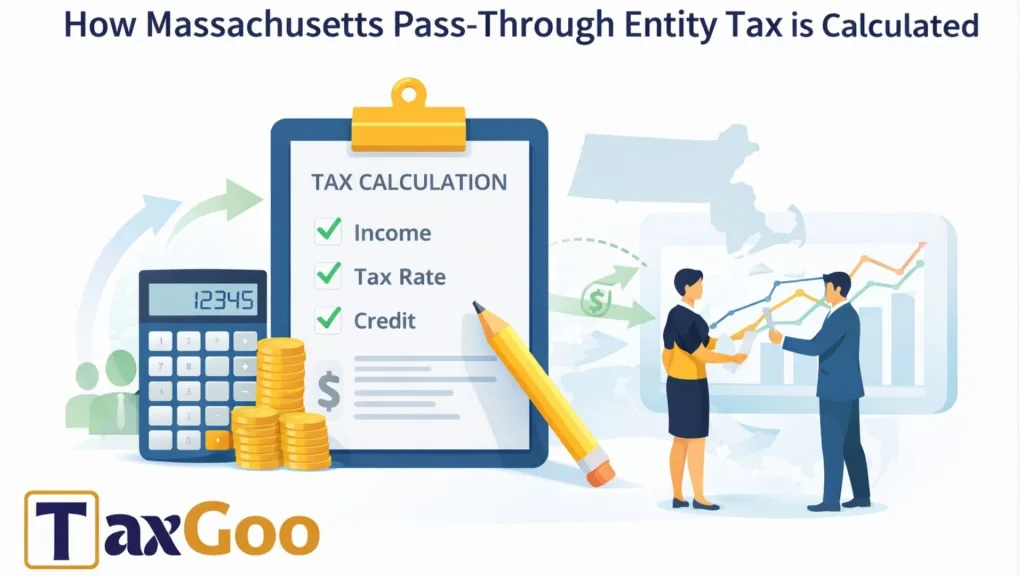
The Massachusetts PTE Excise is generally 5% of the entity income that passes through to qualified members and is subject to tax under Chapter 62. For resident qualified members, the calculation generally includes 100% of their applicable income, while for nonresident qualified members, the income is taken into account only to the extent it is apportioned to Massachusetts using the entity’s Massachusetts apportionment percentage.
Guaranteed payments are included in the computation where applicable, and the entity must determine which members are qualified members and which portion of income is actually subject to the excise. If some owners are corporations, the entity also has to identify the portion of income attributable to those corporate owners because that income is not subject to the PTE Excise.
Credit For Owners
Qualified members of an electing Massachusetts pass-through entity are generally allowed a personal income tax credit equal to 90% of their pro rata share of the PTE Excise paid by the entity. Massachusetts guidance and third-party summaries describe this credit as refundable.
That 90% credit is a major feature of the regime because it is what prevents the entity-level payment from simply becoming an extra layer of tax. Still, the rules do not create a full 100% offset, so businesses often need to model the economics carefully before electing.tax.
Election And Filing Rules
The election is annual and must be made by an eligible pass-through entity on an original, timely filed return, including extensions. Once the election is made for the year, it is irrevocable and binding on all owners of the entity for that tax year.
Massachusetts materials indicate that electing entities make the election through their return and related state filing procedures, and some summaries note filing forms such as Form 3, Form 355S with Schedule S, or Form 2, along with Form 63D-ELT. Businesses should match the filing method to their entity type and current Department of Revenue instructions before submitting the election.
Planning Considerations
The Massachusetts Pass-Through Entity Tax can be attractive for owners looking to improve the federal tax treatment of state taxes in light of the SALT cap. But the benefit varies depending on ownership mix, Massachusetts apportionment, resident versus nonresident status, and whether the entity has owners that are corporations or other nonqualified members.
It also does not replace other compliance rules. Massachusetts says pass-through withholding requirements and estimated personal income tax requirements can still apply, although withholding and estimated payments may take the PTE credit into account. That means businesses should not assume the election wipes out all separate owner-level planning or filing obligations.

FAQs
What Is The Massachusetts PTE Tax?
It is an elective 5% entity-level excise for eligible pass-through entities on income subject to Massachusetts personal income tax.
Who Qualifies For The Election?
Partnerships, S corporations, certain LLCs taxed as partnerships or S corporations, and certain trusts may qualify.
Do Owners Get A Credit?
Yes, qualified members generally receive a Massachusetts personal income tax credit equal to 90% of their pro rata share of the excise paid.
Is The Election Automatic?
No, it must be made annually on a timely filed original return, including extensions.