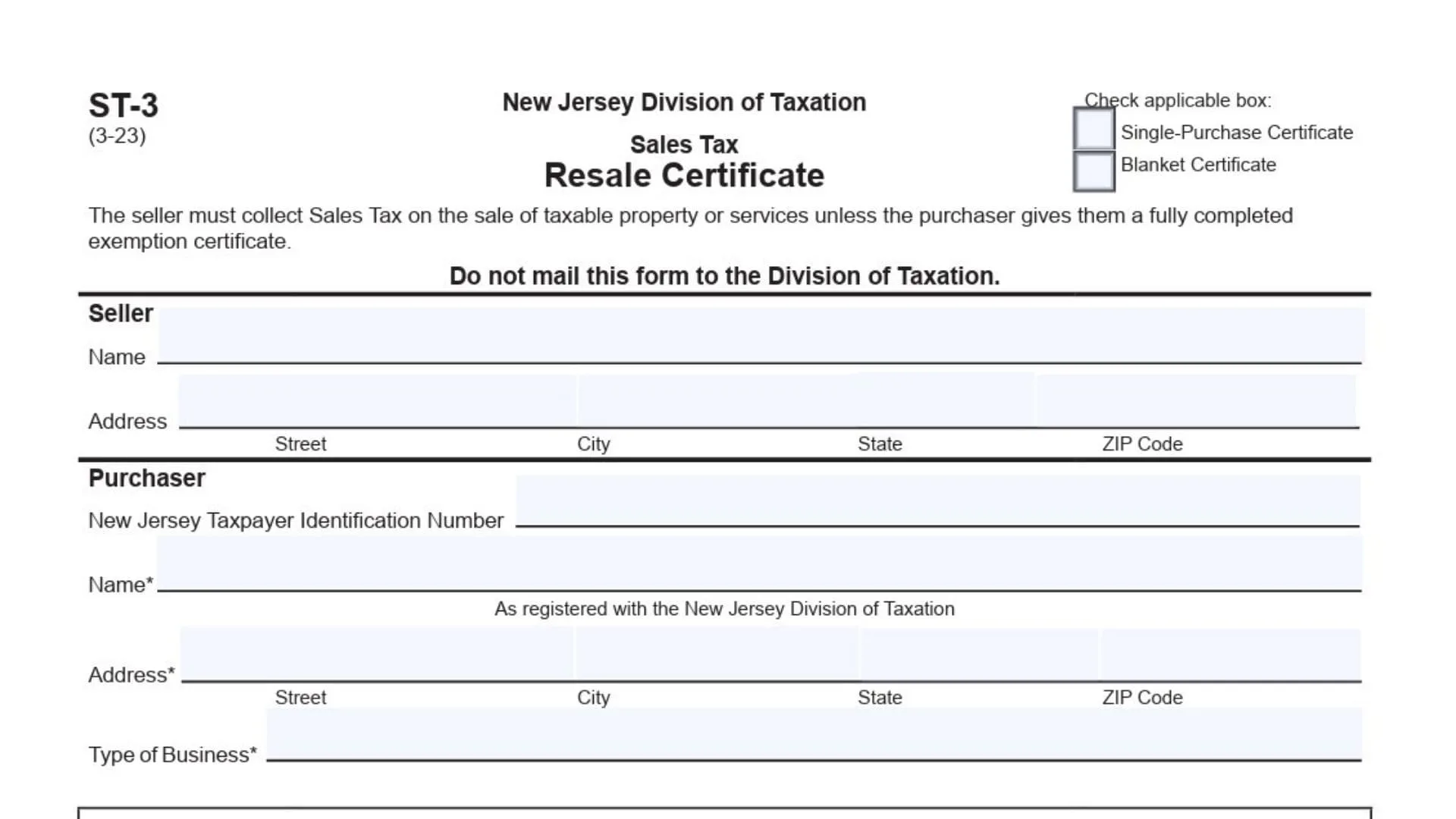
New Jersey Form ST-3 is a resale certificate used when a buyer purchases taxable goods or certain taxable services for resale instead of for personal or business use. The form allows the purchaser to certify that the seller should not charge New Jersey Sales Tax on that transaction because the item or service is being bought for resale, for incorporation into a product that will later be sold, or for use in performing a taxable service in a way that becomes part of the customer’s property or is later transferred to that customer. In simple terms, this form helps prevent Sales Tax from being charged twice in the chain of commerce. The buyer gives the completed certificate to the seller, and the seller keeps it in their records as support for not collecting tax. This form is not something you file with the state as a routine submission for each transaction. Instead, it is a document that must be properly completed and handed to the seller at the time of purchase or within the allowed timeframe. It only works when the purchaser is eligible to use it, and it must be filled out carefully because a missing detail, a vague description, or an improper use can lead to tax problems later. Businesses commonly use this form when buying inventory for resale, raw materials that become part of products for sale, or qualifying items used in taxable repair or service work. It is an important document for retailers, wholesalers, manufacturers, and some service businesses that regularly buy items without paying tax because those items will be resold or passed along in a taxable transaction.
How To File New Jersey ST3 Resale Certificate
You generally do not file Form ST-3 with the state. Instead, you complete it and give it to the seller from whom you are purchasing taxable property or services for resale. The seller must keep the certificate in their records to support the tax-exempt treatment of the sale.
If you are using it for one transaction only, mark it as a single-purchase certificate. If you expect to make repeated purchases of the same general type from the same seller, you may use it as a blanket certificate by choosing that option at the top. When used as a blanket certificate, later invoices or sales slips tied to that certificate should identify the purchaser clearly.
The form should be completed in full before the seller accepts it. If the certificate is incomplete, the seller may have to charge Sales Tax. For practical purposes, this means the purchaser should review every field, provide a valid New Jersey taxpayer identification number, explain the nature of the business, describe what is being bought, and sign and date the certification.

How To Complete New Jersey ST3 Form
Before you begin, gather your business name exactly as registered, your New Jersey taxpayer identification number, your business address, the seller’s information, and a clear description of what you are buying and why it qualifies for resale treatment. Be specific. General or sloppy wording can create confusion and increase the chance the seller rejects the form.
You should also decide whether the purchase is a one-time transaction or part of an ongoing purchasing relationship. That choice affects the checkbox at the top of the form and how the certificate may be used later.
New Jersey ST3 Form Line By Line Instructions
Line 1: At the top of the form, choose whether the certificate is for a Single-Purchase Certificate or a Blanket Certificate. Select Single-Purchase if the certificate applies to just one transaction. Select Blanket if it will cover repeated purchases of the same general kind from the same seller over time.
Line 2: Enter the seller’s name. This should be the legal business name of the company or person selling the property or service to you.
Line 3: Enter the seller’s address on the street line. Use the seller’s business street address, not a vague location description.
Line 4: Enter the seller’s city. Write the city that belongs with the seller’s address.
Line 5: Enter the seller’s state. Use the proper state abbreviation if appropriate.
Line 6: Enter the seller’s ZIP Code. Make sure it matches the seller’s business mailing address.
Line 7: Enter the purchaser’s New Jersey Taxpayer Identification Number. This is a key part of the certificate. It identifies the buyer as a registered New Jersey taxpayer authorized to collect Sales and Use Tax.
Line 8: Enter the purchaser’s name exactly as registered with the New Jersey Division of Taxation. Do not use a shortened trade label or informal business nickname unless that is the registered name.
Line 9: Enter the purchaser’s street address. This should be the business address connected to the purchaser.
Line 10: Enter the purchaser’s city. Use the city for the purchaser’s business address.
Line 11: Enter the purchaser’s state. Use the correct state abbreviation if needed.
Line 12: Enter the purchaser’s ZIP Code. Double-check accuracy so the address is complete.
Line 13: Enter the Type of Business. Describe the nature of the purchaser’s business in a straightforward way, such as clothing retailer, furniture manufacturer, auto repair shop, electronics reseller, or another accurate business category. Keep it specific enough to show why the resale claim makes sense.
Line 14: Review the certification statement that says the purchaser holds a valid authority to collect New Jersey Sales and Use Tax. By signing the form, the purchaser is confirming this statement is true. There is nothing to fill in on this numbered item, but you should not sign the form unless it accurately describes your status.
Line 15: Complete the section asking what the purchaser is principally engaged in selling. Describe the type of property or service your business normally sells. For example, you might enter household appliances, office furniture, motor vehicle repair services, computer accessories, or restaurant equipment. Be direct and clear.
Line 16: Complete the section describing the property or services being purchased. Identify what you are buying in enough detail for the seller to understand the transaction. Instead of writing merchandise or supplies, use specific wording such as wooden dining chairs, replacement brake pads, packaged beauty products, or mobile phone screen repair parts.
Line 17: In the section about how the property is being purchased, check all boxes that apply. Choose the option for resale in present form if you are buying the item to resell it as is. Choose the option for resale as converted into or as a component part of a product if the item will become part of something you manufacture or produce for sale. Choose the service-related property option if the item will be used in performing a taxable service on personal property and will become part of the serviced item or later be transferred to the customer in connection with that service.
Line 18: In the section about services being purchased, check the box that fits your situation. Choose the first option if you are buying services and will either charge tax on them or resell those services. Choose the second option if the services will be performed on personal property that is held for sale.
Line 19: Read the purchaser’s certification paragraph carefully. This paragraph states that the purchaser has followed the rules for using a resale certificate, believes the seller is not required to collect Sales or Use Tax on the covered transaction, and is making the statement under penalty of perjury and false swearing. There is no blank to complete within the paragraph itself, but understanding it is essential before signing.
Line 20: Enter the Print Name of the person signing the certificate. This should be the individual who has authority to act for the business.
Line 21: Sign on the Authorized Signature line. The signer must be an authorized person, such as an owner, partner, or corporate officer.
Line 22: Enter the signer’s Title. Examples include Owner, Partner, President, Treasurer, Member, or another title showing authority to sign for the business.
Line 23: Enter the Date the certificate is signed. Use the actual signing date, not the invoice date unless they are the same.
How To Use The Form Correctly
A properly completed ST-3 should be given to the seller, who must keep it on file. The seller can generally rely on it if it is complete and received within the required time. For that reason, the purchaser should make sure the certificate is not missing any required information.
This form is appropriate when the purchase truly qualifies for resale treatment. Common examples include a retail store buying inventory for sale, a manufacturer buying materials that will become part of finished goods, or a repair business buying parts that will be transferred to customers as part of taxable repair work.
It is not appropriate for items your business uses itself, even if your business also sells similar items. Office equipment, cleaning supplies, business tools, and materials used to improve your own premises are typical examples of purchases that generally do not belong on a resale certificate. Contractors also need to be careful, because this form is not the right certificate for every type of purchase they make.
Blanket Certificate Rules
If you use the form as a blanket certificate, it can cover future purchases of the same general kind from the same seller when you have an ongoing business relationship. This is useful for businesses that buy inventory or qualifying items regularly from one vendor.
A recurring relationship generally means purchases continue without a long gap between transactions. Once the blanket certificate is in place, later purchase records should clearly show the purchaser’s name, address, and identification number so the transactions can be matched back to the certificate.
Recordkeeping And Practical Tips
Sellers should keep the certificate in their records for the required retention period. Purchasers should also keep a copy for their own files in case a seller later asks questions or a transaction needs to be verified.
To avoid rejection or audit issues, use complete business names, provide a correct New Jersey taxpayer identification number, and write detailed descriptions instead of broad labels. If one section does not apply, make sure your other entries still clearly support why the purchase qualifies. A well-completed ST-3 is precise, readable, and logically connected to the buyer’s actual business activity.