
If you run a business in the Beaver State, understanding Oregon Corporate Income Tax is essential for staying compliant, managing cash flow, and avoiding unnecessary tax surprises. Oregon corporate income tax applies to many corporations doing business in Oregon, earning Oregon-source income, or maintaining a taxable presence in the state, and it plays a major role in overall business tax planning for companies of all sizes. Whether you operate a traditional C corporation, manage a multistate company with Oregon sales, or are simply researching Oregon business tax requirements before expanding, it helps to know how Oregon corporate excise tax, Oregon corporate income tax rates, nexus rules, minimum tax obligations, filing thresholds, apportionment rules, and Oregon Department of Revenue requirements fit together. Business owners often search for answers about Oregon corporate tax return filing, Oregon corporate excise tax vs income tax, Oregon corporation minimum tax, Oregon state business taxes, and who must file in Oregon, and for good reason, because the rules can differ depending on where a corporation is organized and whether it is actively doing business in the state. In simple terms, Oregon taxes corporate activity through a system that generally distinguishes between corporations doing business in Oregon and corporations that only have Oregon-source income, so knowing which category applies can save time, money, and stress.
What Oregon Corporate Income Tax Means
Oregon generally imposes tax on corporations through two related systems:
- Corporate excise tax, usually for corporations doing business in Oregon.
- Corporate income tax, generally for corporations with Oregon-source income but not doing business in Oregon.
This distinction matters because the filing requirement depends on the corporation’s connection to the state. If a company has enough activity, sales, employees, property, or operational presence in Oregon, it may be considered to be doing business there and could fall under the excise tax framework. If it earns income from Oregon sources without actively doing business in the state, the income tax framework may apply instead.
In everyday use, many people refer to both systems broadly as Oregon corporate income tax, even though Oregon law separates them for technical purposes.
Who Needs To File
A corporation may need to file in Oregon if it:
- Is doing business in Oregon.
- Has income from Oregon sources.
- Is incorporated in Oregon.
- Has sufficient nexus with the state.
- Is part of a unitary group with Oregon taxable activity.
This often includes corporations that:
- Sell goods or services into Oregon.
- Maintain employees, inventory, or offices in Oregon.
- Own or lease property in the state.
- Receive income tied to Oregon operations or customers.
- Participate in multistate business structures that allocate income to Oregon.
For multistate businesses, nexus is especially important. A corporation does not always need a full office in Oregon to trigger tax obligations. Economic activity alone can sometimes create a filing requirement, depending on the facts.
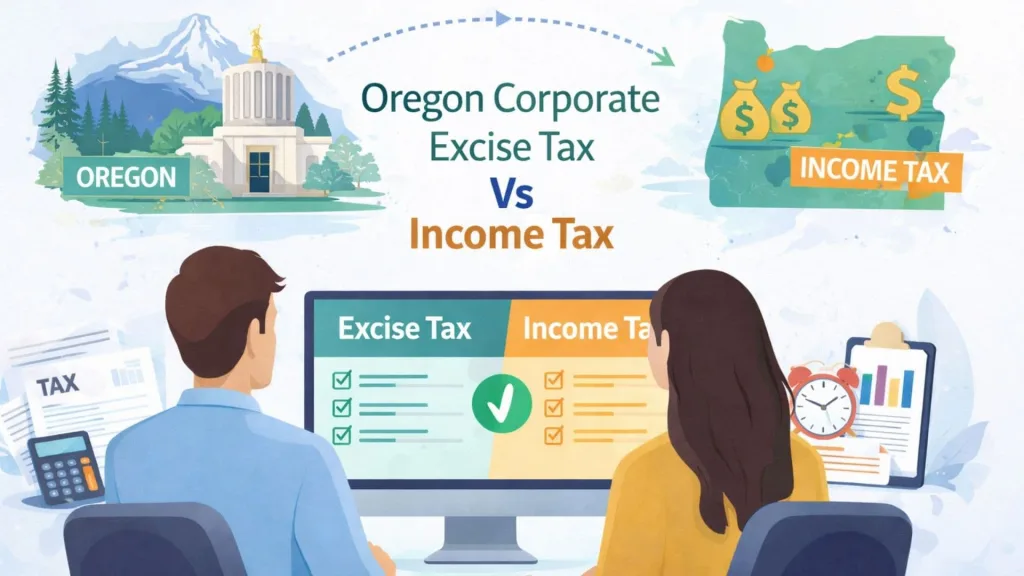
Oregon Corporate Excise Tax Vs Income Tax
The easiest way to understand the difference is this:
- A corporation doing business in Oregon is generally subject to the corporate excise tax.
- A corporation not doing business in Oregon but receiving Oregon-source income is generally subject to the corporate income tax.
This distinction can affect:
- Which return is filed.
- How taxable income is calculated.
- Whether the corporation owes a minimum tax.
- How Oregon views the company’s state-level tax presence.
For many operating corporations, the excise tax is the more common issue. Still, companies with passive or limited in-state income should not assume they are exempt from Oregon filing obligations.
Oregon Corporate Income Tax Rates
Oregon taxes C corporations using a structure that includes both a tax on Oregon taxable income and, for many corporations subject to excise tax, a minimum tax based on Oregon sales.
In general, Oregon’s corporate tax system includes:
- A tax rate of 6.6% on the first $1 million of taxable income.
- A tax rate of 7.6% on taxable income above $1 million.
For corporations subject to Oregon corporate excise tax, the tax is often the greater of:
- The calculated tax on taxable income, or
- The Oregon minimum tax based on Oregon sales.
Because thresholds and administrative guidance can change, businesses should verify current return instructions and Department of Revenue rules before filing.
Oregon Minimum Tax
One of the most talked-about parts of Oregon business taxation is the corporate minimum tax. This matters even when taxable income is low, because the corporation may still owe tax based on Oregon sales.
The minimum tax generally applies to corporations subject to Oregon corporate excise tax, and it scales upward as Oregon sales increase. This means a company with modest profit but significant Oregon sales may still face a meaningful state tax bill.
That catches some businesses off guard. They assume low profit means low tax, but Oregon’s structure can produce a different result.

How Oregon Taxable Income Is Determined
Oregon corporate taxable income often begins with federal taxable income, then adjusts for state-specific additions, subtractions, and allocation rules. After that, multistate corporations typically apply apportionment formulas to determine how much income Oregon can tax.
Key factors may include:
- Federal taxable income.
- Oregon additions and subtractions.
- Apportionment of business income.
- Allocation of nonbusiness income, if applicable.
- Net operating loss considerations.
- Credits allowed under Oregon law.
For many businesses, the apportionment formula is a major planning point because it determines the share of total income that is taxable in Oregon.
Apportionment For Multistate Businesses
If a corporation operates in more than one state, Oregon generally uses an apportionment method to assign part of the company’s income to Oregon. In many cases, this relies heavily on sales.
This becomes especially important for companies that:
- Sell remotely into Oregon.
- Operate e-commerce businesses.
- Provide digital or professional services across state lines.
- Have customers in several states.
- Use a centralized business model with distributed revenue sources.
A simple example helps. If a company earns income nationwide but a portion of its taxable sales are assigned to Oregon, that Oregon share may be used to calculate its Oregon taxable income.
Publicly Traded Corporations And Unitary Groups
Large businesses often file as part of a unitary group, meaning related entities engaged in a common enterprise may need to report income together. Oregon’s combined reporting approach can affect:
- Taxable income calculation.
- Apportionment percentages.
- Intercompany transactions.
- Filing complexity.
- Overall tax liability.
This is one reason corporate state taxation can become technical quickly. A business with multiple related entities should usually review Oregon filing rules carefully before preparing its return.
Filing Requirements And Deadlines
Corporations subject to Oregon tax generally must file an Oregon corporate return by the applicable due date, usually tied to the federal corporate filing calendar. Estimated tax payments may also be required during the year.
Important filing points include:
- Filing the correct Oregon corporate return.
- Meeting annual due dates.
- Making estimated tax payments if required.
- Reporting Oregon-source income accurately.
- Keeping records that support apportionment and deductions.
Missing a deadline can lead to penalties and interest, so compliance matters just as much as tax calculation.

Estimated Tax Payments
Corporations expecting to owe enough Oregon tax may need to make quarterly estimated payments. This helps the state collect tax throughout the year and helps businesses avoid underpayment penalties.
Estimated tax planning is useful for:
- Businesses with fluctuating revenue.
- Seasonal companies.
- Growing corporations entering Oregon for the first time.
- Multistate businesses with changing apportionment factors.
If your Oregon activity is increasing, it is smart to revisit estimated payment obligations before the next filing cycle sneaks up.
Common Issues Businesses Face
Businesses dealing with Oregon corporate income tax often run into the same questions:
- Does selling into Oregon create nexus?
- Is the company subject to excise tax or income tax?
- How is Oregon sales factor sourcing determined?
- Does the minimum tax apply even with little or no profit?
- How should a multistate corporation apportion income?
- Are combined reporting rules relevant?
These questions matter because small classification errors can lead to underreporting or overpaying. Neither outcome is ideal.
Tax Planning Considerations
Smart planning can reduce confusion and help corporations stay compliant. Useful areas to review include:
- Whether the corporation has Oregon nexus.
- How revenue is sourced to Oregon.
- Whether the business is subject to minimum tax.
- Entity structure and filing status.
- Estimated payment obligations.
- Recordkeeping for sales, payroll, and property.
- State tax exposure from remote operations.
For expanding businesses, Oregon should be part of the state tax conversation early, not after the return is already due.
Oregon Corporate Income Tax And Remote Business Activity
Remote work and digital commerce have made state tax rules more relevant than ever. A company can have meaningful Oregon tax exposure without opening a storefront in Portland or setting up a warehouse in Salem.
For example, a corporation that sells software subscriptions to Oregon customers, uses remote employees based in Oregon, or generates recurring service revenue from the state may need to examine:
- Nexus standards.
- Oregon-source income rules.
- Apportionment treatment.
- Registration and filing obligations.
That is why modern businesses should look beyond physical location and focus on economic reality.
Records To Keep
Good documentation makes Oregon tax compliance much easier. Businesses should retain:
- Federal and Oregon tax returns.
- Financial statements.
- Sales records by state.
- Payroll and contractor records.
- Property and lease documentation.
- Workpapers supporting apportionment.
- Correspondence related to Oregon tax notices.
Strong records help support your position if questions come up later.
Penalties And Compliance Risks
Failing to comply with Oregon corporate tax requirements can create:
- Late filing penalties.
- Late payment penalties.
- Interest on unpaid tax.
- Extra administrative burden.
- Potential notices or audits.
Even if the amount at issue is not huge, the cleanup process can be frustrating. It is usually cheaper and easier to get the filing right the first time.

Final Thoughts On Oregon Corporate Income Tax
Oregon corporate income tax is not just a line item on a return, it is a compliance issue that touches nexus, apportionment, sales sourcing, minimum tax rules, and filing obligations for corporations with Oregon activity. Businesses that understand the difference between corporate excise tax and corporate income tax, monitor their Oregon sales, and keep solid records are in a much better position to manage state tax exposure confidently.
FAQs
Who Pays Oregon Corporate Income Tax?
Corporations with Oregon-source income or business activity in Oregon may need to file and pay tax.
Is Oregon Corporate Excise Tax The Same As Income Tax?
No. Excise tax usually applies to corporations doing business in Oregon, while income tax generally applies to corporations with Oregon-source income but no in-state business activity.
Does Oregon Have A Corporate Minimum Tax?
Yes. Many corporations subject to excise tax may owe a minimum tax based on Oregon sales.
Do Remote Sellers Need To Worry About Oregon Tax?
Yes. Remote sales, Oregon customers, or employees in the state can create tax obligations.