
An overpayment from previous year is the portion of a prior federal tax overpayment that you chose to apply to the following year’s estimated income tax instead of receiving as a refund. You may also see it described as a prior-year overpayment, estimated tax credit from the previous year, refund applied to next year, tax overpayment carried forward, or amount applied from a prior return. Although the wording can make it sound like a deduction or a special tax credit, it is actually money you already paid to the IRS through paycheck withholding, quarterly estimated tax payments, refundable credits, or other federal tax payments. When those payments exceeded the tax shown on your prior return, you could request the excess as a refund, apply it to the next tax year, or split it between both options. If you carried some or all of the amount forward, it becomes part of your estimated tax payments for the current year and can reduce the balance you owe when you file. Understanding how the amount moves between tax years is especially important for freelancers, independent contractors, sole proprietors, landlords, investors, gig workers, and anyone else who pays quarterly estimated taxes.
What Is An Overpayment From The Previous Year?
An overpayment from the previous year is money from your last federal income tax return that was transferred to the current tax year as an estimated tax payment.
For example, suppose your 2024 tax return showed a $4,000 overpayment. You asked the IRS to refund $1,500 and apply the remaining $2,500 to your 2025 estimated tax.
The $2,500 becomes an overpayment from the previous year on your 2025 return. It is combined with other estimated payments you made for 2025 and helps cover your final federal tax liability.
The amount is not new income, and it is not a deduction. It is a payment credit created by money you previously sent to the IRS.
How A Previous-Year Overpayment Is Created
A federal tax overpayment occurs when your total payments and refundable credits are greater than the tax you owe for the year.
The excess may result from:
- Too much federal income tax withheld from your paycheck
- Estimated tax payments that exceeded your final liability
- A large refundable tax credit
- Tax withheld from retirement or investment income
- A payment submitted with a filing extension
- A duplicate or additional federal tax payment
- Lower income or higher deductions than expected
- An overpayment created by an amended return
When completing the prior-year return, you decide how the excess should be handled. You may receive it as a refund or instruct the IRS to apply an amount toward the following year’s estimated tax.
The amount becomes a previous-year overpayment only when it is credited forward.
Where To Find The Amount On Your Tax Return
Look at the refund and overpayment section of your prior federal return.
For example, on the 2025 Form 1040:
- Line 34 shows the total overpayment.
- Line 35a shows the portion requested as a refund.
- Line 36 shows the amount applied to 2026 estimated tax.
When preparing the following year’s return, the amount carried forward is included with your estimated tax payments.
On the 2025 Form 1040, line 26 includes estimated federal income tax payments made for 2025 and any overpayment applied from a 2024 original or amended return.
The exact line numbers can change in future versions of the form, so always review the instructions for the tax year you are filing.
Is An Overpayment The Same As A Refund?
No. An overpayment is the amount by which your payments and refundable credits exceed your tax liability.
A refund is the portion of that overpayment returned to you.
You may have a $5,000 overpayment but receive only a $2,000 refund because you applied the other $3,000 toward next year’s estimated tax. You could also receive less if part of the refund was used to pay an eligible outstanding debt.
A prior-year overpayment is therefore not an additional refund. It is the portion that was intentionally moved into the next tax year.
How It Affects Your Current Tax Return
The carried-forward amount is treated as a federal estimated tax payment for the current year.
It increases your total payments on the return. Those payments are compared with your final federal tax liability to determine whether you:
- Owe a balance
- Have paid the exact amount due
- Have another overpayment
- Qualify for a refund
Consider this example:
- Current federal tax liability: $12,000
- Federal income tax withheld: $5,000
- Quarterly estimated payments: $4,000
- Overpayment carried forward from last year: $2,500
- Total payments: $11,500
- Remaining balance: $500
Without the prior-year overpayment, the remaining balance would have been $3,000. The transferred credit reduces it to $500.
Does It Count As An Estimated Tax Payment?
Yes. A prior-year overpayment applied to the current year is included with estimated federal income tax payments.
This matters because the U.S. tax system generally requires taxpayers to pay taxes throughout the year through withholding, estimated payments, or both.
A carried-forward overpayment can help cover taxes on income that is not subject to regular withholding, including:
- Self-employment income
- Freelance and contract earnings
- Rental income
- Interest and dividends
- Capital gains
- Prizes and awards
- Certain retirement distributions
- Business profits
- Gig economy income
However, the credit may not cover your full estimated tax obligation. You should still calculate whether additional quarterly payments are required.
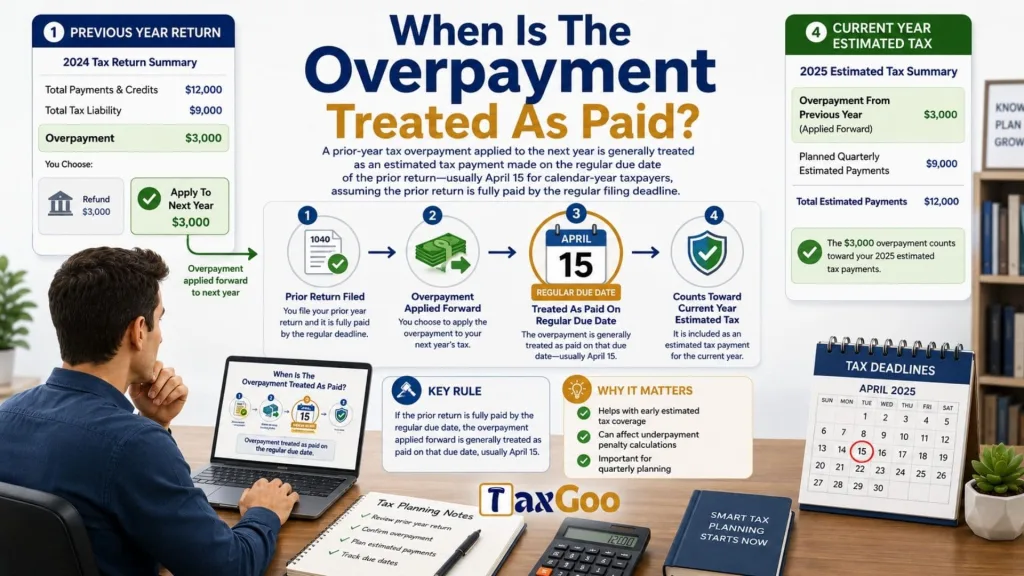
When Is The Overpayment Treated As Paid?
For estimated tax penalty calculations, the timing of the carried-forward credit can matter.
When a prior return is fully paid before the regular filing deadline, an overpayment elected for the next year is generally treated as an estimated tax payment made on the regular due date of the prior return. For a calendar-year individual taxpayer, that date is usually April 15.
This means the transferred credit normally helps with the earliest estimated tax period. It does not automatically spread itself evenly across every quarterly installment.
Taxpayers using annualized income calculations or dealing with a potential underpayment penalty should review Form 2210 carefully or consult a qualified tax professional.
Can It Reduce An Estimated Tax Penalty?
It can help, but it does not guarantee that no penalty will apply.
The IRS may assess an estimated tax underpayment penalty when you did not pay enough tax during the year or did not pay enough by the required installment dates.
A previous-year overpayment can reduce that risk because it counts toward your current estimated tax payments. Whether it is enough depends on factors such as:
- Your current tax liability
- Your prior-year tax
- Your adjusted gross income
- Federal withholding
- Other estimated payments
- The timing of payments
- Whether your income was earned evenly during the year
Many taxpayers avoid the penalty by meeting an applicable safe harbor based on the current year’s tax or the previous year’s tax. The detailed calculation can vary, especially for higher-income taxpayers, farmers, fishermen, and people whose income changed significantly during the year.
Can You Get The Carried-Forward Amount Back?
Once you elect to apply a federal overpayment to the following year’s estimated tax, the IRS generally treats that election as final.
You normally cannot contact the IRS a few months later and simply ask it to convert the amount into a refund because you changed your mind or need the cash.
Instead, the credit remains on the next year’s tax account. If your total payments eventually exceed your tax liability, the unused amount may become part of another overpayment when you file that year’s return.
At that point, you may request a refund or apply it forward again.
This is why you should estimate your next year’s income and tax needs before choosing to carry a large amount forward.
Can You Apply Only Part Of An Overpayment?
Yes. You may divide an overpayment between a refund and the next year’s estimated tax.
Suppose your return shows a $6,000 overpayment. You could choose to:
- Receive the entire $6,000 as a refund
- Apply the entire $6,000 to next year
- Receive $4,000 and apply $2,000 forward
- Use another combination that fits your financial needs
Splitting the amount can be helpful when you want immediate cash while also preparing for future estimated payments.
Why The Amount May Be Missing From Your Return
A missing previous-year overpayment can happen for several reasons.
It Was Requested As A Refund
Review your prior return carefully. You may have requested the entire overpayment as a refund rather than applying part of it forward.
The Amount Was Entered Incorrectly
The carried-forward amount may have been omitted or typed incorrectly when preparing the current return.
Compare the amount on the prior return with the current-year estimated tax section.
The IRS Changed The Prior Return
The IRS may have corrected a math error, disallowed a credit, adjusted income, or made another change that reduced the original overpayment.
You should receive a notice explaining a significant adjustment.
The Overpayment Was Used For Another Debt
The federal government may use an overpayment to cover certain eligible debts before applying the remaining amount as requested.
This could reduce or eliminate the credit available for the new tax year.
The IRS Could Not Apply It
The IRS may issue a CP45 notice when it could not apply an overpayment to the next year’s estimated taxes as requested.
The notice should explain what happened. You may need to update your records and adjust the estimated payments you plan to make.
The Payment Was Posted Under Different Information
A payment or credit may be harder to match if there was a name change, an incorrect Social Security number, a filing-status change, or a change involving a spouse.
How To Verify A Prior-Year Overpayment
Start with the copy of the prior federal tax return you filed.
Check the line showing the amount applied to the next year’s estimated tax. Do not rely only on the total overpayment or expected refund because those figures may be different.
Next, review:
- Your IRS Online Account
- Your tax account transcript
- Any IRS adjustment notices
- Any refund offset notice
- Your tax software records
- The confirmation from your tax preparer
- Estimated payment records for the current year
Your account transcript may help show credits, adjustments, payments, and transfers recorded by the IRS.
If the IRS records do not match the filed return, contact the IRS using the number shown on the relevant notice or ask a qualified tax professional to review the account.
How To Enter It In Tax Software
Most tax preparation programs ask a question similar to:
“Did you apply any of last year’s refund to this year’s estimated taxes?”
Enter only the amount that was actually applied forward. Do not enter:
- The total prior-year refund
- The total prior-year overpayment before the refund was subtracted
- A state tax overpayment on the federal return
- The total estimated payments made during the current year
- A tax credit carryforward
- A capital loss carryforward
The software should combine the transferred overpayment with your other estimated federal payments and place the total on the appropriate line of Form 1040.
Keep a copy of the prior return available while answering the interview questions.
Federal And State Overpayments Are Separate
A federal overpayment and a state income tax overpayment belong to separate tax systems.
An amount applied from your prior federal return is reported on your current federal return. An overpayment applied by a state is generally reported only on that state’s current return.
Do not combine the two amounts.
State forms, line numbers, deadlines, and rules vary. Review the instructions from the appropriate state tax agency.
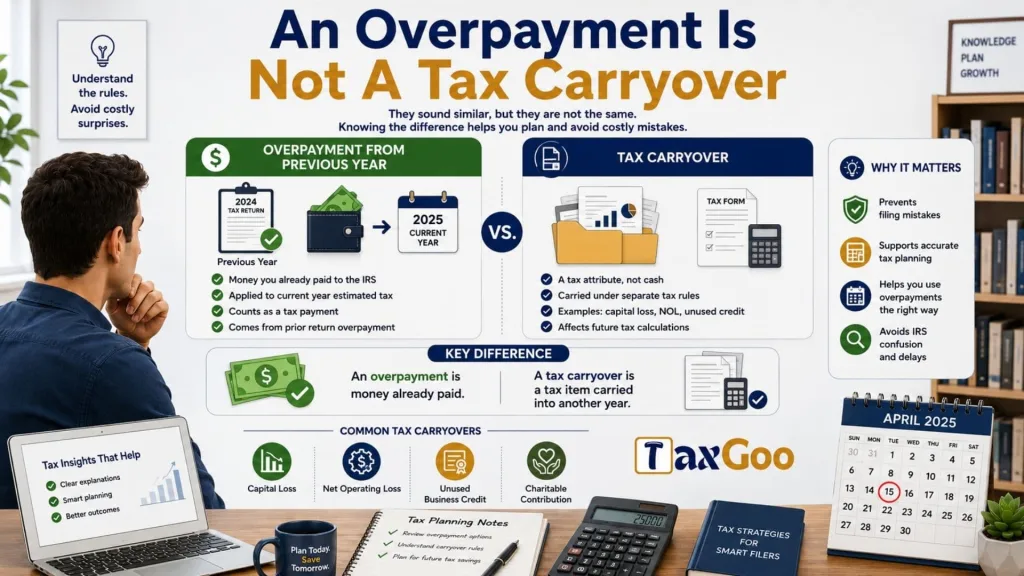
An Overpayment Is Not A Tax Carryover
The phrase “overpayment from previous year” is sometimes confused with other items carried between tax years.
It is not the same as:
- A capital loss carryover
- A net operating loss carryforward
- An unused business credit
- A charitable contribution carryover
- A foreign tax credit carryover
- A passive activity loss
- A prior-year refund
- A prior-year balance due
Those items involve separate calculations and tax rules. A previous-year overpayment is simply money credited toward the current tax year.
What Happens If The Prior Return Is Amended?
An amended return can increase or decrease a previous-year overpayment.
If an amended prior-year return creates an additional overpayment and that amount is applied to the current year’s estimated tax, include the applied amount with current estimated payments.
If an amendment reduces an overpayment that was previously carried forward, your current-year estimated tax credit may also be reduced. That could create a larger balance or affect an underpayment calculation.
Do not assume that the amount from the original return remains correct after an amendment or IRS adjustment.
What If You Change Filing Status?
Changes involving marriage, divorce, or separate returns can make previous-year payments more complicated.
For example, spouses may have made joint estimated payments in the prior year but file separate returns for the current year. They may need to determine how the payments and carried-forward credit should be divided.
The IRS provides specific rules for dividing joint estimated payments when spouses cannot agree. Name changes and Social Security number mismatches can also affect how a payment is posted.
These situations deserve careful review because claiming the full credit on more than one return can create delays or IRS correspondence.
How To Avoid Confusion Next Year
Keep a year-round record of every federal tax payment.
Your records should include:
- Estimated tax payment dates
- Payment confirmation numbers
- Amounts paid through IRS Direct Pay
- Electronic Federal Tax Payment System records
- Extension payments
- Federal withholding forms
- The amount applied from the prior year
- Copies of IRS notices
- Your filed federal return
If you regularly receive a large overpayment, review your withholding or estimated tax calculations.
Employees can check federal withholding and submit a new Form W-4 when appropriate. Self-employed taxpayers can update their estimated tax calculations as income, deductions, and credits change.
The goal is to pay enough during the year without unnecessarily sending far more than you expect to owe.
Example Of An Overpayment From Previous Year
Jordan is an independent web designer. His 2024 federal return showed an overpayment of $7,000 because his quarterly payments were based on higher expected profits.
Jordan requested a $3,000 refund and applied $4,000 to his 2025 estimated tax.
During 2025, he also made three additional estimated payments of $2,000 each. His total estimated tax payments reported for 2025 are:
- Previous-year overpayment: $4,000
- Current-year estimated payments: $6,000
- Total estimated payments: $10,000
Jordan’s final federal tax liability is $11,200. After adding any withholding and other eligible payments, the carried-forward amount helps determine whether he owes money or receives another refund.
The $4,000 is not taxed again. It is simply credited as money already paid.
Common Mistakes To Avoid
Do not enter the full prior-year refund as an estimated payment. Only use the amount specifically applied to the current year.
Do not claim the same amount twice by including it as both a refund and a carried-forward payment.
Do not combine federal and state overpayments.
Do not assume your tax software automatically knows the amount when you switch software providers or prepare the return on a different account.
Do not ignore an IRS notice that changes the prior-year overpayment.
Finally, do not reduce your current estimated payments until you confirm that the carried-forward credit was actually accepted and posted.
Final Thoughts
An overpayment from previous year is a federal tax payment that moved from your prior return into the current year because you chose to apply it toward estimated taxes. It can lower your current balance, contribute toward required estimated payments, and help reduce the risk of underpayment, but it must be reported accurately.
Check the prior return, confirm the amount applied forward, compare it with IRS records, and include it with current estimated tax payments. When the amount is missing, adjusted, connected to a joint return, or affected by an amended return, review the details before filing. A tax professional can help when the credit is large or the IRS account history is unclear.

Frequently Asked Questions
Is A Previous-Year Overpayment Taxable Income?
No. It is generally money you already paid to the IRS, not new income.
Where Do I Report It?
Include it with estimated federal tax payments on the current Form 1040.
Is It The Same As Last Year’s Refund?
No. It is the portion of the overpayment applied forward instead of refunded.
Can I Claim The Full Prior-Year Overpayment?
Only claim the amount that was actually applied to the current tax year.
Can I Change It To A Refund Later?
The election to apply it forward generally cannot be changed after filing.
Does It Replace Quarterly Estimated Payments?
Not always. Calculate whether additional payments are still required.
What Is A CP45 Notice?
It means the IRS could not apply the overpayment as you requested.
Can An Amended Return Create This Credit?
Yes. An overpayment from an amended return may be applied to estimated tax.
Are Federal And State Overpayments Combined?
No. Report each amount on the return for the government that received it.
What If My Tax Software Does Not Show It?
Review the prior return and enter the applied amount in the estimated tax payment section.