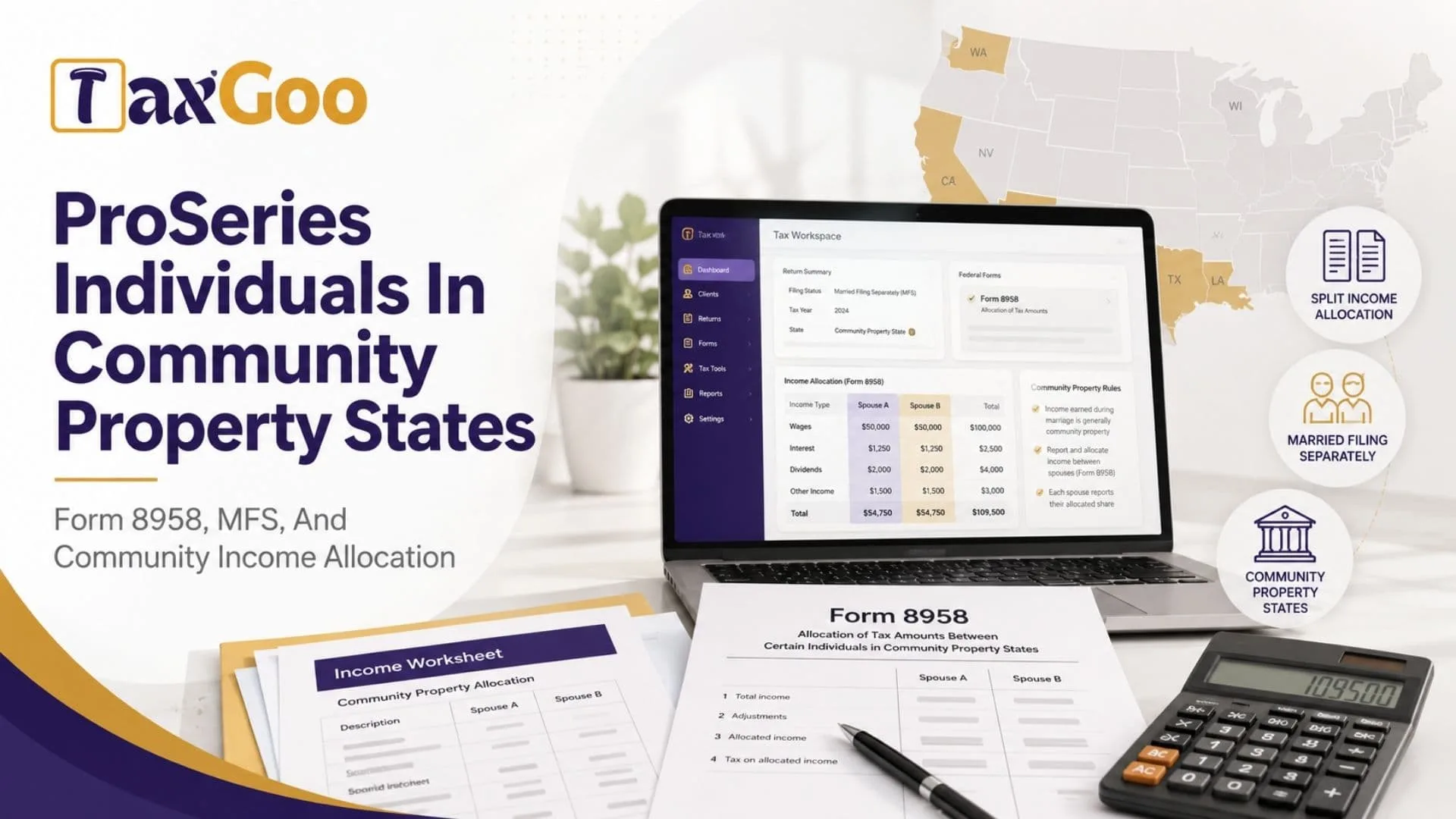
When tax preparers search for ProSeries individuals in community property states, they are usually trying to solve one big problem, how to correctly prepare an individual return when community property rules affect income, deductions, and withholding. This topic often comes up when a married couple lives in a community property state and files separate returns, or when registered domestic partners in certain states must allocate tax items under federal rules. In these cases, the return is not just about entering W-2s and 1099s. It also involves dividing community income, identifying separate income, and reporting the right figures on Form 8958, Allocation of Tax Amounts Between Certain Individuals in Community Property States. According to the IRS, Publication 555 explains how community property laws affect federal income tax reporting, and Form 8958 is used to show how income, deductions, credits, and withholding are allocated between certain individuals in community property states. The IRS also lists the community property states as Arizona, California, Idaho, Louisiana, Nevada, New Mexico, Texas, Washington, and Wisconsin. Intuit also provides ProSeries help content tied to Form 8958, which shows how central this form is when working inside the software. In short, this is a return-prep issue that combines tax law, software workflow, and careful review before filing.
What Are Community Property States?
Community property states are states where certain income and property acquired during marriage may belong equally to both spouses.
For federal tax purposes, this matters most when spouses file separately. Instead of each spouse simply reporting only what appears under their own name, some items may need to be split under community property rules.
The IRS lists these nine community property states:
- Arizona
- California
- Idaho
- Louisiana
- Nevada
- New Mexico
- Texas
- Washington
- Wisconsin
Publication 555 is the main IRS resource for understanding these rules. It explains how community income, separate income, community property, and separate property can affect a federal return.
Why This Matters In ProSeries
ProSeries users need to know when the software return also needs a community property allocation.
The software helps prepare the return, but the tax law still controls the reporting. That means the preparer must understand which items are community and which are separate before finalizing the numbers.
Intuit’s ProSeries help center includes Form 8958 support content, which confirms that this form is a key part of the workflow for affected returns.
In plain terms, ProSeries can assist with return preparation, but the preparer still needs to enter, allocate, and review the data carefully.

What Is Form 8958?
Form 8958 is the IRS form used to allocate tax amounts between certain individuals in community property states.
The IRS says this form is used to determine the allocation of tax amounts between married filing separate spouses or registered domestic partners with community property rights.
This form becomes important when the return includes:
- Wages
- Interest
- Dividends
- Business income
- Deductions
- Federal withholding
- Credits that may need to be split
The form helps show how much belongs to the taxpayer and how much belongs to the spouse or partner.
Who Usually Needs This?
This issue often comes up when married taxpayers file separately in a community property state.
It can also apply to registered domestic partners in certain states. IRS Publication 555 notes that Form 8958 is used by married spouses in community property states who choose to file married filing separately. It is also used by registered domestic partners who are domiciled in Nevada, Washington, or California.
This means the return may be simple in one way, but still require extra work because income allocation rules apply.
Common Items That Need Attention
The hardest part is often figuring out which numbers must be split and which stay separate.
Income earned during the marriage may be community income. Separate property income can depend on state law and the facts of the case. Publication 555 is helpful because it explains these rules in more detail.
Tax preparers often need to pay close attention to:
- Wages from each spouse
- Self-employment income
- Interest and dividends
- Rental income
- IRA deductions
- Federal income tax withheld
- State tax issues tied to filing status
Even when the source document shows one spouse’s name, part of the item may still need to be allocated.
Helpful Tips For Using ProSeries
A careful workflow can save time and reduce mistakes.
Start by gathering complete records for both spouses or partners. Review the filing status first. Then identify which items are community and which are separate under the rules that apply.
Next, prepare the return inputs with allocation in mind. If Form 8958 is required, make sure the figures used there match the numbers on the actual return. Then review withholding, because this is one of the most common spots where numbers get entered incorrectly.
Finally, compare the completed return to your allocation workpapers. A clean review at the end can catch mismatches before filing.
Common Mistakes To Avoid
Most problems happen when preparers rush the allocation step.
A common mistake is assuming each spouse simply reports the forms issued in their own name. Another mistake is forgetting to attach Form 8958 when it is required.
Preparers also run into trouble when they do not separate community items from separate items, or when they split income but forget to split withholding consistently. That can lead to confusing results and possible notices later.
The IRS specifically instructs taxpayers to attach Form 8958 to the separate return showing how the reported items were figured.

Frequently Asked Questions
What Is Form 8958 Used For?
It is used to allocate tax amounts between certain individuals in community property states.
Do Community Property Rules Matter For MFS Returns?
Yes. They often matter a lot when married taxpayers file separately in a community property state.
Does ProSeries Support Form 8958?
Yes. Intuit provides ProSeries help content related to Form 8958.
Which States Are Community Property States?
Arizona, California, Idaho, Louisiana, Nevada, New Mexico, Texas, Washington, and Wisconsin.