
A PTO policy for salaried employees is more than a list of vacation days—it’s the playbook for how paid time off, vacation, sick leave, personal days, and sometimes floating holidays work for exempt employees (often called salaried/exempt) and the managers who approve time away. It should answer the real-world questions employees actually have: How much PTO do I get? Does it accrue or reset? What happens if I take a half-day? Can the company require PTO during office closures? Do unused hours roll over? Is there a payout at termination? And how do you handle unlimited PTO without turning it into “unlimited guilt”? In this article, we’ll cover common policy formats (accrual vs. front-loaded vs. unlimited), best practices for approval workflows and coverage expectations, compliance considerations that pop up for salaried staff, and the small wording choices that prevent confusion—so your PTO rules support rest and retention instead of becoming a recurring Slack argument.
What “Salaried” Means In A PTO Policy (And Why It Gets Confusing)
Many organizations use “salaried” to mean “paid a set amount per pay period,” but PTO policies often intersect with exempt vs. nonexempt status (especially in the U.S.). That distinction matters because employers typically want to:
- Track time away for planning and fairness
- Avoid accidental pay-deduction mistakes for exempt employees
- Keep benefits consistent across teams
Key point: A strong PTO policy doesn’t rely on informal assumptions like “salaried people don’t track time.” It clearly states what must be recorded (full days, partial days, scheduled hours), what needs approval, and what happens when workloads spike.
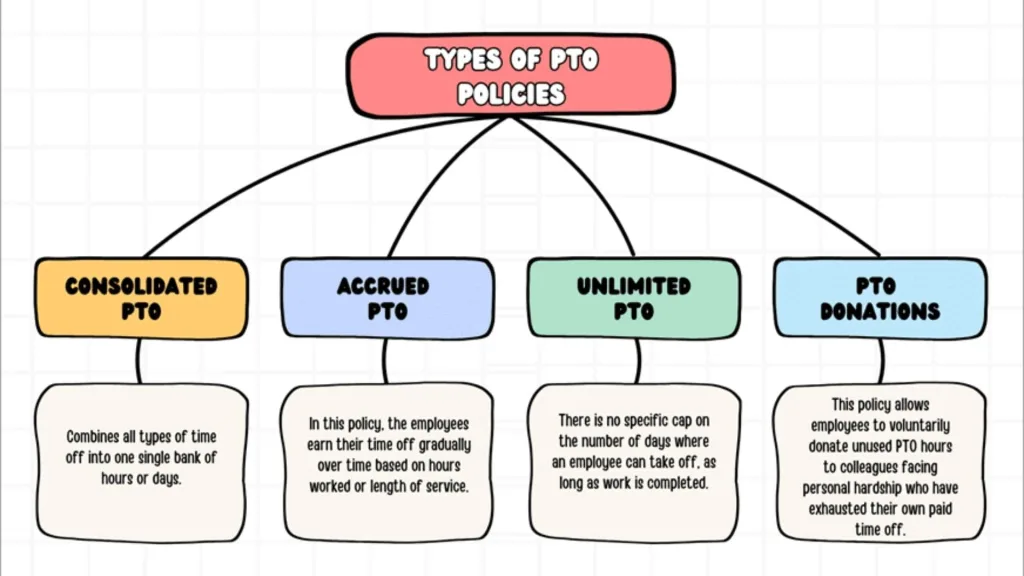
Common PTO Policy Structures For Salaried Employees
Different companies choose different structures depending on culture, industry, and operational needs. Here are the main models you’ll see:
Accrued PTO (Earn-As-You-Go)
Employees earn PTO each pay period (or monthly). This approach:
- Feels “earned” and predictable
- Makes it easier to define maximum balances
- Fits well with payroll systems and reporting
It can also lead to employees hoarding time or feeling like they must “save” PTO for emergencies unless you encourage usage.
Front-Loaded PTO (Banked At The Start Of The Year)
A full PTO allotment is granted at the start of the year (or on an anniversary). This approach:
- Is easy for employees to understand
- Encourages taking time off earlier
- Reduces administrative friction
Companies often add rules for mid-year hires and may address what happens if someone leaves after using more PTO than they “would have accrued.”
Unlimited PTO (Trust-Based Time Off)
Unlimited PTO can work well with mature leadership, clear workload planning, and strong performance management. Done right, it:
- Signals trust
- Supports flexibility and autonomy
- Simplifies accrual bookkeeping
Done poorly, it can result in employees taking less time off due to unclear norms. A good “unlimited” policy still sets expectations, like recommended minimum days and blackout periods if needed.
Split Banks (Vacation + Sick) Vs. Combined PTO
Some companies keep vacation and sick leave separate; others combine them into one PTO bank. Combined PTO is simple, but separate banks can better support health-related leave norms and legal requirements in some jurisdictions.
Core Elements Every Salaried PTO Policy Should Include
A PTO policy becomes much easier to apply when it explicitly covers the “boring but important” details.
Eligibility And Coverage
Define:
- Who is eligible (full-time, part-time, temporary, interns)
- When PTO begins (immediately, after 30/60/90 days)
- Any differences by role level or tenure
How Time Off Is Requested And Approved
Include:
- Where requests are submitted (HRIS, email, manager tool)
- Notice expectations (e.g., 2 weeks for planned vacation)
- Approval rules (first-come/first-served, staffing coverage, peak seasons)
Minimum Increments (Full Day, Half Day, Hourly)
Salaried teams often struggle with “Do I need to log an hour for a dentist appointment?”
Decide and document:
- Whether partial-day PTO is tracked
- The smallest unit used (1 hour, 2 hours, half-day)
Clarity here prevents resentment and inconsistent manager behavior.
Carryover, Rollover, And Caps
Common options:
- No carryover (use-it-or-lose-it)
- Limited rollover (carry up to X hours/days)
- Accrual caps (stop earning once you hit a maximum balance)
Your choice affects employee behavior. If you want people to rest, ensure the rules don’t punish taking time off.
PTO During Company Closures And Holidays
Address:
- Fixed holidays (company paid holidays)
- Office closures (winter break, shutdown week)
- Whether closures require employees to use PTO
Payout At Separation (Resignation Or Termination)
State whether unused PTO is paid out, and how it’s calculated. This can be influenced by local law, so keep policy language aligned with where employees work.

Best Practices That Make PTO Actually Work
A PTO policy can be perfectly written and still fail if the culture undermines it. These practices help:
- Publish norms, not just rules: “Most employees take at least X days per year.”
- Encourage managers to model time off: People follow the behavior they see rewarded.
- Plan coverage, don’t guilt-trip: Require handoff notes and backup owners for key tasks.
- Use blackout periods sparingly: If everything is a blackout period, morale will notice.
- Track burnout signals: High balances can signal people aren’t taking time off.
Compliance And Risk Notes (Keep It Simple, Keep It Safe)
Because laws vary by country and, in the U.S., by state and locality, companies should align the PTO policy with applicable rules on:
- Paid sick leave requirements
- Final pay and PTO payout rules
- Recordkeeping expectations
- Exempt pay rules and permissible deductions
Practical suggestion: If your workforce is multi-state or global, write a core PTO policy and attach location addenda rather than forcing one set of rules everywhere.
Sample PTO Policy Language (Short And Adaptable)
Below is lightweight wording you can customize:
- Accrual Example: “Eligible salaried employees accrue PTO each pay period and may use accrued PTO upon approval.”
- Request Example: “Requests should be submitted at least 10 business days in advance for planned absences of 3+ consecutive workdays.”
- Minimum Use Example: “PTO may be taken in one-hour increments.”
- Carryover Example: “Up to 40 hours of unused PTO may carry over into the next calendar year.”
- Unlimited Guardrail Example: “Unlimited PTO is subject to manager approval and business needs; employees are encouraged to take a minimum of 15 days per year.”
How To Choose The Right PTO Model For Your Team
Ask these questions:
- Do we need predictable staffing coverage (client work, on-call, production schedules)?
- Do we want to reduce liabilities on the balance sheet (accrued PTO can become a financial liability)?
- Is management consistent enough to run unlimited PTO fairly?
- Are we optimizing for retention, hiring competitiveness, or operational simplicity?
The “best” policy is the one employees understand, managers apply consistently, and payroll/HR can administer without constant exceptions.
FAQs
Do Salaried Employees Have To Track PTO?
Often yes—many companies track PTO for planning, fairness, and compliance, even if employees are salaried.
What’s Better: Accrued PTO Or Unlimited PTO?
It depends on your culture and operations: accrued PTO is predictable and easy to administer, while unlimited PTO needs strong norms and consistent managers to stay fair.
Should PTO Include Sick Time For Salaried Employees?
Some companies combine them into one PTO bank for simplicity, but others separate sick time to encourage employees to take time off when ill and to meet local requirements.
Can A Company Require PTO During A Shutdown Week?
Many do, but the policy should clearly explain how closures work and whether employees must use PTO or receive paid closure days.