IRS Schedule K-1 is an information return used to report a person’s share of income, deductions, credits, and other tax items from a pass-through entity or fiduciary arrangement. Instead of paying tax at the entity level in the same way a regular C corporation generally does, a partnership, S corporation, estate, or trust often passes tax items through to the people connected to it. The Schedule K-1 tells the recipient and the IRS what portion of the year’s tax items belongs to that specific partner, shareholder, or beneficiary. This form matters because it connects the entity’s return to the individual or business return of the person receiving the K-1, helping that person report income correctly, claim deductions where allowed, and apply credits or special tax treatments based on the nature of the item. A Schedule K-1 is not a stand-alone tax return for the recipient. It is a reporting schedule that supports the main return filed by the partnership, S corporation, estate, or trust. The details on the form may also affect basis, passive activity reporting, self-employment tax treatment, capital gain reporting, foreign tax reporting, alternative minimum tax items, and several other follow-up forms or schedules. Because of that, each line should be completed carefully, matched to the entity’s books and tax return, and supported by attached statements whenever a line requires additional breakdowns or coded items.
How To File IRS Schedule K-1 Tax Forms
The filing process depends on which K-1 is being prepared, but the overall approach is similar. First, complete the main entity return, because the K-1 amounts come from that return and from the entity’s year-end records. Next, prepare a separate Schedule K-1 for each partner, beneficiary, or shareholder who must receive one. Fill in all identifying information, ownership or allocation details, and every income, deduction, credit, and informational item that applies to that person. If a line requires additional codes, explanations, or activity-level detail, include an attached statement. After that, provide the K-1 to the recipient and submit it with the related entity return according to the filing rules that apply to that return. If the original K-1 needs correction, mark it as amended. If it is the last year the entity, estate, or trust will issue a K-1 to that person, mark it as final when the form calls for that designation.
Form 1065 Schedule K-1, Partnership
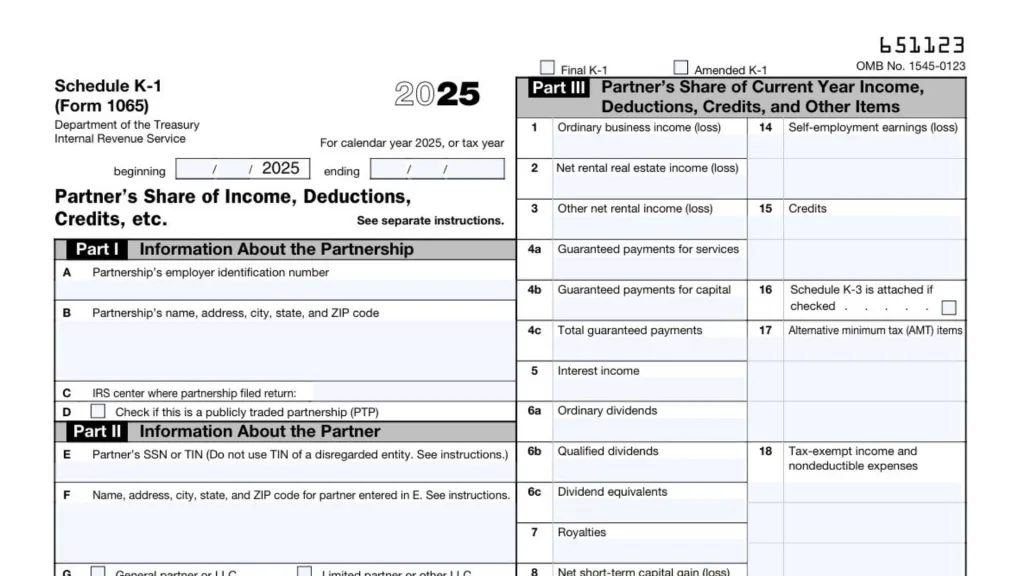
Form 1065 Schedule K-1 is used by a partnership to report each partner’s share of the partnership’s tax items for the year. It shows the partner’s identifying details, ownership percentages, liability share, capital account activity, and allocated amounts for income, deductions, credits, distributions, foreign tax items, and other special information. A separate Schedule K-1 is prepared for each partner. The information on this schedule is based on the partnership’s books, tax return, and allocation rules under the partnership agreement and tax law.
How To Complete Form 1065 Schedule K-1
Part I, Information About The Partnership
Line A: Enter the partnership’s employer identification number exactly as it appears on the partnership return.
Line B: Enter the partnership’s full legal name and complete mailing address, including city, state, and ZIP code.
Line C: Enter the IRS center where the partnership filed its return.
Line D: Check this box if the partnership is a publicly traded partnership.
Part II, Information About The Partner
Line E: Enter the partner’s Social Security number or taxpayer identification number. Do not enter the tax number of a disregarded entity in place of the partner’s own reporting number.
Line F: Enter the name and full address of the partner whose identifying number appears on Line E.
Line G: Check the box that matches the partner’s status. Use the general partner or LLC member-manager box when that description fits. Use the limited partner or other LLC member box when that status applies.
Line H1: Check whether the partner is domestic or foreign.
Line H2: If the partner is a disregarded entity, enter the partner’s tax identification number and name in the spaces provided.
Line I1: State the type of entity the partner is, such as an individual, corporation, partnership, trust, estate, or another eligible entity classification.
Line I2: Check the box if the partner is a retirement plan, such as an IRA, SEP, Keogh, or a similar arrangement.
Line J: Enter the partner’s share of profit, loss, and capital at the beginning and end of the tax year. Use percentages that reflect the partner’s interest under the partnership’s allocation rules. If there was a decrease because of a sale or exchange of the partnership interest, check the appropriate box.
Line K1: Enter the partner’s share of liabilities at the beginning and end of the year. Report nonrecourse liabilities, qualified nonrecourse financing, and recourse liabilities in the proper spaces.
Line K2: Check this box if the liability amounts shown in Line K1 include liabilities from lower-tier partnerships.
Line K3: Check this box if any of the liabilities reported above are subject to guarantees or other payment obligations by the partner.
Line L: Complete the partner’s capital account analysis. Enter the beginning capital account, capital contributed during the year, current year net income or loss, other increases or decreases, withdrawals and distributions, and ending capital account. If there is an entry for other increases or decreases, attach an explanation.
Line M: Check Yes or No to show whether the partner contributed property that had a built-in gain or built-in loss at the time of contribution. If Yes applies, attach the required statement.
Line N: Enter the partner’s share of net unrecognized Section 704(c) gain or loss at the beginning and end of the year.
Part III, Partner’s Share Of Current Year Income, Deductions, Credits, And Other Items
Line 1: Enter the partner’s share of ordinary business income or ordinary business loss from partnership operations.
Line 2: Enter the partner’s share of net rental real estate income or loss.
Line 3: Enter the partner’s share of other net rental income or loss that does not belong on the rental real estate line.
Line 4a: Enter guaranteed payments made to the partner for services.
Line 4b: Enter guaranteed payments made to the partner for the use of capital.
Line 4c: Enter total guaranteed payments. This should reflect the combined amount of the guaranteed payments categories reported above.
Line 5: Enter the partner’s share of interest income.
Line 6a: Enter the partner’s share of ordinary dividends.
Line 6b: Enter the partner’s share of qualified dividends.
Line 6c: Enter dividend equivalents if applicable.
Line 7: Enter the partner’s share of royalty income.
Line 8: Enter the partner’s share of net short-term capital gain or loss.
Line 9a: Enter the partner’s share of net long-term capital gain or loss.
Line 9b: Enter the partner’s share of collectibles gain or loss subject to the 28 percent rate rules.
Line 9c: Enter the partner’s share of unrecaptured Section 1250 gain.
Line 10: Enter the partner’s share of net Section 1231 gain or loss.
Line 11: Enter other income or loss that does not fit one of the earlier income lines. Provide an attached statement when more detail is needed.
Line 12: Enter the partner’s Section 179 deduction amount.
Line 13: Enter other deductions that are separately stated. Use an attached statement when the deductions must be identified by type or code.
Line 14: Enter self-employment earnings or loss for the partner.
Line 15: Enter credits allocated to the partner. Attach supporting detail if more than one credit or coded item applies.
Line 16: Check the box if Schedule K-3 is attached.
Line 17: Enter alternative minimum tax items that must be separately reported to the partner.
Line 18: Enter tax-exempt income and nondeductible expenses in the proper categories so the partner can track basis and other tax effects.
Line 19: Enter distributions made to the partner during the year.
Line 20: Enter other information that must be separately reported. Include a statement if the item requires codes, explanations, or special reporting instructions.
Line 21: Enter foreign taxes paid or accrued that are allocable to the partner.
Line 22: Check this box if the partner has more than one activity for at-risk purposes, and provide the necessary attached statement.
Line 23: Check this box if the partner has more than one activity for passive activity purposes, and provide the necessary attached statement.
Form 1041 Schedule K-1, Estate Or Trust Beneficiary
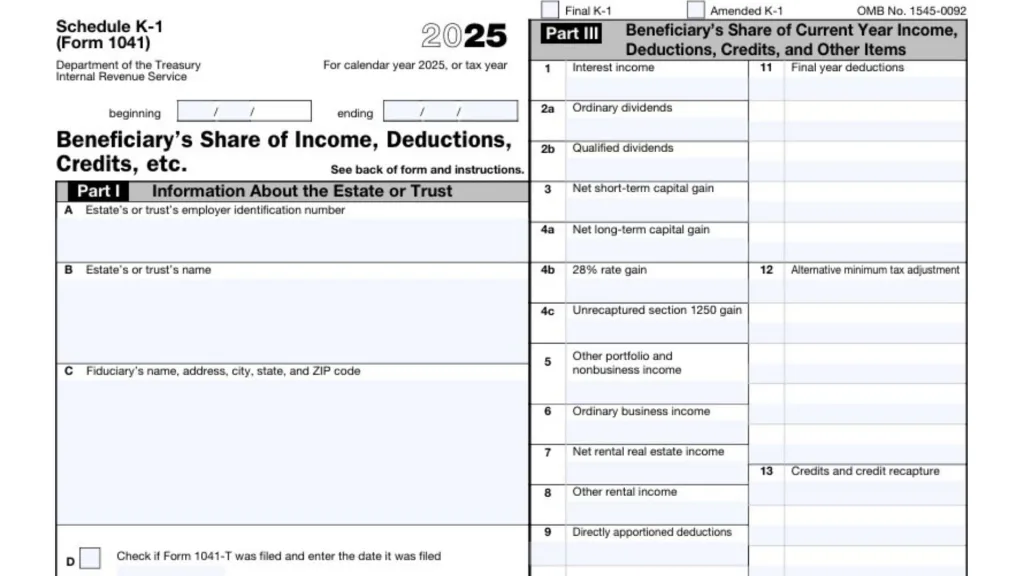
Form 1041 Schedule K-1 is used by an estate or trust to report a beneficiary’s share of income, deductions, credits, and other tax items for the year. It shows what portion of the estate’s or trust’s taxable items is allocated or distributed to that beneficiary. It also tells the beneficiary what kinds of items they may need to report on their own tax return, including ordinary income items, capital gain items, deductions, tax-exempt amounts, credits, and special informational entries. A separate Schedule K-1 is prepared for each beneficiary receiving reportable items.
How To Complete Form 1041 Schedule K-1
Part I, Information About The Estate Or Trust
Line A: Enter the estate’s or trust’s employer identification number.
Line B: Enter the legal name of the estate or trust.
Line C: Enter the fiduciary’s name and complete mailing address, including city, state, and ZIP code.
Line D: Check the box if Form 1041-T was filed, then enter the date it was filed.
Line E: Check the box if this is the final Form 1041 for the estate or trust.
Part II, Information About The Beneficiary
Line F: Enter the beneficiary’s identifying number.
Line G: Enter the beneficiary’s name and complete address, including city, state, and ZIP code.
Line H: Check whether the beneficiary is domestic or foreign.
Part III, Beneficiary’s Share Of Current Year Income, Deductions, Credits, And Other Items
Line 1: Enter the beneficiary’s share of interest income.
Line 2a: Enter the beneficiary’s share of ordinary dividends.
Line 2b: Enter the beneficiary’s share of qualified dividends.
Line 3: Enter the beneficiary’s share of net short-term capital gain.
Line 4a: Enter the beneficiary’s share of net long-term capital gain.
Line 4b: Enter the beneficiary’s share of 28 percent rate gain.
Line 4c: Enter the beneficiary’s share of unrecaptured Section 1250 gain.
Line 5: Enter other portfolio income or nonbusiness income that belongs to the beneficiary.
Line 6: Enter ordinary business income allocable to the beneficiary.
Line 7: Enter net rental real estate income allocable to the beneficiary.
Line 8: Enter other rental income allocable to the beneficiary.
Line 9: Enter directly apportioned deductions. Break these out by code and describe them clearly on the attached statement when necessary.
Line 10: Enter the estate tax deduction amount allocable to the beneficiary.
Line 11: Enter final year deductions if they apply in the last year of the estate or trust. Use the correct code or attached breakdown for each type of deduction or carryover.
Line 12: Enter alternative minimum tax adjustment items that must be separately reported to the beneficiary.
Line 13: Enter credits and credit recapture items using a clear breakdown if more than one credit applies.
Line 14: Enter other information that the beneficiary needs for tax reporting, basis tracking, investment interest limitation work, Section 199A reporting, foreign tax reporting, or other special tax treatment.
Codes For Line 9, Directly Apportioned Deductions
Line 9, Code A: Use this code for depreciation directly apportioned to the beneficiary.
Line 9, Code B: Use this code for depletion directly apportioned to the beneficiary.
Line 9, Code C: Use this code for amortization directly apportioned to the beneficiary.
Codes For Line 11, Final Year Deductions
Line 11, Code A: Use this code for excess deductions related to Section 67(e) expenses in the final year.
Line 11, Code B: Use this code for excess deductions that are non-miscellaneous itemized deductions in the final year.
Line 11, Code C: Use this code for a short-term capital loss carryover passed out in the final year.
Line 11, Code D: Use this code for a long-term capital loss carryover passed out in the final year.
Line 11, Code E: Use this code for a net operating loss carryover for regular tax purposes.
Line 11, Code F: Use this code for a net operating loss carryover for minimum tax purposes.
Codes For Line 12, Alternative Minimum Tax Adjustment
Line 12, Code A: Use this code for the adjustment for minimum tax purposes.
Line 12, Code B: Use this code for the AMT adjustment related to qualified dividends.
Line 12, Code C: Use this code for the AMT adjustment related to net short-term capital gain.
Line 12, Code D: Use this code for the AMT adjustment related to net long-term capital gain.
Line 12, Code E: Use this code for the AMT adjustment related to unrecaptured Section 1250 gain.
Line 12, Code F: Use this code for the AMT adjustment related to 28 percent rate gain.
Line 12, Code G: Use this code for accelerated depreciation.
Line 12, Code H: Use this code for depletion.
Line 12, Code I: Use this code for amortization.
Line 12, Code J: Use this code for exclusion items.
Codes For Line 13, Credits And Credit Recapture
Line 13, Code A: Use this code for credit for estimated taxes.
Line 13, Code B: Use this code for credit for backup withholding.
Line 13, Code C: Use this code for low-income housing credit.
Line 13, Code D: Use this code for advanced manufacturing production credit.
Line 13, Code E: Use this code for clean electricity production credit.
Line 13, Code F: Use this code for work opportunity credit.
Line 13, Code G: Use this code for credit for small employer health insurance premiums.
Line 13, Code H: Use this code for biofuel producer credit.
Line 13, Code I: Use this code for credit for increasing research activities.
Line 13, Code J: Use this code for renewable electricity production credit.
Line 13, Code K: Use this code for empowerment zone employment credit.
Line 13, Code L: Use this code for clean fuel production credit.
Line 13, Code M: Use this code for orphan drug credit.
Line 13, Code N: Use this code for credit for employer-provided childcare facilities and services.
Line 13, Code O: Use this code for biodiesel and renewable diesel fuels credit.
Line 13, Code P: Use this code for credit to holders of tax credit bonds.
Line 13, Code Q: Use this code for credit for employer differential wage payments.
Line 13, Code R: Use this code for recapture of credits.
Line 13, Code S: Use this code for credit for production from advanced nuclear power facilities.
Line 13, Code T: Use this code for zero-emission nuclear power production credit.
Line 13, Code ZZ: Use this code for other credits not separately listed in the earlier codes.
Codes For Line 14, Other Information
Line 14, Code A: Use this code for tax-exempt interest.
Line 14, Code B: Use this code for foreign taxes.
Line 14, Code C: Use this code for qualified rehabilitation expenditures.
Line 14, Code D: Use this code for basis of energy property.
Line 14, Code E: Use this code for net investment income.
Line 14, Code F: Use this code for gross farm and fishing income.
Line 14, Code G: Use this code for foreign trading gross receipts under Section 942(a).
Line 14, Code H: Use this code for adjustment for Section 1411 net investment income or deductions.
Line 14, Code I: Use this code for Section 199A information.
Line 14, Code J: Use this code for qualifying advanced coal project property and qualifying gasification project property.
Line 14, Code K: Use this code for qualifying advanced energy project property.
Line 14, Code L: Use this code for advanced manufacturing investment property.
Line 14, Code M: Use this code for clean electricity investment credit.
Line 14, Code ZZ: Use this code for other information that must be reported separately.
Form 1120-S Schedule K-1, S Corporation Shareholder
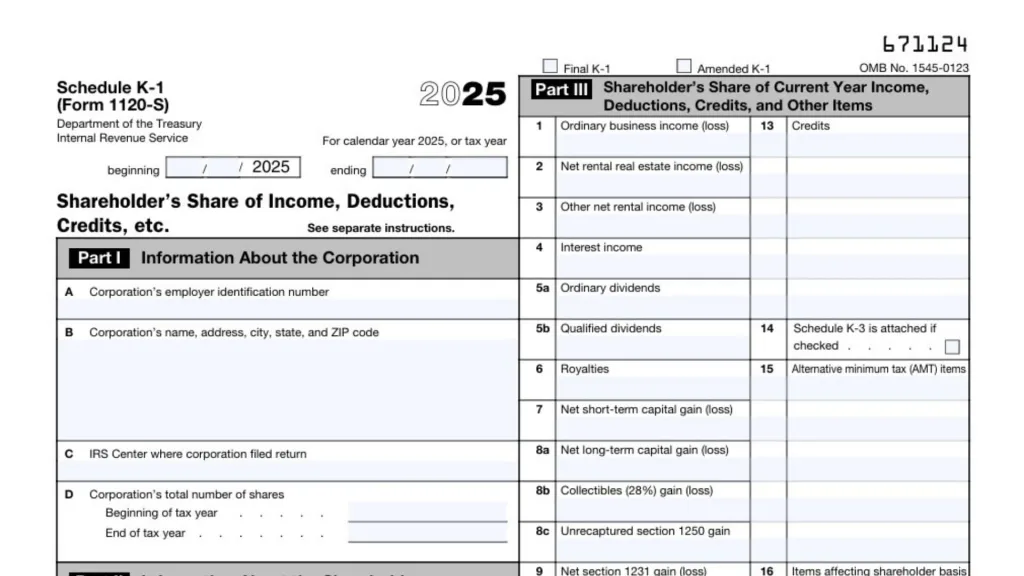
Form 1120-S Schedule K-1 is used by an S corporation to report each shareholder’s share of income, deductions, credits, and other tax items for the year. It identifies the shareholder, shows ownership information, and lists separately stated items that the shareholder may need for their personal or business tax return. Because an S corporation generally passes many tax items through to its shareholders, this form helps connect the corporation’s return to the shareholder’s own reporting. A separate Schedule K-1 is prepared for each shareholder.
How To Complete Form 1120-S Schedule K-1
Part I, Information About The Corporation
Line A: Enter the corporation’s employer identification number.
Line B: Enter the corporation’s legal name and complete mailing address, including city, state, and ZIP code.
Line C: Enter the IRS center where the corporation filed its return.
Line D: Enter the corporation’s total number of shares at the beginning of the tax year and at the end of the tax year.
Part II, Information About The Shareholder
Line E: Enter the shareholder’s identifying number.
Line F1: Enter the shareholder’s name and full mailing address, including city, state, and ZIP code.
Line F2: If the shareholder is a disregarded entity, trust, estate, nominee, or similar person, enter the tax identification number and name of the person or entity responsible for reporting the item.
Line F3: State the type of entity the shareholder is.
Line G: Enter the shareholder’s current year allocation percentage.
Line H: Enter the shareholder’s number of shares at the beginning of the tax year and at the end of the tax year.
Line I: Enter the amount of loans from the shareholder at the beginning of the tax year and at the end of the tax year.
Part III, Shareholder’s Share Of Current Year Income, Deductions, Credits, And Other Items
Line 1: Enter the shareholder’s share of ordinary business income or loss.
Line 2: Enter the shareholder’s share of net rental real estate income or loss.
Line 3: Enter the shareholder’s share of other net rental income or loss.
Line 4: Enter the shareholder’s share of interest income.
Line 5a: Enter the shareholder’s share of ordinary dividends.
Line 5b: Enter the shareholder’s share of qualified dividends.
Line 6: Enter the shareholder’s share of royalty income.
Line 7: Enter the shareholder’s share of net short-term capital gain or loss.
Line 8a: Enter the shareholder’s share of net long-term capital gain or loss.
Line 8b: Enter the shareholder’s share of collectibles gain or loss subject to the 28 percent rate rules.
Line 8c: Enter the shareholder’s share of unrecaptured Section 1250 gain.
Line 9: Enter the shareholder’s share of net Section 1231 gain or loss.
Line 10: Enter other income or loss not reported on an earlier line. Use an attached statement if more detail is needed.
Line 11: Enter the Section 179 deduction passed through to the shareholder.
Line 12: Enter other deductions that must be separately stated. Break them out by type when necessary.
Line 13: Enter credits allocated to the shareholder. Include supporting detail if multiple credits apply.
Line 14: Check the box if Schedule K-3 is attached.
Line 15: Enter alternative minimum tax items that must be separately stated to the shareholder.
Line 16: Enter items affecting shareholder basis.
Line 17: Enter other information that must be reported separately to the shareholder.
Line 18: Check this box if there is more than one activity for at-risk purposes, and include the needed detail in an attached statement.
Line 19: Check this box if there is more than one activity for passive activity purposes, and include the needed detail in an attached statement.