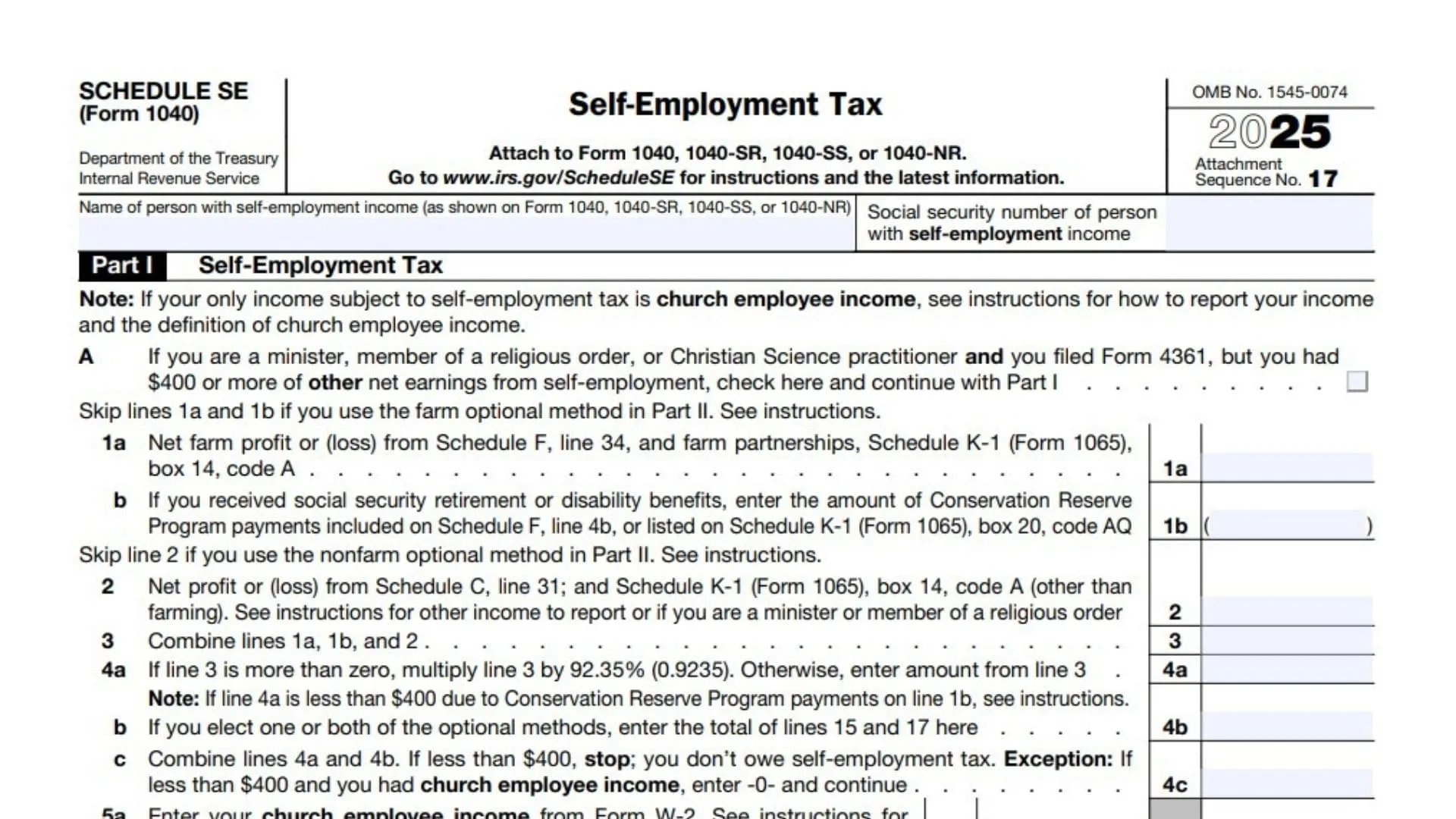
The IRS Schedule SE is a vital tax form used by independent contractors, freelancers, and small business owners to calculate their self-employment tax, which encompasses both Social Security and Medicare taxes. Unlike traditional employees whose employers withhold these taxes automatically from their paychecks, self-employed individuals must calculate and pay these obligations themselves based on their net earnings. If your net earnings from self-employment were $400 or more during the tax year, or if you earned church employee income of $108.28 or more, you are generally required to file this schedule alongside your Form 1040, 1040-SR, 1040-SS, or 1040-NR. Filing the Schedule SE is crucial not only for staying compliant with federal tax laws but also for ensuring that you are credited within the Social Security system, which ultimately determines your eligibility for retirement, disability, and survivor benefits. The form consists of two main sections: Part I for the standard calculation of self-employment tax, and Part II, which offers optional methods for figuring net earnings if your profits were unusually low or you operated at a loss.

How to Complete Schedule SE (Form 1040)
Part I: Self-Employment Tax Calculation
Before starting the numbered lines, you must provide your name exactly as it appears on your main tax return, along with the Social Security Number of the person who generated the self-employment income. There is also a checkbox labeled “A” near the top; you must check this box and proceed with Part I only if you are an ordained minister, a member of a religious order, or a Christian Science practitioner who previously filed Form 4361 for an exemption, but you still made $400 or more from other non-exempt self-employment work.
Line 1a: Record your net farm profit or loss. You will pull this number from Schedule F, line 34, or from box 14, code A of Schedule K-1 (Form 1065) if you are in a farming partnership. If you choose to use the Farm Optional Method located in Part II, you should leave this line blank.
Line 1b: If you currently receive Social Security retirement or disability benefits, you must enter the total amount of Conservation Reserve Program payments you received. You can find this amount on Schedule F, line 4b, or on your Schedule K-1 (Form 1065) in box 20, code AQ. Remember to format this number as a negative amount in the provided parentheses, as it will be subtracted from your total.
Line 2: Input your net profit or loss from any nonfarm business activities. This figure comes directly from Schedule C, line 31, or from Schedule K-1 (Form 1065), box 14, code A for nonfarm partnerships. If you are using the Nonfarm Optional Method in Part II, skip this line entirely.
Line 3: Combine the amounts you entered on lines 1a, 1b, and 2. Write the resulting total here. This figure represents your total net earnings or losses from all of your self-employment activities.
Line 4a: Determine your taxable self-employment earnings. If the total on line 3 is greater than zero, multiply that number by 92.35% (0.9235) and enter the result. If your line 3 amount is zero or less, simply carry that exact number over to this line.
Line 4b: This line is only for individuals utilizing the optional methods found in Part II. If you elected to use either the Farm Optional Method, the Nonfarm Optional Method, or both, you must add the totals from lines 15 and 17 together and enter the combined sum here.
Line 4c: Add the values from line 4a and line 4b. If the resulting sum is less than $400, you do not owe any self-employment tax, and you can stop filling out the form here. However, there is an exception: if your total is less than $400 but you earned church employee income, you must enter a zero on this line and continue to the next step.
Line 5a: Report any church employee income you earned. This amount will be listed on your Form W-2.
Line 5b: Calculate the taxable portion of your church income by multiplying the amount on line 5a by 92.35% (0.9235). If the calculated result falls below $100, enter a zero on this line.
Line 6: Add the totals from line 4c and line 5b. This final number represents your total net earnings subject to self-employment tax.
Line 7: This line is pre-filled with $176,100, which is the maximum amount of combined wages and self-employment earnings subject to Social Security tax for the 2025 tax year. You do not need to calculate anything for this line.
Line 8a: Enter the total amount of Social Security wages and tips you earned from standard employment, which can be found by adding boxes 3 and 7 on all your W-2 forms, plus any Tier 1 railroad retirement compensation. If this total is $176,100 or higher, you must skip lines 8b through 10 and proceed straight to line 11.
Line 8b: Document any unreported tips that are subject to Social Security tax. You will pull this figure directly from Form 4137, line 10.
Line 8c: Record any wages that are subject to Social Security tax as determined by Form 8919, line 10.
Line 8d: Combine the values from lines 8a, 8b, and 8c to find your total wages and tips already subject to Social Security tax.
Line 9: Subtract the total on line 8d from the maximum threshold on line 7 ($176,100). If the result is zero or a negative number, enter zero here and on line 10, then move directly to line 11.
Line 10: Compare the amounts on line 6 and line 9. Take the smaller of those two numbers and multiply it by 12.4% (0.124). This calculates the Social Security portion of your self-employment tax.
Line 11: Multiply the total net earnings from line 6 by 2.9% (0.029). This calculates the Medicare portion of your self-employment tax.
Line 12: Add the amounts from line 10 and line 11 together. This is your total self-employment tax owed. You must enter this final figure here, and also transfer it to Schedule 2 (Form 1040), line 4, or Form 1040-SS, Part I, line 3.
Line 13: Calculate your deductible self-employment tax. Multiply your total tax from line 12 by 50% (0.50). Enter this number here, and also report it on Schedule 1 (Form 1040), line 15, to claim it as an adjustment to your income.
Part II: Optional Methods To Figure Net Earnings
Part II is only necessary if your profits were very small or you experienced a net loss, and you wish to use an alternative calculation to receive credit toward your Social Security coverage or claim certain tax credits.
Line 14: This line is pre-filled with $7,240, which represents the maximum allowable income that can be claimed using the optional methods for the 2025 tax year.
Line 15: For the Farm Optional Method, you must first calculate two-thirds of your gross farm income. Then, compare that calculated number against the $7,240 maximum on line 14. Enter the smaller of the two numbers on this line. Make sure to also carry this amount over to line 4b in Part I.
Line 16: For the Nonfarm Optional Method, subtract the amount on line 15 from the $7,240 maximum shown on line 14. This determines the remaining balance available for the nonfarm calculation.
Line 17: Calculate two-thirds of your gross nonfarm income. Compare that result to the available balance you determined on line 16. Enter the smaller of the two amounts here. Finally, remember to add this number to any farm optional amount and include the total on line 4b in Part I.