
If you are completing a tax residency questionnaire, university onboarding form, payroll document, or international visitor profile, you may suddenly face the question, “What Date Did You First Enter The US On This Immigration Status?” It sounds simple, but the answer can become confusing when you have visited the United States more than once, returned after a vacation, changed from F-1 to H-1B status, received a J-1 program extension, used OPT or CPT, or arrived under one visa category before moving to another. In most cases, this question is asking for the date your current immigration status first began for your relevant U.S. stay, rather than your most recent airport arrival or the date of your very first trip to America under a completely different status. To choose the correct immigration status entry date, you may need to check your Form I-94 admission record, CBP arrival and departure history, passport entry stamps, Form I-20, Form DS-2019, Form I-797 approval notice, visa category, change of status approval, or employer and school records. The goal is to show when you first entered, or legally began, the specific status you are reporting, such as F-1 student, J-1 exchange visitor, H-1B worker, or another nonimmigrant classification. Once you understand what the form is really asking, the answer is usually much easier to find than it first appears.
Quick Answer: Which Date Should You Enter?
Enter the date you first entered the United States in the immigration status the form is asking about.
For example, if you are reporting F-1 status and your first F-1 entry was August 12, 2022, that is usually the date you should enter, even if you later traveled abroad and returned in F-1 status again.
There are important exceptions:
- If you changed status while already in the United States and did not travel out and re-enter, use the effective date your new status began.
- If you received an extension of the same status, such as an extended DS-2019 or continued F-1 authorization, the extension date is generally not a new first-entry date.
- If your school, employer, sponsor, or tax platform gives instructions for a specific current program or appointment, follow those instructions for that form.
What Does “On This Immigration Status” Mean?
The phrase “on this immigration status” focuses on your status category, not simply your physical presence in the United States.
Your immigration status may be connected to a classification such as:
- F-1 student status
- J-1 exchange visitor status
- H-1B temporary worker status
- M-1 vocational student status
- O-1 extraordinary ability status
- L-1 intracompany transferee status
- TN professional status
A person can have more than one U.S. arrival date. You might have first visited as a tourist, later studied in F-1 status, and eventually worked in H-1B status. Each of those events is different.
When a questionnaire asks for your first entry on this immigration status, it is usually not asking when you first visited the country for any reason. It is asking when your present or relevant status category first began in connection with the information you are reporting.
Why This Question Can Feel Confusing
The confusion usually comes from having several dates that all look important:
- The date your visa was issued
- The date you first entered the United States in your life
- The date you most recently arrived at a U.S. airport
- The start date on your I-20 or DS-2019
- The effective date on a change of status approval
- The expiration date on your I-94
- The date an extension was approved
These dates do not always mean the same thing.
A visa stamp helps you request entry to the United States, but it does not always establish the date your status began. Your most recent I-94 may show your latest admission, but it may not be the date you first entered under the same status category. A program document may show your current authorized period, but you may have entered earlier under that same classification.
The key is to identify what the form wants, then match it to the document that best proves that event.

Why The Date Matters For Tax And Immigration Records
This question often appears in systems used by international students, scholars, employees, and visitors because your immigration status history can affect recordkeeping and tax residency analysis.
For tax purposes, your days of presence in the United States may matter when determining whether you are treated as a resident or nonresident for a particular tax year. Some individuals in student or exchange visitor categories may also have special rules for counting days of presence. Because of that, a tax or payroll platform may need to know when a particular status first began, as well as your full arrival and departure history.
For immigration records, identifying the beginning of your status can also help you keep your documents consistent. Your answer should make sense alongside your I-94, passport stamps, approval notices, program documents, and any previous visits you report elsewhere in the form.
This field does not decide your immigration rights by itself. It is one piece of your overall history, so accuracy matters.
Which Date Should You Use In Different Situations?
Use the examples below as a practical guide. When your institution or platform provides specific instructions, those instructions should control your submission.
| Your Situation | Date You Will Usually Enter |
|---|---|
| You entered the United States for the first time in your current status | The date of that first admission in the current status |
| You entered under the same status before, left, and later returned under that same status | The earliest entry date for that status, unless the form specifically asks about your current program or visit |
| You entered in one status, then changed to a new status while remaining in the United States | The effective date your new status began |
| You extended your existing status without changing classification | The original start or entry date for that continuing status, not the extension approval date |
| You are on OPT after F-1 study | Usually your first F-1 status date, because OPT is connected to F-1 status |
| You received a new DS-2019 extension in the same J-1 category | Usually the date you began that J-1 status, not the extension date |
| You started a new sponsor-specific or program-specific J-1 appointment | Check the sponsor or system instructions, as the requested date may relate to the current exchange program |
| You changed from F-1 to H-1B inside the United States | The H-1B effective date shown in your approval documentation, if you did not depart and re-enter in H-1B status |
Example 1: You Entered The United States In F-1 Status More Than Once
Suppose Maria first entered the United States in F-1 student status on August 18, 2021. She went home during summer break in 2023, then returned in F-1 status on August 10, 2023.
If the question asks when she first entered the United States on F-1 status, her answer will usually be August 18, 2021, not the date of her later return.
Her August 2023 arrival is still part of her travel history, but it is not the first time she entered under F-1 status.
Example 2: You Changed From F-1 To H-1B Without Leaving The Country
Suppose Daniel entered the United States in F-1 status on September 2, 2020. His employer later sponsored him for H-1B status, which became effective on October 1, 2024. Daniel stayed in the United States during the change and did not travel abroad before the H-1B start date.
If his form asks when he first entered the United States on H-1B status, there may be no airport arrival in H-1B status yet. In this situation, he will generally use October 1, 2024, the date his H-1B status became effective in the United States.
His original F-1 entry date belongs to his prior status history, not his H-1B status answer.
Example 3: You Received An Extension Of The Same Status
Suppose Aisha arrived in J-1 status on January 15, 2023. Her DS-2019 was later extended through December 2026, and she stayed in the United States throughout that period.
If she is still reporting the same continuing J-1 status, she will usually enter January 15, 2023, rather than the date her extension was issued.
An extension generally continues an existing status. It does not automatically create a new first entry.
Example 4: You Previously Visited As A Tourist
Suppose Leo visited the United States on a B-2 tourist visa in 2018. In 2024, he entered again as an F-1 student.
If the question asks when he first entered the United States on F-1 status, he should report the 2024 F-1 entry date. His 2018 tourist visit may be relevant to a separate question asking about his first-ever U.S. visit or complete travel history, but it is not his first F-1 entry.
Example 5: You Re-Entered After Temporary Travel
Suppose Priya began H-1B status on October 1, 2022. She traveled internationally in 2024 and re-entered the United States in H-1B status on July 6, 2024.
If she is asked for the first date she entered or began H-1B status, she will generally use October 1, 2022, rather than her July 2024 re-entry date.
A later trip does not normally restart the history of the same status category.
Documents That Can Help You Find The Correct Date
You do not need to rely on memory alone. The following records can help you confirm your answer.
Form I-94 Arrival And Departure Record
Your I-94 record can show information related to your most recent admission, including your class of admission and authorized period of stay. It is one of the first documents to review when checking your current entry information.
Remember, your most recent I-94 may show your latest arrival rather than the earliest arrival under the same status. If you have multiple trips, compare it with your travel history and older documents.
CBP Travel History
U.S. Customs and Border Protection provides travel history information for many nonimmigrant visitors. This history can help you identify arrival and departure dates, especially when you have traveled more than once.
It is useful when you remember your visa category but not the exact day you arrived.
Passport Stamps
Your passport may contain admission stamps showing arrival dates and sometimes class of admission. Passport stamps are particularly helpful when reviewing older entries or checking a record against your travel history.
Form I-20 For F-1 Students
If you are or were in F-1 status, your I-20 can help you identify your program period and related student status records. Use it alongside your I-94 and passport travel history to confirm your first F-1 entry or status start.
Form DS-2019 For J-1 Exchange Visitors
For J-1 visitors, the DS-2019 identifies your exchange visitor program and category. If you have received extensions or joined more than one program, review the documents carefully and follow any sponsor-specific instructions about which J-1 beginning date to report.
Form I-797 Approval Notice
If you changed status while already inside the United States, your I-797 approval notice may show the effective date of your new classification. This is often the most useful date when there was no new entry at a port of arrival.
School, Sponsor, Or Employer Records
An international student office, exchange program sponsor, employer immigration team, or payroll department may already have the date connected to your current program or approved status. This can be especially helpful if your documents span several years or include status changes.
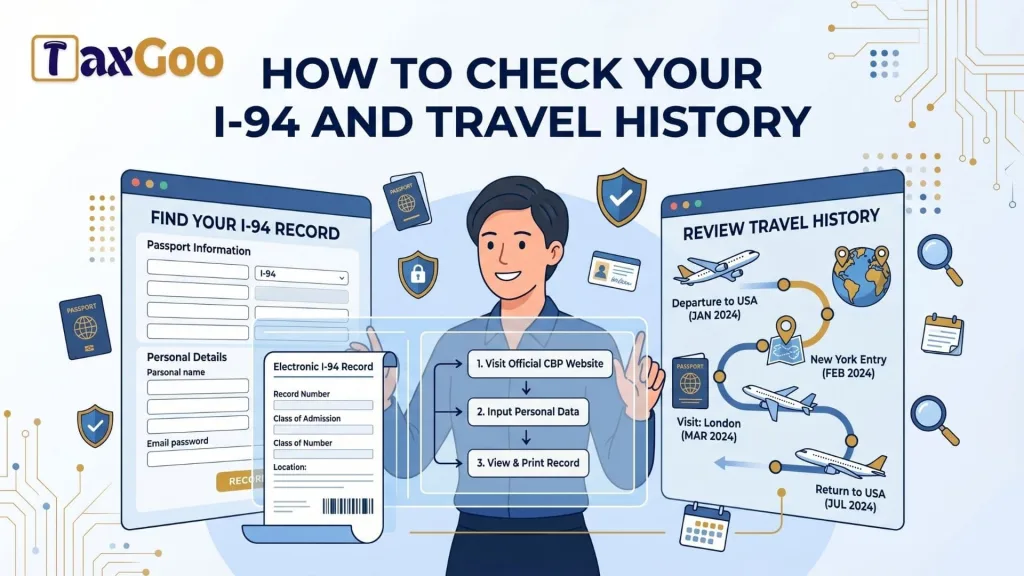
How To Check Your I-94 And Travel History
When you need to verify a U.S. entry date, begin with your official arrival record and supporting documents.
Step 1: Identify The Status You Are Reporting
Before searching for dates, confirm whether the form is asking about F-1, J-1, H-1B, or another classification. Do not mix dates from separate categories.
Step 2: Review Your Most Recent I-94
Retrieve your I-94 record and confirm your class of admission and most recent arrival details. Check whether the listed category matches the status you are entering on the form.
Step 3: Review Your Arrival And Departure History
Look for earlier arrivals in the same status category. If the question asks for your first entry in that status, your earliest matching arrival may be the correct answer.
Step 4: Compare Your Supporting Documents
Match the date against your passport stamps, I-20, DS-2019, I-797 approval notice, or older I-94 records. This helps prevent entering a date from the wrong status or the wrong trip.
Step 5: Check For A Change Of Status Or Extension
If you never re-entered the United States after receiving a new status, use the date that status legally began, based on your approval documentation or official instructions.
If you only received an extension of the same status, do not assume the extension date should replace your original entry or start date.
Step 6: Ask For Help Before Guessing
When your records do not align, your platform gives unclear wording, or you have several programs in the same visa category, contact the responsible office or a qualified adviser before submitting the date.
Common Mistakes To Avoid
Entering Your Most Recent Arrival Date Automatically
Your latest arrival may not be your first entry under the status being reported. A vacation or family visit abroad does not necessarily reset your answer.
Entering Your First-Ever Visit To The United States
A tourist visit years before your student or work status may belong in your complete travel history, but it may not answer this particular question.
Using Your Visa Issue Date
The date printed on a visa stamp is not always the date you entered or began status in the United States. A visa can be issued before you travel.
Using An Extension Date As A New Entry Date
An extension often continues your existing authorization. It generally should not be treated as a fresh entry into the same status.
Ignoring An In-Country Change Of Status
If your new status began while you remained in the United States, you may need the status effective date rather than an arrival stamp.
Guessing Because Your Passport Is Incomplete
If you cannot immediately find the right stamp, check your I-94, CBP travel history, approval notices, program documents, and institutional records before entering an estimate.
What If Your I-94 Or Travel History Does Not Show The Date You Need?
Sometimes a record is missing, incomplete, or difficult to retrieve. Older trips may not appear as expected, a name format may prevent an online match, or your answer may relate to a status change rather than an airport entry.
Try these steps:
- Check that your name, date of birth, passport number, and country of issuance are entered exactly as used for travel.
- Search your passport for entry stamps connected to the correct status.
- Review older immigration documents, including prior I-20s, DS-2019s, I-797 approval notices, and archived I-94 copies.
- Contact your school international office, exchange sponsor, employer, or payroll department if the question is tied to their system.
- Seek qualified assistance if an inaccurate answer could affect tax filing, payroll treatment, or immigration records.
Do not invent a date simply to move past the screen. A few extra minutes of checking can prevent corrections later.
First Entry Date Versus Most Recent Entry Date
These two dates are often different.
Your first entry date on a status is the date you initially entered or began that particular classification for the period being reported.
Your most recent entry date is the latest time you physically arrived in the United States, which may have happened after travel while you continued in the same status.
For example, a student may first enter in F-1 status in 2022, visit family abroad in 2024, and return in F-1 status later that year. The most recent I-94 may show the 2024 arrival, while the answer to the first-entry question may still be the 2022 date.
First Entry Date Versus Status Expiration Date
A first-entry date tells the system when your relevant status began. An expiration or authorized-stay date tells the system how long that status or authorized period continues.
These are not interchangeable.
For example, a J-1 visitor may arrive in January 2024 and have a DS-2019 ending in June 2026. January 2024 may answer the first-entry question, while June 2026 may answer a separate expiration or program end question.
First Entry Date Versus Visa Issue Date
A visa may be issued before you travel to the United States. The issue date shows when the visa was granted in your passport, while the entry date shows when you used the status for admission or when the status began through an approved change inside the country.
Always check which one the form requests before copying a date from your visa page.
A Simple Decision Guide
Use this quick sequence when you are unsure:
Question 1: What immigration status am I reporting right now?
Write down the status category, such as F-1, J-1, or H-1B.
Question 2: Did I physically enter the United States in this status?
If yes, look for the first arrival connected to that status.
Question 3: Did I change to this status while already inside the United States?
If yes, look for the effective date of the approved status change.
Question 4: Did I only extend the same status?
If yes, keep the original applicable status beginning date unless your program instructions say otherwise.
Question 5: Have I had more than one program under the same category?
If yes, review the form guidance or ask your sponsor which program start date it requires.
When You Should Get Professional Help
Many people can answer this field by reviewing their travel and status documents. Still, help may be sensible when:
- You changed status inside the United States more than once
- You have had several F-1 or J-1 programs
- You have missing entry records or mismatched documents
- The date affects a tax residency calculation
- Your employer or institution has given instructions that conflict with your understanding
- You are preparing an immigration filing that must be consistent with past answers
An international office or payroll team can often clarify the system they use. A qualified tax professional can help with tax residency questions. An immigration attorney can help when status history or immigration filings are involved.
Final Checklist Before You Submit Your Answer
Before pressing submit, confirm that:
- You know which immigration status the field is asking about
- You are not accidentally entering a date from a different visa category
- You checked your I-94 or available travel history
- You reviewed relevant status documents, such as I-20, DS-2019, or I-797
- You considered whether you changed status inside the United States
- You did not treat a simple extension as a new first entry without instructions to do so
- You asked for clarification if your records were unclear
A correct date is usually the result of matching the question to the right document, not simply choosing the newest date you can find.

Frequently Asked Questions
What Date Should I Enter If I Have Been In The Same Status For Years?
Use the date you first entered or began that status, unless your form specifically asks for your latest entry or current program start date.
Do I Use My Latest I-94 Arrival Date?
Only if it is also your first entry in the status being reported, or the form specifically requests your most recent arrival.
Do I Include A Tourist Visit Before My Student Visa?
Not for a question about your first F-1 or J-1 entry. A prior tourist visit may belong in a separate full travel history section.
What If I Changed Status Without Leaving The United States?
Use the effective date of your new status shown in your approval documentation or follow the instructions from the platform requesting the information.
Does OPT Create A New F-1 Entry Date?
Usually no. OPT is generally connected to your F-1 status, so your relevant F-1 starting date typically remains the same.
Should I Use The Date My Visa Was Issued?
Usually no. A visa issue date is different from your U.S. entry date or in-country status effective date.
What If I Cannot Find My Old Entry Date?
Review your travel history, old passports, previous immigration documents, school or employer records, and request help from the office responsible for your form.
Can The Correct Date Differ Between Two Forms?
Yes. One form may ask for your first-ever U.S. visit, another may ask for your first entry under a status category, and another may ask for the beginning of your current program.