If you are asking, “what if you only made one estimated tax payment before April 15,” the answer depends on how much you paid, which tax year it covered, and whether enough tax was paid throughout the year. For US federal income taxes, estimated payments are common for freelancers, independent contractors, small business owners, landlords, and investors whose income is not fully covered by paycheck withholding. The first estimated payment for a tax year is usually due April 15, but it is not the only installment date. A payment made by April 15 might count toward the current year’s estimated taxes, while a separate payment due on the same date could be the balance owed when filing the previous year’s return. Paying last year’s tax bill does not automatically satisfy this year’s estimated tax requirement. Here is what to check.
How Estimated Tax Payments Work
For most individuals, estimated federal income tax payments are due April 15, June 15, September 15, and January 15 of the following year. Dates may shift for weekends or legal holidays. Generally, you may need estimated payments if you expect to owe at least $1,000 after withholding and refundable credits, and your withholding is below the required threshold. That threshold is usually the smaller of 90% of current-year tax or 100% of prior-year tax. Some higher-income taxpayers generally use 110% of prior-year tax. See the IRS estimated tax guidance and Publication 505.
Is One Payment Before April 15 Enough?
It can be, if the payment was large enough and applied to the correct tax year. A single payment may cover the required annual amount and prevent a penalty. If it only covered the first installment, you may still need to pay the later installments. The IRS generally considers both how much you paid and when you paid it.
You may not need estimated payments if withholding is sufficient or your tax due after withholding and refundable credits is less than $1,000. Special rules apply to some taxpayers. One payment does not automatically mean you owe a penalty or that you are covered.
Why April 15 Can Be Confusing
April 15 can be the deadline to file your previous year’s tax return and pay its balance, as well as the deadline for the first estimated payment for the current year. These are separate obligations. When paying online, select “Estimated Tax” and the correct tax year. A balance-due payment for a filed return may not count as an estimated payment for the new year. Check your IRS account if unsure.
What If You Missed Later Payments?
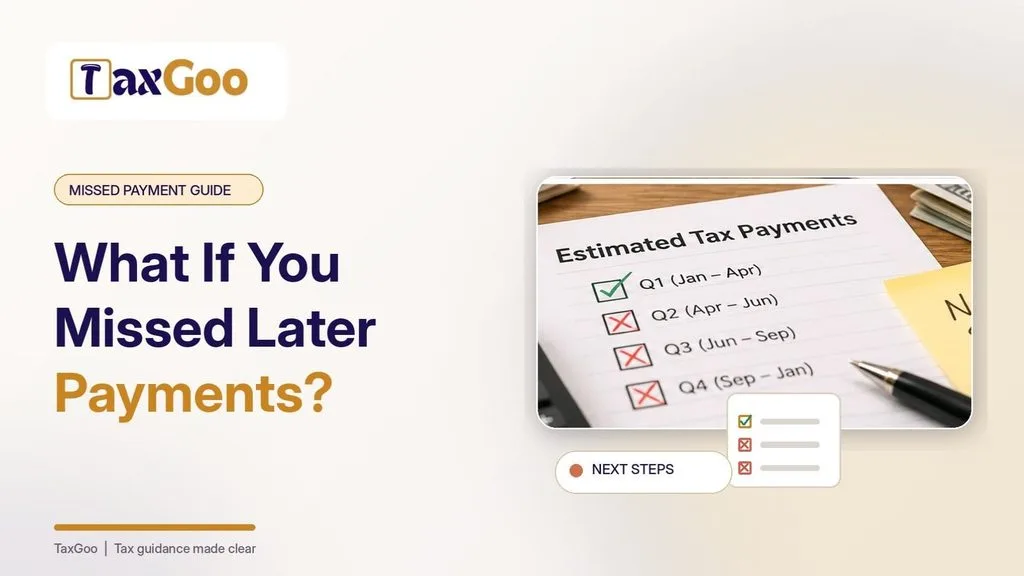
If you paid in April but missed the June, September, or January installments, you could owe an underpayment penalty. The IRS generally calculates it based on the amount underpaid, how long it remained unpaid, and the applicable interest rates. It is calculated separately for each installment period, so a later payment may not erase a penalty from an earlier period. You could owe a penalty even if you receive a refund when filing. Read the IRS underpayment penalty guidance before drawing conclusions.
How to Reduce or Avoid a Penalty
Total your withholding, estimated payments, and refundable credits. Compare the amount with the safe harbor: generally 90% of current-year tax or 100% of prior-year tax, whichever is smaller. If your prior-year adjusted gross income exceeded $150,000, or $75,000 if married filing separately, the prior-year threshold is generally 110%.
If you missed a payment, pay promptly using the correct tax year. A late payment may reduce an accruing penalty, but may not erase an earlier underpayment. If you have a job, increasing federal withholding for the rest of the year may help. For penalty calculations, withholding is generally treated as paid evenly throughout the year, subject to IRS rules.
If your income arrived unevenly, such as a large freelance payment or capital gain late in the year, Form 2210’s annualized income method may help match required payments to when you earned the income. A waiver may be available in certain situations, including some disasters or qualifying hardship circumstances. Review the current Form 2210 instructions or consult a qualified tax professional if the calculation is complicated.
A Simple Example
Suppose your required estimated payments are $2,000 per installment. You pay $2,000 by April 15, then make no further payments. That first payment alone may not satisfy later installments. However, enough wage withholding or a payment large enough to cover the applicable annual requirement could change the result. Your tax figures and dates matter more than the number of transactions.
The Bottom Line
Making only one estimated tax payment before April 15 does not automatically trigger a penalty. The outcome depends on the amount, the tax year credited, your total tax, your withholding, and whether you met the required thresholds on time. Confirm how the payment was applied, check the safe-harbor rules, and make any missing payment promptly.

FAQs
Can I Pay All My Estimated Taxes in April?
Potentially, if you pay the required amount on time and it is credited correctly. Check the IRS rules for your situation.
Will I Owe a Penalty for Missing Quarterly Payments?
Possibly. The amount and timing of payments, your withholding, and any applicable exception affect the result.
Related Keywords
estimated tax payment deadline, estimated tax underpayment penalty, IRS quarterly tax payments, missed estimated tax payments, estimated taxes for freelancers, April 15 tax payment, Form 2210, estimated tax safe harbor