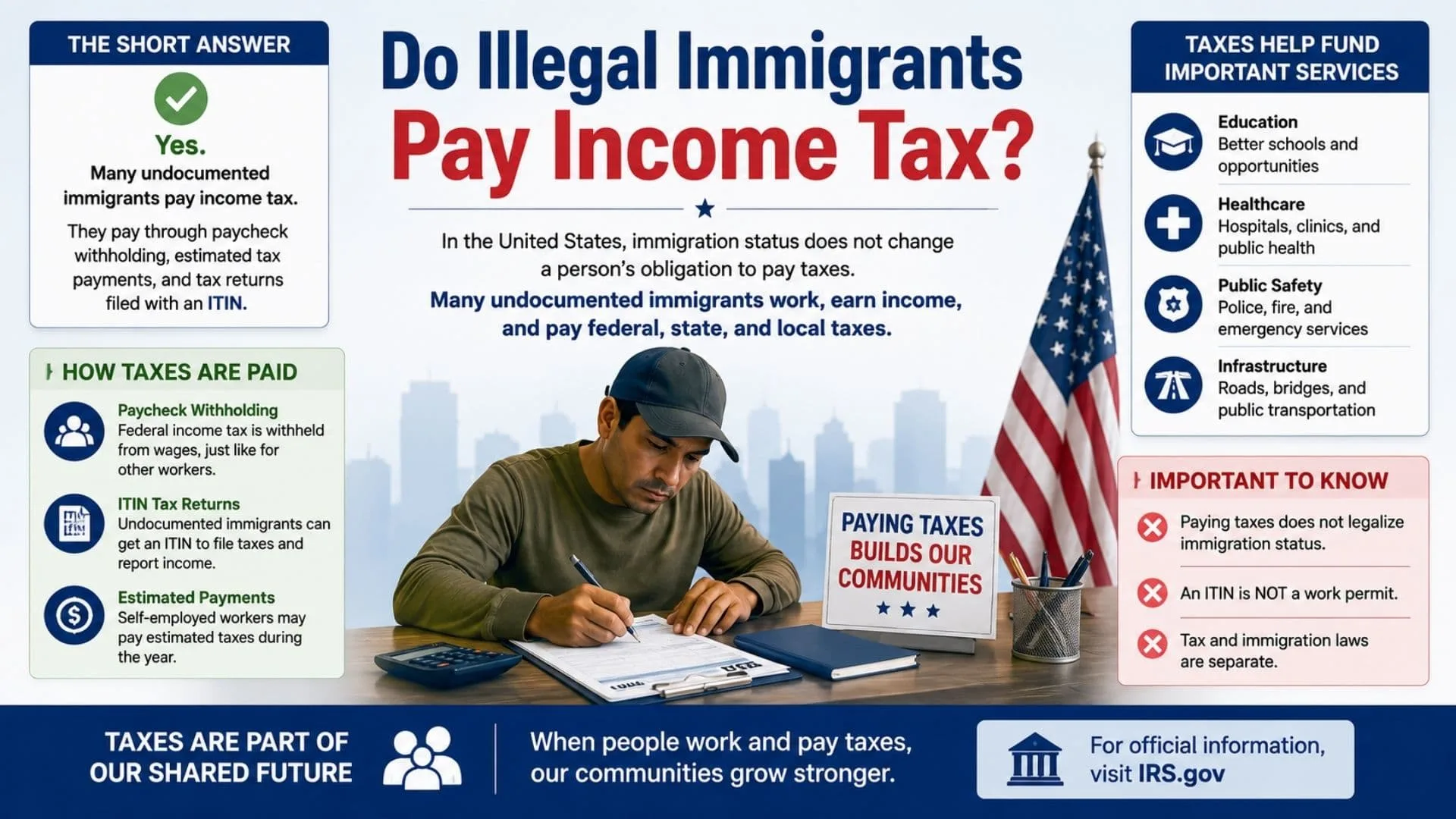
The question do illegal immigrants pay income tax has a clear but nuanced answer: many undocumented immigrants pay federal and state income taxes, while others may not owe or file for the same reasons that some U.S. citizens do not, such as earning below a filing threshold. Under U.S. tax law, immigration status and tax residency are separate concepts. An undocumented person may be treated as a resident alien for tax purposes after meeting the substantial presence test, which can require reporting income on Form 1040 under rules similar to those applying to citizens. Someone treated as a nonresident alien may instead need to file Form 1040-NR and report qualifying U.S.-source income. Workers may pay through paycheck withholding, estimated tax payments, or a return filed with an Individual Taxpayer Identification Number, commonly called an ITIN. Paying taxes does not create lawful immigration status, authorize employment, or provide Social Security eligibility, but lacking lawful status does not automatically erase a federal tax obligation.
The Direct Answer
Yes, undocumented immigrants can and do pay income tax in the United States. Not every undocumented person owes federal income tax. Filing requirements depend on income, filing status, tax residency, earnings, withholding, and available deductions or credits.
Immigration Status And Tax Residency
For federal tax purposes, a noncitizen is generally treated as a resident alien or nonresident alien. These labels do not decide whether someone has lawful immigration status.
A person may become a resident alien for tax purposes by meeting the substantial presence test. A resident alien generally files Form 1040 and follows many of the same reporting rules as a citizen.
A nonresident alien usually files Form 1040-NR when a filing requirement applies and is generally taxed on certain U.S.-source income and income connected with a U.S. trade or business.
How Undocumented Workers Pay Income Tax
Paycheck Withholding
If a worker is included on an employer’s payroll, federal income tax may be withheld from each paycheck. Unauthorized employment does not make wages tax-free.
Withholding is a prepayment. The final liability is calculated on the return after considering income, deductions, credits, and payments.
Filing With An ITIN
A person who has a federal tax filing or reporting requirement but is not eligible for a Social Security number may apply for an ITIN. The IRS issues ITINs for federal tax purposes regardless of immigration status.
An ITIN allows someone to file a return, report income, pay tax, and claim benefits for which the person qualifies. It does not provide work authorization, change immigration status, or create Social Security eligibility.
Estimated Tax Payments
Self-employed workers and independent contractors may have no withholding. They may need to make estimated payments and report business income on a federal return.
Cash income is not automatically exempt. Tips, freelance earnings, and day labor income can be taxable even when no Form W-2 or Form 1099 is received.
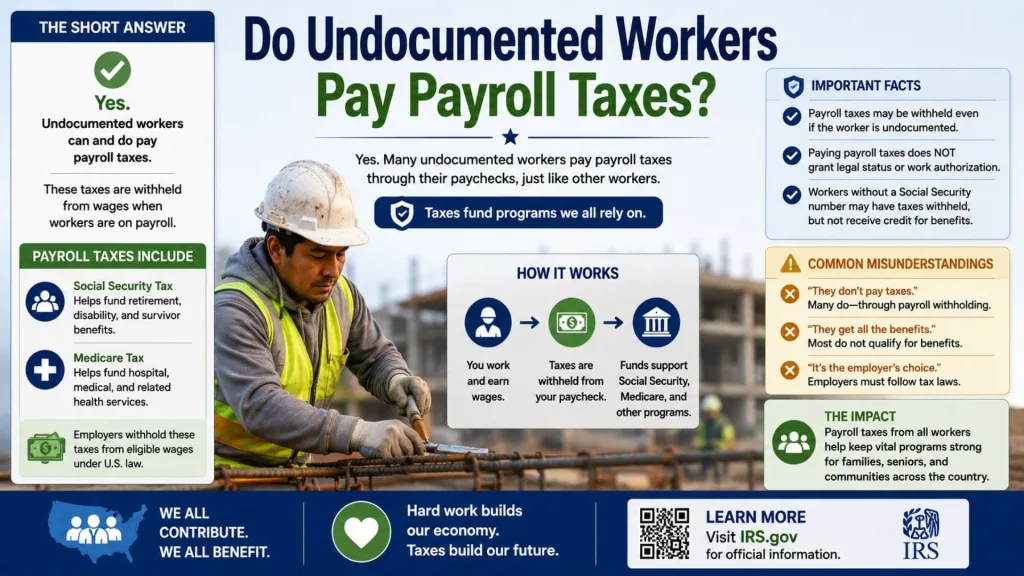
Do Undocumented Workers Pay Payroll Taxes?
Many do. Workers on payroll may have Social Security and Medicare taxes withheld along with federal income tax.
If a wage report contains a name and Social Security number that do not match government records, the wages may enter the Social Security Administration’s Earnings Suspense File. Taxes may still have been collected even though the worker does not receive credit for those earnings.
What Other Taxes May Be Paid?
They may also pay state or local income taxes, sales taxes, property taxes, excise taxes, and self-employment tax.
Can An Undocumented Taxpayer Receive A Refund?
Possibly. A refund may be available when withholding or estimated payments exceed the final liability, or when the taxpayer qualifies for an allowable refundable credit.
A refund usually represents an overpayment. Credit eligibility varies, and some benefits require valid Social Security numbers rather than ITINs.
Does Paying Taxes Provide Legal Status?
No. Filing a tax return or obtaining an ITIN does not legalize a person’s presence, provide employment authorization, or guarantee an immigration benefit.
Tax and immigration laws operate separately. Anyone concerned about how a filing could affect an immigration matter should speak with a qualified tax professional and a licensed immigration attorney.
Common Misunderstandings
The claim that undocumented immigrants never pay taxes is incorrect. Many have tax withheld or file returns using an ITIN.
The opposite claim, that every undocumented immigrant pays federal income tax, is also too broad. Some have no filing requirement, some owe no income tax, and some do not comply with the law.
An ITIN is also not a work permit.
Final Thoughts
So, do illegal immigrants pay income tax? Many do through payroll withholding, estimated payments, and tax returns filed with an ITIN or another valid taxpayer identification number. Whether someone must file depends on tax residency, income, and the type of earnings involved.
Undocumented status does not automatically remove tax responsibilities. Individual situations vary, so taxpayers should seek help from a credentialed preparer familiar with immigrant and international tax issues.

Frequently Asked Questions
Can An Undocumented Immigrant Get An ITIN?
Yes. A person with a federal tax need who is not eligible for an SSN may qualify.
Does An ITIN Allow Someone To Work?
No. It is only a federal tax-processing number.
Which Tax Return Is Used?
A tax resident generally files Form 1040. A qualifying nonresident generally files Form 1040-NR.
Does Paying Taxes Change Immigration Status?
No. Tax filing does not grant legal status.