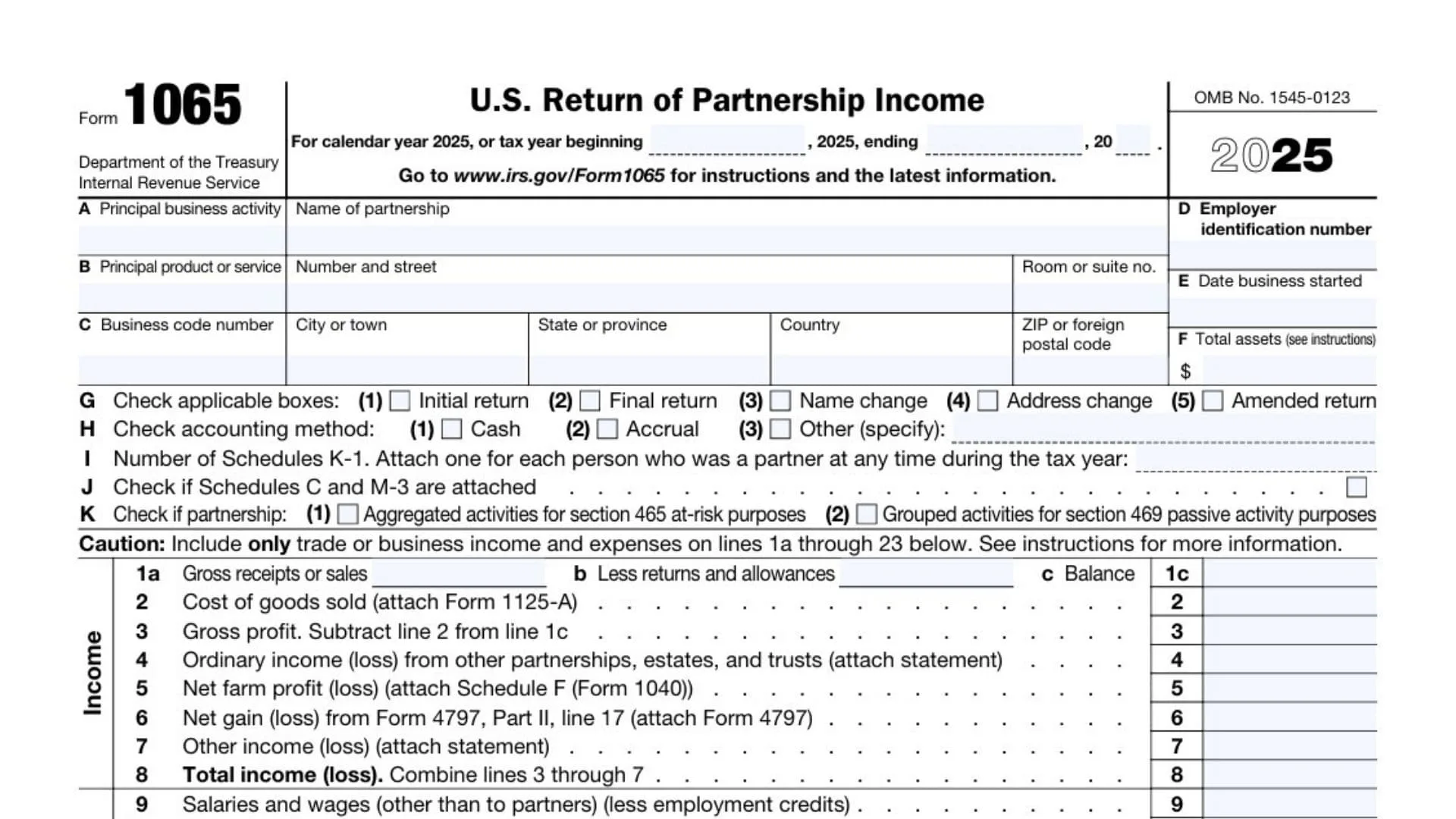
Form 1065 is the U.S. Return of Partnership Income used by partnerships to report their income, deductions, gains, losses, and other financial information for a tax year. The form is filed by partnerships, including entities treated as partnerships for federal tax purposes, to provide the IRS with details about the partnership’s operations and financial activity. Form 1065 does not generally calculate income tax paid by the partnership itself because partnership income and losses usually pass through to the individual partners. Instead, the form reports partnership activity and provides information that partners use when preparing their own tax returns. The form collects information about the partnership’s identity, business activity, accounting method, assets, income, deductions, payments, partner information, and special tax situations. The 2025 version of Form 1065 is identified as the “U.S. Return of Partnership Income” and includes the main return, Schedule B, Schedule K, Schedule L, Schedule M-1, Schedule M-2, and related information sections.
Completing Form 1065 correctly is important because inaccurate information can affect the tax reporting of every partner in the partnership. The form requires careful reporting of income items, deductible expenses, ownership information, balance sheet details, and partner allocations. Partnerships should gather financial records, accounting information, partner details, and supporting statements before beginning the form.
How To File Form 1065
Form 1065 is submitted to the Internal Revenue Service as the partnership’s annual income return. The partnership should complete the main return and attach all required schedules, statements, and supporting forms. The filing includes information about the partnership’s income and deductions, partner distributive share items, balance sheet information, and reconciliation schedules.
Before completing the form, gather the partnership’s accounting records, income statements, expense records, asset information, partner ownership information, and copies of any required supporting forms. The first page requires basic identification information, including the partnership name, address, employer identification number, business activity details, accounting method, and information about attached schedules.

How To Complete Form 1065
Part 1: Partnership Information
The top section of Form 1065 identifies the partnership and provides basic information needed to process the return.
Tax Year Information
Enter the calendar year or fiscal tax year covered by the return. Include the beginning and ending dates if the partnership uses a tax year other than the calendar year.
Name Of Partnership
Enter the legal name of the partnership as used for tax purposes.
Address Information
Provide the partnership’s mailing address, including street address, city or town, state or province, country, and ZIP or foreign postal code.
Line A: Principal Business Activity
Enter the main business activity performed by the partnership.
Line B: Principal Product Or Service
Describe the primary product sold or service provided by the partnership.
Line C: Business Code Number
Enter the applicable business activity code that identifies the partnership’s primary business.
Line D: Employer Identification Number
Enter the partnership’s employer identification number assigned by the IRS.
Line E: Date Business Started
Enter the date the partnership began conducting business activities.
Line F: Total Assets
Enter the partnership’s total assets according to the applicable instructions.
Line G: Return Status Boxes
Check the appropriate box if the return is an initial return, final return, name change, address change, or amended return.
Line H: Accounting Method
Select the accounting method used by the partnership. The options include cash, accrual, or another method that must be specified.
Line I: Number Of Schedules K-1
Enter the number of Schedule K-1 forms attached. A Schedule K-1 must be prepared for each person who was a partner at any time during the tax year.
Line J: Schedule C And Schedule M-3 Attachment Indicator
Check this box if the partnership attaches Schedule C and Schedule M-3.
Line K: Partnership Activity Classification
Check the applicable boxes if the partnership has aggregated activities for section 465 at-risk purposes or grouped activities for section 469 passive activity purposes.
Income Section
The income section reports partnership business income and related amounts. Only trade or business income and expenses should generally be included in the applicable lines of this section.
Line 1a: Gross Receipts Or Sales
Enter the partnership’s total gross receipts or sales before reductions.
Line 1b: Returns And Allowances
Enter reductions from returned goods, refunds, allowances, or similar adjustments.
Line 1c: Balance Of Gross Receipts Or Sales
Subtract line 1b from line 1a to determine the adjusted gross receipts amount.
Line 2: Cost Of Goods Sold
Enter the partnership’s cost of goods sold amount. Attach Form 1125-A when required.
Line 3: Gross Profit
Subtract line 2 from line 1c to calculate gross profit.
Line 4: Income Or Loss From Other Partnerships, Estates, And Trusts
Report ordinary income or loss received from other partnerships, estates, and trusts. Attach supporting statements when required.
Line 5: Net Farm Profit Or Loss
Enter net farm profit or loss and attach Schedule F when applicable.
Line 6: Net Gain Or Loss From Form 4797
Report the net gain or loss from Form 4797, Part II, line 17, and attach Form 4797.
Line 7: Other Income Or Loss
Enter other income or loss amounts not reported on earlier lines and attach a statement explaining the items.
Line 8: Total Income Or Loss
Combine lines 3 through 7 to calculate total income or loss.
Deductions Section
The deductions section of Form 1065 reports the expenses and deductions that reduce the partnership’s income. These amounts should generally relate to the partnership’s trade or business activities and must be supported by appropriate records.
Line 9: Salaries And Wages
Enter wages paid to employees who are not partners. Reduce this amount by any applicable employment credits. Payments made to partners are generally reported separately as guaranteed payments.
Line 10: Guaranteed Payments To Partners
Enter guaranteed payments made to partners for services or the use of capital. These payments are reported separately from employee wages.
Line 11: Repairs And Maintenance
Enter expenses related to repairing and maintaining partnership property that qualify as deductible expenses.
Line 12: Bad Debts
Enter deductible bad debt expenses recognized by the partnership.
Line 13: Rent
Enter rental expenses paid for business property, equipment, or other qualifying rented assets.
Line 14: Taxes And Licenses
Enter deductible taxes, licenses, and similar government charges related to the partnership’s operations.
Line 15: Interest
Enter deductible interest expenses according to the applicable instructions and limitations.
Line 16a: Depreciation
Enter depreciation expense for partnership assets. Attach Form 4562 when required.
Line 16b: Less Depreciation Reported Elsewhere
Enter depreciation amounts already included in other parts of the return, including amounts reported on Form 1125-A or other schedules.
Line 16c: Depreciation Deduction
Enter the adjusted depreciation amount after subtracting depreciation reported elsewhere from line 16a.
Line 17: Depletion
Enter deductible depletion expenses. Oil and gas depletion should not be included on this line.
Line 18: Retirement Plans
Enter deductible contributions for retirement plans and similar qualified programs.
Line 19: Employee Benefit Programs
Enter deductible employee benefit expenses paid by the partnership.
Line 20: Energy Efficient Commercial Buildings Deduction
Enter the applicable energy efficient commercial buildings deduction and attach Form 7205 when required.
Line 21: Other Deductions
Enter other deductible expenses that are not included on previous lines. Attach a statement explaining these deductions.
Line 22: Total Deductions
Add the amounts from lines 9 through 21 to calculate total deductions.
Line 23: Ordinary Business Income Or Loss
Subtract line 22 from line 8 to determine the partnership’s ordinary business income or loss.
Tax And Payment Section
This section reports certain tax amounts, payments, and balances related to the partnership return.
Line 24: Interest Due Under The Look-Back Method For Long-Term Contracts
Enter interest due under the look-back method for completed long-term contracts. Attach Form 8697 when required.
Line 25: Interest Due Under The Look-Back Method For Income Forecast Method
Enter interest due under the income forecast method and attach Form 8866 when required.
Line 26: BBA AAR Imputed Underpayment
Enter the imputed underpayment amount from a Bipartisan Budget Act administrative adjustment request when applicable.
Line 27: Other Taxes
Enter other applicable taxes that must be reported on the partnership return.
Line 28: Total Balance Due
Add lines 24 through 27 to determine the total balance due.
Line 29: Elective Payment Election Amount From Form 3800
Enter the elective payment election amount reported from Form 3800, when applicable.
Line 30: Payment
Enter payment amounts according to the applicable instructions.
Line 31: Amount Owed
If the combined amount from lines 29 and 30 is less than line 28, enter the remaining amount owed.
Line 32a: Overpayment
If the combined amount from lines 29 and 30 is greater than line 28, enter the overpayment amount.
Line 32b: Routing Number
Enter the bank routing number if a refund or payment-related direct deposit information is required.
Line 32c: Account Type
Select whether the account is a checking account or savings account.
Line 32d: Account Number
Enter the applicable bank account number.
Signature Section
The signature section confirms that the partnership representative or authorized person reviewed the return and believes the information provided is accurate.
Signature Of Partner Or Limited Liability Company Member
The authorized partner or LLC member must sign the return.
Date
Enter the date the return is signed.
IRS Discussion Authorization
Indicate whether the IRS may discuss the return with the paid preparer listed on the form. Select yes or no.
Paid Preparer Use Only
This section is completed by the paid preparer when someone other than a partner or authorized member prepares the return.
Preparer Name
Enter the name of the person who prepared the return.
Preparer Signature
The preparer signs the return.
Date
Enter the preparation date.
Self-Employed Checkbox
Check the box if the preparer is self-employed.
PTIN
Enter the preparer tax identification number.
Firm Name
Enter the name of the preparation firm.
Firm EIN
Enter the employer identification number of the firm.
Firm Address And Phone Number
Provide the firm’s address and telephone number.
Schedule B: Other Information
Schedule B collects additional information about the partnership, including entity type, ownership details, foreign activities, special elections, reporting requirements, and other circumstances that may affect filing obligations. The partnership must answer the applicable questions and provide additional schedules or forms when required.
Entity Information And Ownership Questions
Question 1: Type Of Entity Filing The Return
Select the box that describes the partnership type. The available choices include domestic general partnership, domestic limited partnership, domestic limited liability company, domestic limited liability partnership, foreign partnership, or another type of entity.
Question 2a: Ownership By Certain Entities
Indicate whether any foreign or domestic corporation, partnership, trust, tax-exempt organization, or foreign government owned 50% or more of the partnership’s profits, losses, or capital at the end of the tax year. If the answer is yes, attach Schedule B-1 with information about partners owning 50% or more of the partnership.
Question 2b: Ownership By Individuals Or Estates
Indicate whether any individual or estate directly or indirectly owned 50% or more of the partnership’s profits, losses, or capital at the end of the tax year. If yes, attach Schedule B-1 as required.
Question 3a: Ownership Interest In Corporations
Answer whether the partnership owned at least 20% of any class of voting stock of a foreign or domestic corporation, or owned 50% or more of the total voting power of the corporation’s stock. If yes, complete the ownership details below.
Corporation Name
Enter the name of the corporation in which the partnership holds the required ownership interest.
Employer Identification Number Of Corporation
Enter the corporation’s employer identification number if available.
Country Of Incorporation
Enter the country where the corporation was incorporated.
Percentage Owned In Voting Stock
Enter the percentage of voting stock owned by the partnership.
Question 3b: Ownership Interest In Partnerships Or Trusts
Answer whether the partnership owned at least 20% of another partnership, or at least 50% of the profit, loss, capital, or beneficial interest in another partnership or trust. If yes, provide the required ownership information.
Name Of Entity
Enter the name of the partnership, trust, or other entity owned by the filing partnership.
Employer Identification Number Of Entity
Enter the employer identification number of the owned entity, if available.
Type Of Entity
Enter the classification or type of entity owned by the partnership.
Country Of Organization
Enter the country where the entity was organized.
Maximum Percentage Owned In Profit, Loss, Or Capital
Enter the maximum ownership percentage held by the partnership.
Partnership Filing Requirement Questions
Question 4: Small Partnership Exception Requirements
Answer whether the partnership meets all four listed conditions:
- Total receipts for the tax year were less than $250,000.
- Total assets at the end of the tax year were less than $1 million.
- Schedule K-1 forms were filed with the return and provided to partners by the required due date.
- The partnership is not filing and is not required to file Schedule M-3.
If all conditions are met, the partnership may not need to complete certain balance sheet and reconciliation sections.
Question 5: Publicly Traded Partnership Status
Indicate whether the partnership is a publicly traded partnership as defined under section 469(k)(2).
Question 6: Cancellation Or Modification Of Debt
Indicate whether the partnership had debt canceled, forgiven, or modified during the tax year in a way that reduced the principal amount owed.
Question 7: Form 8918 Material Advisor Disclosure
Indicate whether the partnership filed or is required to file Form 8918, Material Advisor Disclosure Statement, related to a reportable transaction.
Question 8: Foreign Financial Accounts
Indicate whether the partnership had an interest in, signature authority over, or other authority over a foreign financial account during the tax year. If yes, enter the foreign country name when required.
Question 9: Foreign Trust Transactions
Indicate whether the partnership received a distribution from, acted as a grantor of, or transferred assets to a foreign trust. If applicable, additional reporting may be required.
Question 10a: Section 754 Election
Indicate whether the partnership has made or previously made a section 754 election that remains in effect. If yes, enter the effective date of the election.
Question 10b: Section 743(b) Optional Basis Adjustment
Indicate whether the partnership made an optional basis adjustment under section 743(b) during the tax year. If yes, enter the total aggregate net positive and net negative amounts of the adjustments and attach the required supporting statement.
Question 10c: Section 734(b) Optional Basis Adjustment
Indicate whether the partnership made an optional basis adjustment under section 734(b) during the tax year. If the answer is yes, enter the total aggregate net positive amount and total aggregate net negative amount of the section 734(b) adjustments made for partnership property. The partnership must attach a statement explaining the calculation and allocation of each basis adjustment.
Question 10d: Required Basis Adjustment Under Sections 743(b) Or 734(b)
Indicate whether the partnership was required to adjust the basis of partnership property because of a substantial built-in loss under section 743(d) or a substantial basis reduction under section 734(d). If yes, enter the total aggregate amount of the adjustments and attach a statement showing the calculation and allocation.
Question 10e: Reserved For Future Use
This item is reserved for future use and does not require an entry.
Question 11: Like-Kind Exchange Property Distribution
Check the box if, during the current or prior tax year, the partnership distributed property received through a like-kind exchange or contributed that property to another entity, excluding certain disregarded entities wholly owned by the partnership throughout the tax year.
Question 12: Distribution Of Partnership Property Interests
Indicate whether the partnership distributed a tenancy-in-common interest or another undivided interest in partnership property to any partner during the tax year.
Question 13a: Forms 8858 Attached
If the partnership is required to file Form 8858 for foreign disregarded entities or foreign branches, enter the number of Forms 8858 attached to the return.
Question 13b: Reserved For Future Use
This item is reserved for future use and does not require information.
Question 14: Foreign Partners
Indicate whether the partnership has any foreign partners. If yes, enter the number of Forms 8805 filed for the partnership relating to foreign partner withholding tax reporting.
Question 15: Forms 8865 Attached
Enter the number of Forms 8865 attached to the return for reporting certain foreign partnership interests.
Question 16a: Payments Requiring Form 1099
Indicate whether the partnership made payments during the tax year that require filing one or more Forms 1099.
Question 16b: Filing Required Forms 1099
If the answer to question 16a is yes, indicate whether the partnership filed or will file the required Forms 1099.
Question 17: Forms 5471 Attached
Enter the number of Forms 5471 attached to the return for reporting certain foreign corporation interests.
Question 18: Foreign Government Partners
Enter the number of partners that are foreign governments under section 892.
Question 19: Payments Involving Foreign Partners
Indicate whether the partnership made payments to foreign partners or received payments allocated to foreign partners that require Forms 1042 and 1042-S reporting under applicable withholding rules.
Question 20: Specified Domestic Entity Requirement
Indicate whether the partnership was a specified domestic entity required to file Form 8938 for the tax year.
Question 21: Section 721(c) Partnership Status
Indicate whether the partnership is a section 721(c) partnership as defined by the applicable regulations.
Question 22: Nondeductible Interest Or Royalty Payments
Indicate whether the partnership paid or accrued interest or royalty amounts for which one or more partners are not allowed a deduction under section 267A. If yes, enter the total amount of disallowed deductions.
Question 23: Section 163(j) Election
Indicate whether the partnership had an election under section 163(j) in effect for a real property trade or business or farming business during the tax year.
Question 24: Business Interest Expense Reporting Requirement
Indicate whether the partnership meets any of the listed conditions related to excess business interest expense, business interest expense limitations, or tax shelter status. If yes, complete and attach Form 8990.
The conditions include:
- The partnership owns a pass-through entity with current or prior-year carryover excess business interest expense.
- The partnership has average annual gross receipts above the applicable threshold and has business interest expense.
- The partnership is a tax shelter with business interest expense.
Question 25: Qualified Opportunity Fund Self-Certification
Indicate whether the partnership intends to self-certify as a qualified opportunity fund. If yes, complete Form 8996 and enter the required amount from that form.
Question 26: Foreign Partners Subject To Section 864(c)(8)
Enter the number of foreign partners subject to section 864(c)(8) because of a transfer of a partnership interest or receipt of a partnership distribution. Complete Schedule K-3, Part XIII, for each applicable foreign partner.
Question 27: Transfers Between Partnership And Partners
Indicate whether the partnership had transfers with partners during the tax year that are subject to disclosure requirements under the applicable regulations.
Schedule B: Additional Questions
Question 28: Foreign Corporation Acquisition Of Partnership Assets
Indicate whether, since December 22, 2017, a foreign corporation directly or indirectly acquired substantially all of the partnership’s trade or business assets and the ownership percentage exceeded the applicable threshold. If yes, provide ownership percentages by vote and value.
Question 29a: Form 7208 Requirement Under Foreign Corporation Rules
Indicate whether the partnership is required to file Form 7208 under applicable foreign corporation rules.
Question 29b: Form 7208 Requirement Under Covered Surrogate Foreign Corporation Rules
Indicate whether the partnership is required to file Form 7208 under covered surrogate foreign corporation rules. If yes to either part of question 29, complete Form 7208.
Question 30: Digital Asset Transactions
Indicate whether the partnership received, sold, exchanged, or otherwise disposed of a digital asset or financial interest in a digital asset during the tax year.
Question 31: Reserved For Future Use
This question is reserved for future use and does not require an entry.
Question 32: Election Out Of Subchapter K
Check the box if the partnership is making an election out of subchapter K under section 761.
Question 33: Election Out Of Centralized Partnership Audit Regime
Indicate whether the partnership is electing out of the centralized partnership audit regime under section 6221(b). If yes, complete Schedule B-2 and enter the required amount from that schedule. If no, complete the partnership representative designation section.
Designation Of Partnership Representative
The partnership representative section identifies the person or entity responsible for representing the partnership during IRS partnership audit procedures.
Partnership Representative Name
Enter the first and last name of the partnership representative, or the name of the entity acting as the representative.
Partnership Representative Address
Enter the U.S. address, including street, city, state, ZIP code, and phone number of the partnership representative.
Designated Individual Name
If the partnership representative is an entity, enter the name of the designated individual responsible for acting on behalf of that entity.
Designated Individual Address
Enter the U.S. address and phone number of the designated individual.
Schedule K: Partners’ Distributive Share Items
Schedule K reports the partnership’s total income, deductions, credits, and other items that are allocated among the partners. The amounts entered on Schedule K are used to prepare each partner’s Schedule K-1, which shows each partner’s individual share of partnership activity.
Income Items
Line 1: Ordinary Business Income Or Loss
Enter the partnership’s ordinary business income or loss from Form 1065, page 1, line 23. This amount represents the partnership’s regular business profit or loss before allocation among partners.
Line 2: Net Rental Real Estate Income Or Loss
Enter net income or loss from rental real estate activities. Attach Form 8825 when required to provide details about rental real estate activity.
Line 3a: Other Gross Rental Income Or Loss
Enter gross income or loss from rental activities other than rental real estate reported on line 2.
Line 3b: Expenses From Other Rental Activities
Enter deductible expenses related to other rental activities. Attach a statement when required.
Line 3c: Other Net Rental Income Or Loss
Subtract line 3b from line 3a to calculate net rental income or loss from other rental activities.
Line 4a: Guaranteed Payments For Services
Enter guaranteed payments made to partners for services performed for the partnership.
Line 4b: Guaranteed Payments For Capital
Enter guaranteed payments made to partners for the use of capital.
Line 4c: Total Guaranteed Payments
Add lines 4a and 4b to determine total guaranteed payments.
Line 5: Interest Income
Enter interest income earned by the partnership during the tax year.
Line 6a: Ordinary Dividends
Enter ordinary dividends received by the partnership.
Line 6b: Qualified Dividends
Enter qualified dividends included in the partnership’s dividend income.
Line 6c: Dividend Equivalents
Enter dividend equivalent amounts that must be reported under applicable tax rules.
Line 7: Royalties
Enter royalty income received by the partnership.
Line 8: Net Short-Term Capital Gain Or Loss
Enter net short-term capital gain or loss. Attach Schedule D (Form 1065) when required.
Line 9a: Net Long-Term Capital Gain Or Loss
Enter net long-term capital gain or loss. Attach Schedule D (Form 1065) when required.
Line 9b: Collectibles Gain Or Loss
Enter gain or loss from collectibles subject to the applicable 28% maximum rate.
Line 9c: Unrecaptured Section 1250 Gain
Enter unrecaptured section 1250 gain and attach a supporting statement when required.
Line 10: Net Section 1231 Gain Or Loss
Enter net section 1231 gain or loss from business property transactions. Attach Form 4797 when required.
Line 11: Other Income Or Loss
Enter other income or loss items not reported on previous lines. Provide the type of income or loss when required.
Schedule K Deductions
The deduction section reports amounts that reduce partnership income and are separately reported to partners.
Line 12: Section 179 Deduction
Enter the partnership’s section 179 deduction amount. Attach Form 4562 when required.
Line 13a: Cash Contributions
Enter deductible charitable contributions made in cash.
Line 13b: Noncash Contributions
Enter deductible charitable contributions made with property or other noncash assets.
Line 13c: Investment Interest Expense
Enter investment interest expense that must be separately reported to partners.
Line 13d(1): Section 59(e)(2) Expenditure Type
Identify the type of expenditure subject to section 59(e)(2) reporting.
Line 13d(2): Section 59(e)(2) Expenditure Amount
Enter the amount of section 59(e)(2) expenditures.
Line 13e: Other Deductions
Enter other separately stated deductions and identify the type when required.
Self-Employment Items
Line 14a: Net Earnings Or Loss From Self-Employment
Enter the partnership’s net earnings or loss from self-employment activities.
Line 14b: Gross Farming Or Fishing Income
Enter gross farming or fishing income included in self-employment calculations.
Line 14c: Gross Nonfarm Income
Enter gross nonfarm income included in self-employment calculations.
Schedule K Credits
Credits are separately reported because partners may need the information when calculating their own tax obligations.
Line 15a: Low-Income Housing Credit Under Section 42(j)(5)
Enter the applicable low-income housing credit amount under section 42(j)(5).
Line 15b: Other Low-Income Housing Credit
Enter other qualifying low-income housing credit amounts.
Line 15c: Qualified Rehabilitation Expenditures
Enter qualified rehabilitation expenditures related to rental real estate and attach Form 3468 when applicable.
Line 15d: Other Rental Real Estate Credits
Enter other rental real estate credits and describe the type of credit.
Line 15e: Other Rental Credits
Enter other rental-related credits and identify the credit type.
Line 15f: Other Credits
Enter other credits not reported on previous lines and provide the required description.
Schedule K: Partners’ Distributive Share Items
International Items
The international section of Schedule K identifies partnership items that have international tax relevance. These amounts may require additional reporting through Schedule K-2 and other international tax forms depending on the partnership’s activities and circumstances.
Line 16a: Schedule K-2 Reporting Indicator
Check this box if the partnership is attaching Schedule K-2, Partners’ Distributive Share Items, International, to report items with international tax relevance.
Line 16b: Exception To Filing Schedule K-2
Check this box if the partnership qualifies for an exception from filing Schedule K-2.
Alternative Minimum Tax Items
The Alternative Minimum Tax section reports items that partners may need when calculating alternative minimum tax adjustments on their individual returns.
Line 17a: Post-1986 Depreciation Adjustment
Enter the adjustment amount related to post-1986 depreciation differences for alternative minimum tax purposes.
Line 17b: Adjusted Gain Or Loss
Enter the adjusted gain or loss amount used for alternative minimum tax calculations.
Line 17c: Depletion Other Than Oil And Gas
Enter depletion amounts other than oil and gas depletion that must be reported for alternative minimum tax purposes.
Line 17d: Oil, Gas, And Geothermal Properties Gross Income
Enter gross income from oil, gas, and geothermal properties for alternative minimum tax reporting.
Line 17e: Oil, Gas, And Geothermal Properties Deductions
Enter deductions related to oil, gas, and geothermal properties for alternative minimum tax purposes.
Line 17f: Other AMT Items
Enter other alternative minimum tax items and attach a statement explaining the amounts.
Other Information
The other information section reports items that do not fit into income, deduction, or credit categories but may affect partner tax reporting.
Line 18a: Tax-Exempt Interest Income
Enter tax-exempt interest income received or earned by the partnership.
Line 18b: Other Tax-Exempt Income
Enter other tax-exempt income amounts that must be separately reported to partners.
Line 18c: Nondeductible Expenses
Enter expenses that are not deductible but must be reported to partners because they affect their partnership basis.
Line 19a: Distributions Of Cash And Marketable Securities
Enter cash and marketable securities distributed to partners during the tax year.
Line 19b: Distributions Of Other Property
Enter distributions of property other than cash and marketable securities.
Line 20a: Investment Income
Enter investment income earned by the partnership.
Line 20b: Investment Expenses
Enter investment expenses related to investment income activities.
Line 20c: Other Items And Amounts
Enter additional separately reported items and attach a statement describing each item.
Line 21: Total Foreign Taxes Paid Or Accrued
Enter the total amount of foreign taxes paid or accrued by the partnership during the tax year.
Analysis Of Net Income (Loss) Per Return
This section analyzes the partnership’s net income or loss and separates the amounts by partner type. It helps reconcile the partnership’s income among different categories of partners.
Line 1: Net Income Or Loss
Combine Schedule K lines 1 through 11. Then subtract the total of Schedule K lines 12 through 13e and line 21 to calculate net income or loss per return.
Line 2: Analysis By Partner Type
Report the allocation of net income or loss among different partner categories.
The categories include:
- Corporate partners.
- Individual active partners.
- Individual passive partners.
- Partnership partners.
- Exempt organization partners.
- Nominee or other partner types.
Line 2a: General Partners
Enter the applicable allocation amounts for general partners based on partner type.
Line 2b: Limited Partners
Enter the applicable allocation amounts for limited partners based on partner type.
Schedule L: Balance Sheets Per Books
Schedule L reports the partnership’s balance sheet information based on its accounting records. It includes beginning and ending balances for assets, liabilities, and partner capital accounts.
Assets
Column Information
Enter beginning-of-year and end-of-year amounts for each balance sheet item. The columns are used to compare the partnership’s financial position at the start and end of the tax year.
Line 1: Cash
Enter cash balances at the beginning and end of the tax year.
Line 2a: Trade Notes And Accounts Receivable
Enter amounts owed to the partnership from customers or other business-related receivables.
Line 2b: Less Allowance For Bad Debts
Enter the allowance for accounts that may not be collected.
Line 3: Inventories
Enter inventory amounts held by the partnership.
Line 4: U.S. Government Obligations
Enter investments in U.S. government obligations.
Line 5: Tax-Exempt Securities
Enter tax-exempt securities owned by the partnership.
Line 6: Other Current Assets
Enter other current assets and attach a supporting statement when required.
Line 7a: Loans To Partners Or Related Persons
Enter loans made to partners or persons related to partners.
Line 7b: Mortgage And Real Estate Loans
Enter mortgage loans and real estate loans held by the partnership.
Line 8: Other Investments
Enter other investments and attach a statement explaining the amounts.
Line 9a: Buildings And Other Depreciable Assets
Enter the cost or value of buildings and other depreciable assets.
Line 9b: Less Accumulated Depreciation
Enter accumulated depreciation related to depreciable assets.
Line 10a: Depletable Assets
Enter assets subject to depletion.
Line 10b: Less Accumulated Depletion
Enter accumulated depletion amounts.
Line 11: Land
Enter land owned by the partnership, reduced by applicable amortization.
Line 12a: Intangible Assets
Enter amortizable intangible assets.
Line 12b: Less Accumulated Amortization
Enter accumulated amortization related to intangible assets.
Line 13: Other Assets
Enter other assets and attach a supporting statement.
Line 14: Total Assets
Add all asset lines to calculate total assets.
Schedule K: Partners’ Distributive Share Items
International Items
The international section of Schedule K identifies partnership items that have international tax relevance. These amounts may require additional reporting through Schedule K-2 and other international tax forms depending on the partnership’s activities and circumstances.
Line 16a: Schedule K-2 Reporting Indicator
Check this box if the partnership is attaching Schedule K-2, Partners’ Distributive Share Items, International, to report items with international tax relevance.
Line 16b: Exception To Filing Schedule K-2
Check this box if the partnership qualifies for an exception from filing Schedule K-2.
Alternative Minimum Tax Items
The Alternative Minimum Tax section reports items that partners may need when calculating alternative minimum tax adjustments on their individual returns.
Line 17a: Post-1986 Depreciation Adjustment
Enter the adjustment amount related to post-1986 depreciation differences for alternative minimum tax purposes.
Line 17b: Adjusted Gain Or Loss
Enter the adjusted gain or loss amount used for alternative minimum tax calculations.
Line 17c: Depletion Other Than Oil And Gas
Enter depletion amounts other than oil and gas depletion that must be reported for alternative minimum tax purposes.
Line 17d: Oil, Gas, And Geothermal Properties Gross Income
Enter gross income from oil, gas, and geothermal properties for alternative minimum tax reporting.
Line 17e: Oil, Gas, And Geothermal Properties Deductions
Enter deductions related to oil, gas, and geothermal properties for alternative minimum tax purposes.
Line 17f: Other AMT Items
Enter other alternative minimum tax items and attach a statement explaining the amounts.
Other Information
The other information section reports items that do not fit into income, deduction, or credit categories but may affect partner tax reporting.
Line 18a: Tax-Exempt Interest Income
Enter tax-exempt interest income received or earned by the partnership.
Line 18b: Other Tax-Exempt Income
Enter other tax-exempt income amounts that must be separately reported to partners.
Line 18c: Nondeductible Expenses
Enter expenses that are not deductible but must be reported to partners because they affect their partnership basis.
Line 19a: Distributions Of Cash And Marketable Securities
Enter cash and marketable securities distributed to partners during the tax year.
Line 19b: Distributions Of Other Property
Enter distributions of property other than cash and marketable securities.
Line 20a: Investment Income
Enter investment income earned by the partnership.
Line 20b: Investment Expenses
Enter investment expenses related to investment income activities.
Line 20c: Other Items And Amounts
Enter additional separately reported items and attach a statement describing each item.
Line 21: Total Foreign Taxes Paid Or Accrued
Enter the total amount of foreign taxes paid or accrued by the partnership during the tax year.
Analysis Of Net Income (Loss) Per Return
This section analyzes the partnership’s net income or loss and separates the amounts by partner type. It helps reconcile the partnership’s income among different categories of partners.
Line 1: Net Income Or Loss
Combine Schedule K lines 1 through 11. Then subtract the total of Schedule K lines 12 through 13e and line 21 to calculate net income or loss per return.
Line 2: Analysis By Partner Type
Report the allocation of net income or loss among different partner categories.
The categories include:
- Corporate partners.
- Individual active partners.
- Individual passive partners.
- Partnership partners.
- Exempt organization partners.
- Nominee or other partner types.
Line 2a: General Partners
Enter the applicable allocation amounts for general partners based on partner type.
Line 2b: Limited Partners
Enter the applicable allocation amounts for limited partners based on partner type.
Schedule L: Balance Sheets Per Books
Schedule L reports the partnership’s balance sheet information based on its accounting records. It includes beginning and ending balances for assets, liabilities, and partner capital accounts.
Assets
Column Information
Enter beginning-of-year and end-of-year amounts for each balance sheet item. The columns are used to compare the partnership’s financial position at the start and end of the tax year.
Line 1: Cash
Enter cash balances at the beginning and end of the tax year.
Line 2a: Trade Notes And Accounts Receivable
Enter amounts owed to the partnership from customers or other business-related receivables.
Line 2b: Less Allowance For Bad Debts
Enter the allowance for accounts that may not be collected.
Line 3: Inventories
Enter inventory amounts held by the partnership.
Line 4: U.S. Government Obligations
Enter investments in U.S. government obligations.
Line 5: Tax-Exempt Securities
Enter tax-exempt securities owned by the partnership.
Line 6: Other Current Assets
Enter other current assets and attach a supporting statement when required.
Line 7a: Loans To Partners Or Related Persons
Enter loans made to partners or persons related to partners.
Line 7b: Mortgage And Real Estate Loans
Enter mortgage loans and real estate loans held by the partnership.
Line 8: Other Investments
Enter other investments and attach a statement explaining the amounts.
Line 9a: Buildings And Other Depreciable Assets
Enter the cost or value of buildings and other depreciable assets.
Line 9b: Less Accumulated Depreciation
Enter accumulated depreciation related to depreciable assets.
Line 10a: Depletable Assets
Enter assets subject to depletion.
Line 10b: Less Accumulated Depletion
Enter accumulated depletion amounts.
Line 11: Land
Enter land owned by the partnership, reduced by applicable amortization.
Line 12a: Intangible Assets
Enter amortizable intangible assets.
Line 12b: Less Accumulated Amortization
Enter accumulated amortization related to intangible assets.
Line 13: Other Assets
Enter other assets and attach a supporting statement.
Line 14: Total Assets
Add all asset lines to calculate total assets.
Liabilities And Capital
Line 15: Accounts Payable
Enter amounts owed by the partnership to suppliers, vendors, or other parties for goods and services received but not yet paid.
Line 16: Mortgages, Notes, And Bonds Payable In Less Than One Year
Enter short-term obligations that must be paid within one year, including qualifying mortgages, notes, and bonds payable.
Line 17: Other Current Liabilities
Enter other current liabilities that are not reported on previous lines. Attach a statement explaining the amounts when required.
Line 18: All Nonrecourse Loans
Enter all nonrecourse loan balances owed by the partnership.
Line 19a: Loans From Partners Or Related Persons
Enter loans received from partners or persons related to partners.
Line 19b: Mortgages, Notes, And Bonds Payable In One Year Or More
Enter long-term debt obligations that are due in one year or more.
Line 20: Other Liabilities
Enter other liabilities not included on earlier lines. Attach a statement explaining the amounts.
Line 21: Partners’ Capital Accounts
Enter the partners’ capital account balances according to the partnership’s books.
Line 22: Total Liabilities And Capital
Add liabilities and partners’ capital accounts to determine total liabilities and capital.
Schedule M-1: Reconciliation Of Income (Loss) Per Books With Analysis Of Net Income (Loss) Per Return
Schedule M-1 explains differences between the partnership’s accounting records and the income or loss reported on the tax return. Certain partnerships may need to complete Schedule M-3 instead, depending on the applicable requirements.
Line 1: Net Income Or Loss Per Books
Enter the partnership’s net income or loss according to its accounting records.
Line 2: Income Included On Schedule K But Not Recorded On Books
Enter income amounts reported on Schedule K that were not included in the partnership’s books for the current year. These may include amounts from Schedule K lines 1, 2, 3c, 5, 6a, 7, 8, 9a, 10, and 11.
Line 3: Guaranteed Payments Not Included In Book Income
Enter guaranteed payments made to partners, excluding health insurance payments when applicable, that affect the reconciliation.
Line 4: Expenses Recorded On Books But Not Included On Schedule K
Enter expenses recorded in the partnership’s books that are not included on Schedule K lines 1 through 13e and line 21. Itemize the expenses when required.
Line 4a: Depreciation
Enter depreciation expenses recorded on the books that are not included in Schedule K reporting.
Line 4b: Travel And Entertainment
Enter travel and entertainment expenses included in book income but treated differently for tax reporting purposes.
Line 5: Add Lines 1 Through 4
Combine the amounts from lines 1 through 4 to determine the subtotal used in the reconciliation.
Line 6: Income Recorded On Books Not Included On Schedule K
Enter income included in the partnership’s accounting records that is not included on Schedule K lines 1 through 11. Itemize the income when required.
Line 6a: Tax-Exempt Interest
Enter tax-exempt interest income recorded in the books but not included in taxable income reporting.
Line 7: Deductions Included On Schedule K But Not Charged Against Book Income
Enter deductions reported on Schedule K lines 1 through 13e and line 21 that were not deducted from book income. Itemize when required.
Line 7a: Depreciation
Enter depreciation deductions included in tax reporting but not charged against book income.
Line 8: Add Lines 6 And 7
Add the amounts from lines 6 and 7 to calculate the total adjustments.
Line 9: Income Or Loss Per Return
Subtract line 8 from line 5 to determine the partnership’s income or loss per return. This amount should match the analysis of net income or loss reported elsewhere on Form 1065.
Schedule M-2: Analysis Of Partners’ Capital Accounts
Schedule M-2 tracks changes in partners’ capital accounts during the tax year. It shows how contributions, income, distributions, and other adjustments affect ending capital balances.
Line 1: Balance At Beginning Of Year
Enter the total partners’ capital account balance at the beginning of the tax year.
Line 2a: Cash Contributions
Enter cash contributions made by partners during the year.
Line 2b: Property Contributions
Enter contributions of property made by partners during the year.
Line 3: Net Income Or Loss
Enter the partnership’s net income or loss that increases or decreases partner capital accounts.
Line 4: Other Increases
Enter other increases to partners’ capital accounts and provide an explanation when required.
Line 5: Add Lines 1 Through 4
Add lines 1 through 4 to determine the total amount before distributions and decreases.
Line 6a: Cash Distributions
Enter cash distributions made to partners during the tax year.
Line 6b: Property Distributions
Enter property distributions made to partners during the tax year.
Line 7: Other Decreases
Enter other decreases to partners’ capital accounts and explain the amounts when required.
Line 8: Add Lines 6 And 7
Add distributions and other decreases to determine the total reductions to capital accounts.
Line 9: Balance At End Of Year
Subtract line 8 from line 5 to determine the ending balance of partners’ capital accounts.
Final Review Before Filing
Before submitting Form 1065, the partnership should review the return carefully to confirm that all required information has been included and that all calculations are accurate.
Use the following checklist:
- Verify that the partnership name, address, tax year, and employer identification number are correct.
- Confirm that the principal business activity and business code accurately describe the partnership.
- Review all income entries and ensure supporting records match reported amounts.
- Confirm that deductions are properly categorized and supported by documentation.
- Check that all required attachments, statements, and supporting forms are included.
- Verify that Schedule K-1 forms are prepared for every partner who held an interest during the tax year.
- Review Schedule B answers and attach any required schedules or forms.
- Confirm that Schedule K information matches the amounts reported throughout the return.
- Check that Schedule L balance sheet amounts agree with the partnership’s accounting records.
- Review Schedule M-1 and Schedule M-2 calculations for accuracy.
- Make sure the authorized partner or representative signs the return.
- Confirm that paid preparer information is complete if a preparer was used.