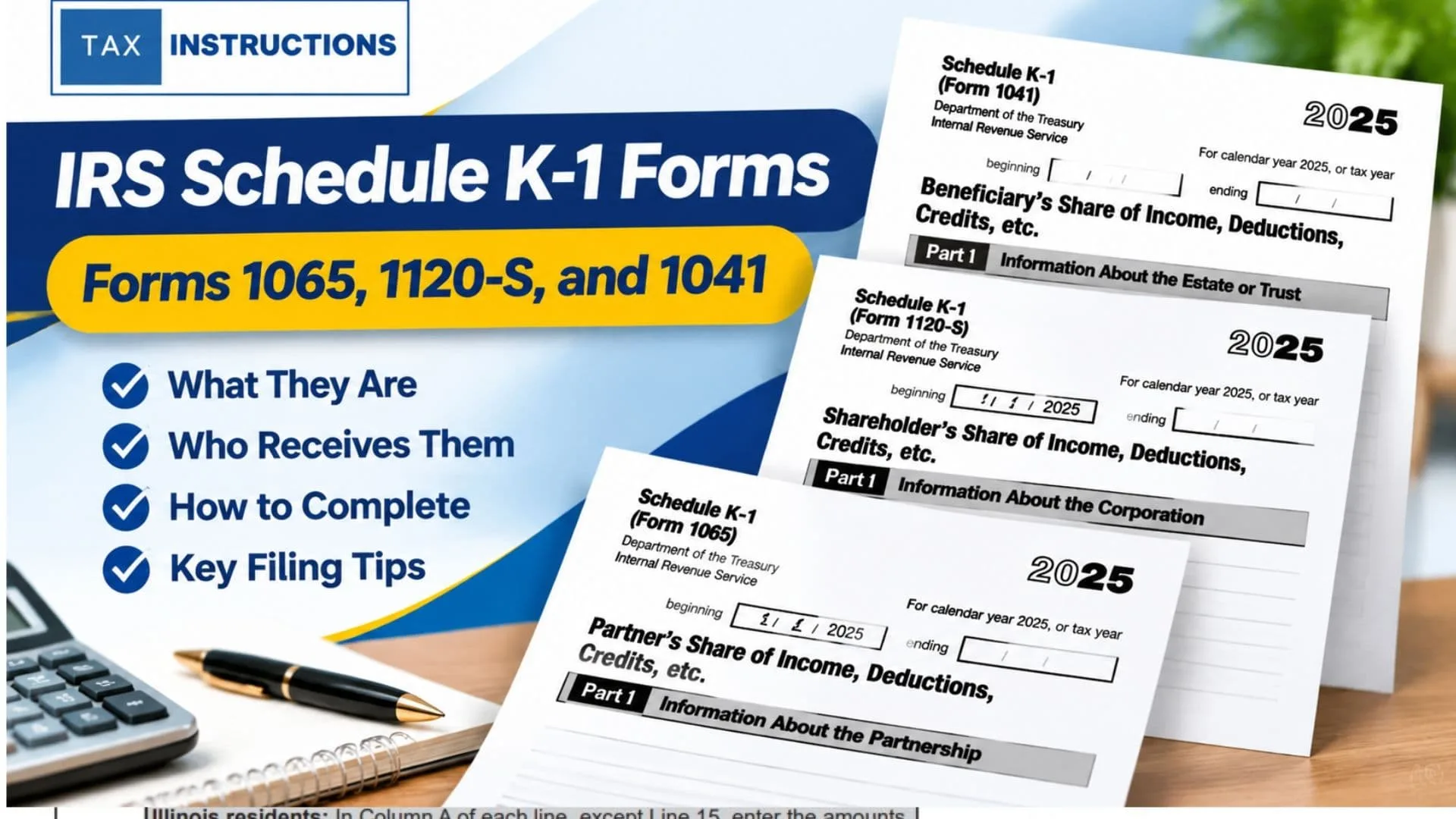
IRS Schedule K-1 is a tax reporting document used to communicate an individual’s share of income, deductions, credits, distributions, and other tax-related information from a business, corporation, estate, or trust. Unlike a standard individual income tax return, Schedule K-1 reports financial information that belongs to a particular partner, shareholder, or beneficiary. The information is then used to prepare the recipient’s individual or other applicable tax return. There are three main versions of Schedule K-1: Form 1065 for partnerships, Form 1120-S for S corporations, and Form 1041 for estates and trusts. Although all three forms share a similar reporting purpose, they collect different information because each entity has its own tax structure and reporting requirements. Partnership K-1 reports a partner’s ownership information, share of business profits and losses, liabilities, capital account activity, and allocated tax items. S corporation K-1 reports a shareholder’s ownership percentage, number of shares, loans, and allocated corporate income or deductions. Estate and trust K-1 reports a beneficiary’s share of income, deductions, credits, and other distributions from an estate or trust. These documents help ensure that income and tax-related items passed through an entity are properly reported by the people who receive them. Completing and interpreting the correct Schedule K-1 is important because different income categories may receive different tax treatment, and certain deductions or credits may be subject to additional limitations. Recipients should review every reported amount, identify any attached statements, and transfer the information to the appropriate sections of their tax returns.
Understanding The Three Types Of Schedule K-1
Before completing or reviewing a Schedule K-1, it is important to identify which version applies to your situation.
Schedule K-1 (Form 1065): Partnership
This version is issued to partners of a partnership. It reports each partner’s allocated share of partnership income, losses, deductions, credits, distributions, and liabilities.
Schedule K-1 (Form 1120-S): S Corporation
This version is issued to shareholders of an S corporation. It reports the shareholder’s allocated portion of corporate income, deductions, credits, and other tax-related information.
Schedule K-1 (Form 1041): Estate Or Trust
This version is issued to beneficiaries of an estate or trust. It identifies the income, deductions, credits, and other tax information allocated to each beneficiary.
How To File Schedule K-1
Schedule K-1 is generally prepared and furnished by the entity that generates the income. The recipient uses the information to prepare their own tax return. It is not generally a separate tax return that the recipient files independently.
The applicable entity files its main federal return:
- Partnerships file Form 1065 and provide Schedule K-1 (Form 1065) to their partners.
- S corporations file Form 1120-S and provide Schedule K-1 (Form 1120-S) to their shareholders.
- Estates and trusts file Form 1041 and provide Schedule K-1 (Form 1041) to their beneficiaries.
Before reviewing a K-1, gather the following information:
- Your taxpayer identification number or Social Security number.
- Your legal name and current mailing address.
- The entity’s identifying information.
- Ownership percentages, share information, or beneficiary details, as applicable.
- Records of capital contributions, distributions, loans, or liabilities when relevant.
- Any additional statements supplied with the K-1.
- Your other tax records needed to prepare your applicable income tax return.
Important: The entity generally prepares the K-1. Partners, shareholders, and beneficiaries should use the completed document to report their allocated tax information. They should not independently invent or estimate amounts that belong to the entity’s tax reporting.

Part One: Schedule K-1 (Form 1065), Partnership
What Is Schedule K-1 (Form 1065)?
Schedule K-1 (Form 1065) is used by partnerships to report each partner’s share of the partnership’s taxable and nontaxable financial activities. It provides information about the partnership, the individual partner, ownership percentages, liabilities, capital account changes, income, deductions, credits, and distributions. The partnership prepares a separate K-1 for each partner and furnishes it to that partner. Partners use the reported amounts to determine how partnership activities affect their individual or other applicable tax returns. The 2025 version contains three main parts: Part I identifies the partnership, Part II identifies the partner and reports ownership and capital information, and Part III provides the partner’s share of current-year income, deductions, credits, and other tax items.
How To Complete Schedule K-1 (Form 1065)
Initial Information And Tax Year
At the top of the form, review the following information before completing the individual sections.
Final K-1 Checkbox
Select this box when the document represents the partner’s final Schedule K-1 from the partnership. It indicates that no further K-1 is expected for that partner from the partnership under the applicable circumstances.
Amended K-1 Checkbox
Select this box when the document corrects or replaces a previously issued Schedule K-1 for the same tax year. Review the amended information carefully against the earlier version.
Tax Year
Enter the applicable tax year. For the 2025 form, the calendar-year period is 2025. If the partnership uses a fiscal tax year, enter the actual beginning and ending dates.
Part I: Information About The Partnership
This section identifies the partnership responsible for issuing the Schedule K-1. The partnership generally completes this section.
Box A: Partnership’s Employer Identification Number
Enter the partnership’s nine-digit Employer Identification Number (EIN). This number identifies the partnership for federal tax reporting purposes.
Box B: Partnership Name And Address
Enter the partnership’s complete legal name, street address, city, state, and ZIP code. Use the address associated with the partnership’s tax records.
Box C: IRS Center Where Partnership Filed Return
Identify the IRS service center where the partnership submitted its Form 1065. This information identifies the location responsible for processing the partnership’s return.
Box D: Publicly Traded Partnership (PTP)
Check this box if the partnership is publicly traded. A publicly traded partnership generally has interests traded on an established securities market or readily tradable on a secondary market, subject to applicable rules.
Part II: Information About The Partner
This section identifies the partner receiving the Schedule K-1 and provides information about their ownership, entity classification, liabilities, and capital account.
Box E: Partner’s Social Security Number Or Taxpayer Identification Number
Enter the partner’s identifying number. This may be a Social Security number (SSN) or another applicable taxpayer identification number (TIN). Do not enter the TIN of a disregarded entity in this box. Follow the applicable identification rules.
Box F: Partner’s Name And Address
Enter the partner’s full legal name, street address, city, state, and ZIP code. The information should match the partner’s tax records.
Box G: General Partner Or Limited Partner
Select the appropriate classification:
- General Partner or LLC Member-Manager: Select this option if the partner has general partner status or is an LLC member-manager.
- Limited Partner or Other LLC Member: Select this option if the partner is classified as a limited partner or another LLC member.
The selection should reflect the partner’s actual legal and tax classification.
Box H1: Domestic Or Foreign Partner
Select one of the following:
- Domestic Partner: Check this box for a partner classified as domestic.
- Foreign Partner: Check this box for a partner classified as foreign.
Box H2: Disregarded Entity Information
If the partner receiving the K-1 is a disregarded entity, provide the identifying information of the person or entity treated as its owner for federal tax purposes.
- TIN: Enter the taxpayer identification number of the responsible owner.
- Name: Enter the legal name of the responsible owner.
Do not confuse the disregarded entity’s information with the information required for the underlying tax owner.
Box I1: Type Of Entity
Identify the partner’s entity classification. Enter the applicable type, such as an individual, corporation, partnership, trust, estate, or another recognized entity category.
The classification should reflect the partner’s actual federal tax status.
Box I2: Retirement Plan Identification
Check this box if the partner is a retirement plan, including an IRA, SEP, Keogh plan, or another applicable retirement arrangement.
Box J: Partner’s Share Of Profit, Loss, And Capital
This section reports the partner’s ownership percentages at the beginning and end of the tax year.
Complete the following three categories:
- Profit: Enter the partner’s percentage share of partnership profits at the beginning and end of the year.
- Loss: Enter the partner’s percentage share of partnership losses at the beginning and end of the year.
- Capital: Enter the partner’s percentage interest in partnership capital at the beginning and end of the year.
If the partner’s percentage decreased because of a sale or exchange of a partnership interest, check the applicable explanation box.
- Sale: Select this option if the decrease resulted from a sale of the partnership interest.
- Exchange: Select this option if the decrease resulted from an exchange of the partnership interest.
Box K1: Partner’s Share Of Liabilities
This section reports the partner’s allocated share of partnership liabilities at the beginning and end of the tax year.
Enter the applicable amounts in the following categories:
- Nonrecourse: Report the partner’s share of partnership nonrecourse liabilities.
- Qualified Nonrecourse Financing: Report the partner’s share of qualified nonrecourse financing.
- Recourse: Report the partner’s share of partnership recourse liabilities.
Enter the beginning and ending amounts separately. These amounts are important when determining the partner’s tax basis and applying other partnership tax rules.
Box K2: Lower-Tier Partnership Liabilities
Check this box if the amounts reported in Box K1 include liabilities allocated to the partnership through one or more lower-tier partnerships.
Box K3: Partner Guarantees Or Payment Obligations
Check this box if any of the liabilities reported in Box K1 are subject to guarantees or other payment obligations by the partner. Review the applicable partnership information before making this selection.
Box L: Partner’s Capital Account Analysis
This section explains how the partner’s capital account changed during the tax year. Enter the amounts in the appropriate categories.
Beginning Capital Account
Enter the capital account balance at the start of the tax year.
Capital Contributed During The Year
Report the amount of money or other capital contributed by the partner during the tax year.
Current Year Net Income (Loss)
Enter the partner’s allocated share of current-year net income or loss that affects the capital account.
Other Increase (Decrease)
Report other adjustments that increased or decreased the capital account. Attach an explanation describing the adjustments.
Withdrawals And Distributions
Enter the total withdrawals and distributions made to the partner during the year. Report the amount as a reduction to the capital account.
Ending Capital Account
Calculate the ending balance using the beginning balance and all applicable increases and decreases.
The general calculation is:
Beginning Capital Account + Capital Contributions + Current-Year Net Income (Loss) + Other Increases (Decreases) – Withdrawals And Distributions.
Use the partnership’s applicable capital account reporting method and supporting records.
Box M: Property Contributed With Built-In Gain Or Loss
Answer whether the partner contributed property that had a built-in gain or loss when transferred to the partnership.
- Yes: Check this option if the partner contributed property with a built-in gain or loss. Attach the required statement.
- No: Check this option if no such property contribution occurred.
This information helps identify potential tax consequences associated with contributed property under partnership rules.
Box N: Partner’s Share Of Net Unrecognized Section 704(c) Gain Or Loss
Enter the partner’s share of net unrecognized Section 704(c) gain or loss.
- Beginning: Report the amount at the start of the tax year.
- Ending: Report the amount at the end of the tax year.
This information relates to differences between the tax basis and fair market value of property contributed to the partnership.
Part III: Partner’s Share Of Current-Year Income, Deductions, Credits, And Other Items
Part III reports the tax-related items allocated to the partner during the year. Each amount should be reviewed carefully because different categories may be subject to different reporting and tax treatment.
Line 1: Ordinary Business Income (Loss)
Enter the partner’s allocated share of ordinary business income or loss from the partnership’s business activities. Report the amount as income or loss, as applicable.
Line 2: Net Rental Real Estate Income (Loss)
Report the partner’s share of net income or loss generated from rental real estate activities. This amount relates specifically to rental real estate rather than other rental operations.
Line 3: Other Net Rental Income (Loss)
Enter the partner’s allocated share of income or loss from rental activities that are not classified as rental real estate activities reported on Line 2.
Line 4a: Guaranteed Payments For Services
Report guaranteed payments made to the partner for services provided to the partnership. These payments are generally determined without regard to partnership income.
Line 4b: Guaranteed Payments For Capital
Enter guaranteed payments made to the partner for the use of capital invested in the partnership.
Line 4c: Total Guaranteed Payments
Enter the combined amount of Lines 4a and 4b. This represents the partner’s total guaranteed payments for the tax year.
Line 5: Interest Income
Report the partner’s allocated share of taxable interest income earned by the partnership.
Line 6a: Ordinary Dividends
Enter the partner’s share of ordinary dividends received by the partnership from investments or other applicable sources.
Line 6b: Qualified Dividends
Report the portion of dividend income that qualifies for qualified dividend treatment. This amount is generally included within ordinary dividends, not added to it as a separate additional amount.
Line 6c: Dividend Equivalents
Enter the partner’s allocated dividend equivalent payments, when applicable. These payments may arise from certain financial arrangements linked to dividend distributions.
Line 7: Royalties
Report the partner’s share of royalty income earned from sources such as intellectual property, natural resources, or other royalty-generating assets.
Line 8: Net Short-Term Capital Gain (Loss)
Enter the partner’s allocated net short-term capital gain or loss. This generally relates to capital assets held for one year or less.
Line 9a: Net Long-Term Capital Gain (Loss)
Report the partner’s share of net long-term capital gain or loss from assets generally held for more than one year.
Line 9b: Collectibles (28%) Gain (Loss)
Enter the partner’s share of gain or loss subject to the special 28% collectibles tax rate rules, when applicable.
Line 9c: Unrecaptured Section 1250 Gain
Report the partner’s allocated unrecaptured Section 1250 gain. This category generally relates to certain gains from the sale of depreciable real property.
Line 10: Net Section 1231 Gain (Loss)
Enter the partner’s share of net gain or loss from Section 1231 property, such as certain business real estate and depreciable business assets.
Line 11: Other Income (Loss)
Report other income or loss allocated to the partner that does not belong in the previously listed categories. Review any attached statement for additional details and applicable reporting codes.
Line 12: Section 179 Deduction
Enter the partner’s allocated share of the partnership’s Section 179 deduction. This amount relates to qualifying business property for which the partnership elected Section 179 expense treatment.
Line 13: Other Deductions
Report other deductions allocated to the partner that are not included in Line 12. Supporting statements may identify the deduction categories and applicable tax treatment.
Line 14: Self-Employment Earnings (Loss)
Enter the partner’s share of earnings or losses relevant to self-employment tax calculations. The amount may affect the partner’s self-employment tax reporting.
Line 15: Credits
Report tax credits allocated to the partner by the partnership. Review attached statements for the individual credit types and any additional reporting requirements.
Line 16: Schedule K-3 Attached
Check this box if Schedule K-3 is attached to the Schedule K-1. Schedule K-3 provides additional information about international tax-related items and other applicable reporting details.
Line 17: Alternative Minimum Tax (AMT) Items
Report information relating to alternative minimum tax adjustments and preference items. Review supporting statements for the specific categories and amounts.
Line 18: Tax-Exempt Income And Nondeductible Expenses
Report the partner’s allocated share of tax-exempt income and nondeductible expenses. These amounts can affect the partner’s basis and capital account even when they do not directly change taxable income.
Line 19: Distributions
Enter the amount of money or property distributed to the partner during the tax year. Distributions may affect the partner’s outside basis and other tax calculations.
Line 20: Other Information
Report additional partnership-related tax information that does not fit into the preceding categories. Review any attached statements for specific codes, explanations, and reporting requirements.
Line 21: Foreign Taxes Paid Or Accrued
Enter the partner’s allocated share of foreign taxes paid or accrued by the partnership. This information may be relevant when calculating foreign tax credits or other international tax adjustments.
Line 22: More Than One Activity For At-Risk Purposes
Check this box if the partner has more than one activity for at-risk purposes. Additional activity information may be provided in an attached statement.
Line 23: More Than One Activity For Passive Activity Purposes
Check this box if the partner has more than one activity for passive activity purposes. Review the attached information when determining the applicable passive activity limitations.
Attached Statements And Additional Information
Some K-1 items require supporting statements that explain individual amounts, codes, or activities. Review these statements alongside the main form because they may contain information necessary to complete the partner’s tax return.

Part Two: Schedule K-1 (Form 1120-S), S Corporation
What Is Schedule K-1 (Form 1120-S)?
Schedule K-1 (Form 1120-S) is an IRS tax document used by S corporations to report each shareholder’s allocated share of corporate income, losses, deductions, credits, and other tax-related items. An S corporation generally passes its taxable income and other reportable items through to its shareholders rather than paying federal income tax on most of its ordinary business income at the corporate level. Each shareholder receives a separate Schedule K-1 reflecting their allocated portion of the corporation’s financial activities. The form also records the shareholder’s identifying information, ownership percentage, number of shares, and loans made to the corporation. Shareholders use the reported information when preparing their individual or other applicable tax returns. Reviewing the document carefully is important because ownership changes, shareholder loans, distributions, and basis-related items can influence the tax treatment of corporate income and deductions.
How To Complete Schedule K-1 (Form 1120-S)
Initial Information And Tax Year
Final K-1 Checkbox
Check this box when the Schedule K-1 represents the shareholder’s final K-1 from the corporation.
Amended K-1 Checkbox
Check this box when the corporation issues a corrected or amended Schedule K-1 for a previously reported tax year.
Tax Year
Enter the calendar or fiscal tax year covered by the K-1. The 2025 version is used for the 2025 calendar tax year or an applicable fiscal year beginning in 2025.
Part I: Information About The Corporation
This section identifies the S corporation issuing the Schedule K-1.
Box A: Corporation’s Employer Identification Number
Enter the corporation’s nine-digit EIN. This number identifies the S corporation for federal tax reporting.
Box B: Corporation’s Name And Address
Enter the corporation’s full legal name, street address, city, state, and ZIP code. Verify that the information matches its tax records.
Box C: IRS Center Where Corporation Filed Return
Identify the IRS service center where the corporation filed its Form 1120-S.
Box D: Corporation’s Total Number Of Shares
Report the corporation’s total outstanding shares at two different points:
- Beginning Of Tax Year: Enter the total number of shares outstanding at the start of the tax year.
- End Of Tax Year: Enter the total number of shares outstanding at the end of the tax year.
These amounts help establish the corporation’s total share structure and provide context for shareholder ownership.
Part II: Information About The Shareholder
This section identifies the shareholder and reports ownership-related details.
Box E: Shareholder’s Identifying Number
Enter the shareholder’s SSN or other applicable taxpayer identification number. Use the identification number belonging to the shareholder.
Box F1: Shareholder’s Name And Address
Enter the shareholder’s full legal name, street address, city, state, and ZIP code. Confirm that the information is accurate and current.
Box F2: Responsible Person Or Entity Information
Complete this section if the shareholder is a disregarded entity, trust, estate, nominee, or similar person or entity.
Provide the information of the individual or entity responsible for reporting the income:
- TIN: Enter the responsible person’s or entity’s taxpayer identification number.
- Name: Enter the responsible person’s or entity’s legal name.
This section helps identify the actual reporting party when the shareholder shown on the form is not the ultimate taxpayer.
Box F3: Type Of Entity
Identify the shareholder’s entity classification. Examples include an individual, corporation, partnership, trust, or estate, depending on the applicable tax classification.
Box G: Current-Year Allocation Percentage
Enter the shareholder’s allocation percentage for the current tax year. This percentage reflects the shareholder’s allocated share of the corporation’s income, deductions, credits, and other items under the applicable allocation rules.
Box H: Shareholder’s Number Of Shares
Report the shareholder’s ownership in the corporation at the beginning and end of the tax year.
- Beginning Of Tax Year: Enter the number of shares owned at the start of the year.
- End Of Tax Year: Enter the number of shares owned at the end of the year.
If the shareholder acquired or disposed of shares during the year, ensure the information reflects the actual ownership records.
Box I: Loans From Shareholder
Report the outstanding amount of loans the shareholder made to the S corporation.
- Beginning Of Tax Year: Enter the outstanding shareholder loan balance at the beginning of the year.
- End Of Tax Year: Enter the outstanding shareholder loan balance at the end of the year.
These amounts help establish the shareholder’s debt relationship with the corporation and may be relevant when determining debt basis.
Part III: Shareholder’s Share Of Current-Year Income, Deductions, Credits, And Other Items
This section reports the financial and tax-related items allocated to the shareholder.
Line 1: Ordinary Business Income (Loss)
Enter the shareholder’s allocated share of the S corporation’s ordinary business income or loss for the tax year.
Line 2: Net Rental Real Estate Income (Loss)
Report the shareholder’s allocated portion of net income or loss from rental real estate activities.
Line 3: Other Net Rental Income (Loss)
Enter income or loss from rental activities that do not qualify as rental real estate income reported on Line 2.
Line 4: Interest Income
Report the shareholder’s allocated share of taxable interest income earned by the corporation.
Line 5a: Ordinary Dividends
Enter the shareholder’s allocated share of ordinary dividends received by the S corporation.
Line 5b: Qualified Dividends
Report the portion of ordinary dividends that qualifies for qualified dividend tax treatment. This amount is included within ordinary dividends rather than representing an additional separate dividend payment.
Line 6: Royalties
Enter the shareholder’s share of royalty income earned by the corporation from applicable royalty-generating activities or assets.
Line 7: Net Short-Term Capital Gain (Loss)
Report the shareholder’s allocated net short-term capital gain or loss, generally relating to capital assets held for one year or less.
Line 8a: Net Long-Term Capital Gain (Loss)
Enter the shareholder’s share of net long-term capital gain or loss, generally relating to capital assets held for more than one year.
Line 8b: Collectibles (28%) Gain (Loss)
Report the shareholder’s share of collectibles gain or loss subject to the special 28% tax rate rules, when applicable.
Line 8c: Unrecaptured Section 1250 Gain
Enter the shareholder’s allocated unrecaptured Section 1250 gain from applicable transactions involving depreciable real property.
Line 9: Net Section 1231 Gain (Loss)
Report the shareholder’s share of net Section 1231 gain or loss from qualifying business property transactions.
Line 10: Other Income (Loss)
Enter other income or loss allocated to the shareholder that does not belong in the preceding categories. Review attached statements for additional details.
Line 11: Section 179 Deduction
Report the shareholder’s allocated share of the corporation’s Section 179 deduction for qualifying business property.
Line 12: Other Deductions
Enter other deductions allocated to the shareholder that are not reported on Line 11. Additional statements may explain the deduction categories and applicable limitations.
Line 13: Credits
Report tax credits allocated to the shareholder by the S corporation. Supporting statements may provide the specific credit descriptions and amounts.
Line 14: Schedule K-3 Attached
Check this box if Schedule K-3 accompanies the Schedule K-1. This schedule provides additional information about international tax-related items.
Line 15: Alternative Minimum Tax (AMT) Items
Report information about alternative minimum tax adjustments and preference items allocated to the shareholder. Review the applicable supporting statements for details.
Line 16: Items Affecting Shareholder Basis
Enter information about items that affect the shareholder’s stock basis or debt basis. These items are important when determining the tax treatment of losses, deductions, and distributions.
Review all attached statements carefully because the individual components may require separate basis calculations.
Line 17: Other Information
Report additional tax-related information that does not fit into the preceding categories. Use the accompanying statements to identify specific information codes and explanations.
Line 18: More Than One Activity For At-Risk Purposes
Check this box if the shareholder has more than one activity for at-risk purposes. This information indicates that additional activity-level details may be necessary when applying at-risk limitations.
Line 19: More Than One Activity For Passive Activity Purposes
Check this box if the shareholder has more than one activity for passive activity purposes. Review any attached statements to determine how the different activities should be treated for tax reporting.
Supporting Statements And Additional Information
The 2025 S corporation Schedule K-1 includes spaces for additional information in several reporting categories. These statements may explain specific deductions, credits, basis adjustments, or other tax items.
Do not assume that a blank description on the main form means no additional information exists. Review all accompanying statements before preparing the shareholder’s tax return.

Part Three: Schedule K-1 (Form 1041), Estate Or Trust
What Is Schedule K-1 (Form 1041)?
Schedule K-1 (Form 1041) is an IRS tax document used by estates and trusts to report the income, deductions, credits, and other tax-related amounts allocated to their beneficiaries. When an estate or trust generates income during a tax year, certain amounts may be distributed or allocated to beneficiaries according to the applicable tax rules and governing documents. The fiduciary responsible for administering the estate or trust prepares the Schedule K-1 for each beneficiary. The document identifies the estate or trust, the fiduciary, and the beneficiary while providing a detailed breakdown of the beneficiary’s allocated financial items. Unlike partnership and S corporation K-1 forms, this version focuses on estate and trust distributions, portfolio income, rental income, business income, estate tax deductions, and final-year deductions. It also includes information about credits, alternative minimum tax adjustments, and other reporting categories. Beneficiaries use this information when preparing their individual income tax returns or other applicable returns. Reviewing the form and its accompanying statements is essential because different types of income and deductions may need to be reported in different sections of the beneficiary’s tax return.
How To Complete Schedule K-1 (Form 1041)
Initial Information And Tax Year
Final K-1 Checkbox
Check this box if the document represents the beneficiary’s final Schedule K-1 from the estate or trust. It indicates that the beneficiary should not expect another K-1 from that entity under the applicable circumstances.
Amended K-1 Checkbox
Check this box if the fiduciary issues a corrected Schedule K-1 to replace information previously reported for the same tax year.
Tax Year
Enter the tax year covered by the document. The 2025 version generally applies to the calendar year beginning January 1, 2025, and ending December 31, 2025. For a fiscal-year estate or trust, enter the actual beginning and ending dates.
Part I: Information About The Estate Or Trust
This section identifies the estate or trust responsible for issuing the beneficiary’s Schedule K-1.
Box A: Estate’s Or Trust’s Employer Identification Number
Enter the estate’s or trust’s nine-digit Employer Identification Number (EIN). This number identifies the entity for federal tax reporting.
Box B: Estate’s Or Trust’s Name
Enter the complete legal name of the estate or trust. Use the name associated with its federal tax identification and reporting records.
Box C: Fiduciary’s Name And Address
Enter the fiduciary’s full name, street address, city, state, and ZIP code.
The fiduciary is the individual or organization responsible for managing the estate or trust and handling its applicable tax reporting obligations.
Box D: Form 1041-T Filing Information
Check this box if Form 1041-T was filed to allocate estimated tax payments to beneficiaries.
Enter the date Form 1041-T was filed in the space provided.
If the form was not filed, leave the checkbox and date field blank.
Box E: Final Form 1041
Check this box if the estate or trust is filing its final Form 1041.
This indicates that the current tax return is the final fiduciary income tax return for the estate or trust.
Part II: Information About The Beneficiary
This section identifies the person or entity receiving the income, deductions, credits, and other allocated amounts.
Box F: Beneficiary’s Identifying Number
Enter the beneficiary’s Social Security number or other applicable taxpayer identification number.
Ensure that the number belongs to the beneficiary receiving the Schedule K-1.
Box G: Beneficiary’s Name And Address
Enter the beneficiary’s complete legal name, street address, city, state, and ZIP code.
Check the information against the beneficiary’s tax records to avoid identification or mailing errors.
Box H: Domestic Or Foreign Beneficiary
Select the appropriate classification:
- Domestic Beneficiary: Check this box if the beneficiary is classified as domestic.
- Foreign Beneficiary: Check this box if the beneficiary is classified as foreign.
The selection should reflect the beneficiary’s applicable tax classification.
Part III: Beneficiary’s Share Of Current-Year Income, Deductions, Credits, And Other Items
Part III contains the amounts allocated to the beneficiary during the tax year. These amounts may need to be reported on different lines or schedules of the beneficiary’s income tax return.
Line 1: Interest Income
Enter the beneficiary’s allocated share of taxable interest income received by the estate or trust.
This amount is generally reported as taxable interest income on Form 1040 or Form 1040-SR.
Line 2a: Ordinary Dividends
Report the beneficiary’s share of ordinary dividend income received by the estate or trust.
This amount generally includes dividend income that does not qualify for the special qualified dividend tax treatment.
Line 2b: Qualified Dividends
Enter the portion of dividend income that qualifies for qualified dividend treatment.
This amount is generally included within ordinary dividends and may receive preferential tax rates when applicable requirements are met.
Line 3: Net Short-Term Capital Gain
Report the beneficiary’s allocated net short-term capital gain.
This generally relates to capital assets held for one year or less. The amount is generally reported through Schedule D.
Line 4a: Net Long-Term Capital Gain
Enter the beneficiary’s allocated net long-term capital gain, generally arising from assets held for more than one year.
The amount is generally reported on Schedule D.
Line 4b: 28% Rate Gain
Report the beneficiary’s share of gain subject to the special 28% collectibles tax rate rules.
This amount is used when completing the applicable 28% Rate Gain Worksheet in the Schedule D instructions.
Line 4c: Unrecaptured Section 1250 Gain
Enter the beneficiary’s allocated unrecaptured Section 1250 gain.
This category generally relates to certain gains from the sale or disposition of depreciable real property.
The amount is used when completing the Unrecaptured Section 1250 Gain Worksheet in the Schedule D instructions.
Line 5: Other Portfolio And Nonbusiness Income
Report other portfolio and nonbusiness income allocated to the beneficiary that does not belong in the previously listed income categories.
This amount is generally reported on Schedule E, following the applicable reporting instructions.
Line 6: Ordinary Business Income
Enter the beneficiary’s allocated share of ordinary business income generated through business activities conducted by the estate or trust.
This amount is generally reported on Schedule E, depending on the applicable reporting requirements.
Line 7: Net Rental Real Estate Income
Report the beneficiary’s share of net income from rental real estate activities.
This amount is generally reported on Schedule E.
Line 8: Other Rental Income
Enter the beneficiary’s allocated income from rental activities that are not classified as rental real estate income reported on Line 7.
This amount is generally reported on Schedule E.
Line 9: Directly Apportioned Deductions
Report deductions allocated directly to the beneficiary from the estate or trust’s activities.
This section uses specific codes to identify the type of deduction.
The following codes explain the deduction categories included in the accompanying reporting information.
- Code A: Depreciation: Reports the beneficiary’s share of depreciation deductions. These amounts may be reported on Form 8582 or Schedule E, depending on the applicable circumstances.
- Code B: Depletion: Identifies depletion deductions associated with qualifying property or natural resource activities. Reporting generally follows Form 8582 or Schedule E.
- Code C: Amortization: Reports amortization deductions allocated to the beneficiary. These amounts generally require reporting through Form 8582 or Schedule E.
Review the attached statement to determine the amount associated with each deduction code.
Line 10: Estate Tax Deduction
Enter the beneficiary’s allocated estate tax deduction, when applicable.
This deduction generally relates to income in respect of a decedent that is included in the beneficiary’s taxable income and is subject to the applicable estate tax deduction rules.
The amount is generally reported on Schedule A.
Line 11: Final Year Deductions
Report deductions allocated to the beneficiary when the estate or trust reaches its final tax year.
This section includes several deduction categories.
- Code A: Excess Deductions Under Section 67(e) Expenses: Reports qualifying excess deductions attributable to administrative expenses under Section 67(e). These amounts are generally reported on Schedule 1 (Form 1040), Line 24k, subject to applicable instructions.
- Code B: Excess Non-Miscellaneous Itemized Deductions: Reports excess deductions classified as non-miscellaneous itemized deductions. The beneficiary should follow the applicable instructions for reporting.
- Code C: Short-Term Capital Loss Carryover: Reports the beneficiary’s share of short-term capital losses carried forward from the estate or trust. This information is generally used on Schedule D.
- Code D: Long-Term Capital Loss Carryover: Reports the beneficiary’s share of long-term capital losses carried forward from the estate or trust. The amount is used in the applicable Schedule D calculations and worksheets.
- Code E: Net Operating Loss Carryover, Regular Tax: Reports a net operating loss carryover for regular income tax purposes. This amount is generally reported on Schedule 1 (Form 1040), Line 8a.
- Code F: Net Operating Loss Carryover, Minimum Tax: Reports a net operating loss carryover associated with alternative minimum tax calculations. The amount is generally used on Form 6251.
Line 12: Alternative Minimum Tax Adjustment
Report adjustments and tax preference items that may affect the beneficiary’s alternative minimum taxable income.
The accompanying information identifies the following categories:
- Code A: Adjustment For Minimum Tax Purposes: Reports adjustments used when calculating alternative minimum tax. This amount is generally reported on Form 6251, Line 2j.
- Code B: AMT Adjustment Attributable To Qualified Dividends: Identifies alternative minimum tax adjustments associated with qualified dividends.
- Code C: AMT Adjustment Attributable To Net Short-Term Capital Gain: Reports adjustments associated with net short-term capital gain.
- Code D: AMT Adjustment Attributable To Net Long-Term Capital Gain: Identifies alternative minimum tax adjustments related to net long-term capital gain.
- Code E: AMT Adjustment Attributable To Unrecaptured Section 1250 Gain: Reports the applicable adjustment associated with unrecaptured Section 1250 gain.
- Code F: AMT Adjustment Attributable To 28% Rate Gain: Identifies adjustments related to gain subject to the special 28% rate rules.
- Code G: Accelerated Depreciation: Reports information about accelerated depreciation adjustments relevant to alternative minimum tax calculations.
- Code H: Depletion: Identifies depletion-related alternative minimum tax adjustments.
- Code I: Amortization: Reports amortization-related adjustments for alternative minimum tax purposes.
- Code J: Exclusion Items: Identifies applicable exclusion items relevant to alternative minimum tax calculations.
For additional reporting guidance, use the applicable beneficiary instructions and Form 6251 instructions. The form also identifies the 2026 Form 8801 in connection with the exclusion item reporting information.
Line 13: Credits And Credit Recapture
Report tax credits allocated to the beneficiary and any applicable credit recapture information.
The form uses the following codes:
- Code A: Credit For Estimated Taxes: Reports the beneficiary’s allocated share of estimated tax payments. This amount is generally reported on Form 1040 or Form 1040-SR, Line 26.
- Code B: Credit For Backup Withholding: Reports federal income tax withheld through backup withholding. This amount is generally reported on Form 1040 or Form 1040-SR, Line 25c.
- Code C: Low-Income Housing Credit: Identifies an allocated low-income housing tax credit.
- Code D: Advanced Manufacturing Production Credit: Reports an allocated advanced manufacturing production credit.
- Code E: Clean Electricity Production Credit: Identifies a credit associated with qualifying clean electricity production.
- Code F: Work Opportunity Credit: Reports an allocated work opportunity tax credit.
- Code G: Credit For Small Employer Health Insurance Premiums: Identifies a credit associated with qualifying health insurance premiums paid by eligible small employers.
- Code H: Biofuel Producer Credit: Reports an applicable biofuel producer credit.
- Code I: Credit For Increasing Research Activities: Identifies a credit associated with qualifying research and development activities.
- Code J: Renewable Electricity Production Credit: Reports an allocated renewable electricity production credit.
- Code K: Empowerment Zone Employment Credit: Identifies a credit associated with qualifying employment in designated empowerment zones.
- Code L: Clean Fuel Production Credit: Reports an applicable clean fuel production credit.
- Code M: Orphan Drug Credit: Identifies a credit associated with qualifying orphan drug research and development activities.
- Code N: Credit For Employer-Provided Childcare Facilities And Services: Reports a credit related to qualifying employer-provided childcare facilities and services.
- Code O: Biodiesel And Renewable Diesel Fuels Credit: Identifies a credit associated with qualifying biodiesel and renewable diesel fuel activities.
- Code P: Credit To Holders Of Tax Credit Bonds: Reports a credit allocated to eligible holders of qualifying tax credit bonds.
- Code Q: Credit For Employer Differential Wage Payments: Identifies a credit associated with qualifying differential wage payments made to employees.
- Code R: Recapture Of Credits: Reports amounts relating to the recapture of previously claimed tax credits.
- Code S: Credit For Production From Advanced Nuclear Power Facilities: Identifies an applicable credit associated with electricity production from qualifying advanced nuclear power facilities.
- Code T: Zero-Emission Nuclear Power Production Credit: Reports the applicable zero-emission nuclear power production credit.
- Code ZZ: Other Credits: Identifies additional credits that do not fall under the preceding categories. Review the beneficiary’s instructions for reporting details.
Line 14: Other Information
This section reports additional tax-related information that may affect the beneficiary’s tax return.
The form identifies several information codes.
- Code A: Tax-Exempt Interest: Reports tax-exempt interest allocated to the beneficiary. This amount is generally reported on Form 1040 or Form 1040-SR, Line 2a.
- Code B: Foreign Taxes: Reports the beneficiary’s allocated share of foreign taxes paid or accrued. This information may be used on Schedule 3 (Form 1040), Line 1, or Schedule A, Line 6, depending on the applicable tax treatment.
- Code C: Qualified Rehabilitation Expenditures: Identifies qualifying rehabilitation expenditures associated with eligible property. Review the beneficiary’s instructions for the applicable reporting treatment.
- Code D: Basis Of Energy Property: Reports information about the basis of qualifying energy property. Additional reporting guidance is provided in the beneficiary’s instructions.
- Code E: Net Investment Income: Reports information about net investment income. This amount may be relevant when completing Form 4952, Line 4a.
- Code F: Gross Farm And Fishing Income: Identifies the beneficiary’s share of gross income from farming and fishing activities. This amount is generally reported on Schedule E, Line 42.
- Code G: Foreign Trading Gross Receipts (Section 942(a)): Reports applicable foreign trading gross receipts under Section 942(a). Review the Instructions for Form 8873 for reporting requirements.
- Code H: Adjustment For Section 1411 Net Investment Income Or Deductions: Reports adjustments related to net investment income or deductions under Section 1411. This information is generally relevant to Form 8960, Line 7.
- Code I: Section 199A Information: Provides information relevant to the qualified business income deduction under Section 199A. Review the beneficiary’s instructions to determine the appropriate tax treatment.
- Code J: Qualifying Advanced Coal Project Property And Qualifying Gasification Project Property: Identifies information related to qualifying advanced coal project property and qualifying gasification project property.
- Code K: Qualifying Advanced Energy Project Property: Reports information related to qualifying advanced energy project property.
- Code L: Advanced Manufacturing Investment Property: Identifies information associated with qualifying advanced manufacturing investment property.
- Code M: Clean Electricity Investment Credit: Reports information about an applicable clean electricity investment credit.
- Code ZZ: Other Information: Identifies additional information that does not fall into the preceding categories. Review the accompanying beneficiary instructions for details.
Attached Statements And Additional Information
Schedule K-1 (Form 1041) includes an important note requiring an attached statement showing the beneficiary’s share of income and directly apportioned deductions from each business, rental real estate activity, and other rental activity.
This statement is particularly important when an estate or trust has multiple income-generating activities. Beneficiaries should review the supporting information before transferring amounts to their tax returns.
The second page of the form also provides reporting guidance that connects individual K-1 categories and codes with the relevant lines and schedules of Form 1040, Form 1040-SR, Schedule A, Schedule D, Schedule E, Schedule 1, Form 6251, and other applicable tax forms.
If the beneficiary does not file Form 1040 or Form 1040-SR, the appropriate instructions for their applicable income tax return should be followed.
Final Review Before Filing
Before using or issuing a Schedule K-1, review all information carefully. Errors in taxpayer identification numbers, ownership information, allocated income, deductions, and supporting statements can create problems when preparing the related tax returns.
Use the following checklist for the applicable K-1 form.
General Schedule K-1 Checklist
- Confirm that the correct Schedule K-1 version has been selected.
- Verify the tax year and applicable beginning and ending dates.
- Check the Final K-1 and Amended K-1 selections.
- Confirm that the entity’s legal name and identification number are correct.
- Verify the recipient’s name, address, and taxpayer identification number.
- Review every income and deduction category.
- Check all applicable credit and adjustment information.
- Review attached statements and supporting schedules.
- Confirm that the recipient has received the complete document.
Additional Checklist For Partnership K-1 (Form 1065)
- Verify the partnership’s EIN and address.
- Confirm the partner’s classification and domestic or foreign status.
- Review the partner’s beginning and ending profit, loss, and capital percentages.
- Verify liability information in Box K1.
- Check lower-tier partnership liability information.
- Review guarantees and payment obligations.
- Reconcile the partner’s capital account activity.
- Review property contributions and Section 704(c) information.
- Verify all income, deductions, credits, and distributions in Part III.
- Check whether Schedule K-3 is attached.
- Review at-risk and passive activity indicators.
Additional Checklist For S Corporation K-1 (Form 1120-S)
- Verify the corporation’s EIN and legal name.
- Confirm the corporation’s beginning and ending total share counts.
- Verify the shareholder’s identifying information.
- Review the shareholder’s entity classification.
- Confirm the current-year allocation percentage.
- Verify beginning and ending shareholder share ownership.
- Review beginning and ending shareholder loan balances.
- Check all allocated income and deduction amounts.
- Review credits and alternative minimum tax items.
- Verify items affecting shareholder basis.
- Check whether Schedule K-3 is attached.
- Review at-risk and passive activity indicators.
Additional Checklist For Estate Or Trust K-1 (Form 1041)
- Verify the estate’s or trust’s EIN and legal name.
- Confirm the fiduciary’s name and address.
- Check whether Form 1041-T was filed and enter the filing date when applicable.
- Confirm whether this is the final Form 1041.
- Verify the beneficiary’s identifying number and address.
- Confirm domestic or foreign beneficiary classification.
- Review all allocated interest and dividend income.
- Verify short-term and long-term capital gains.
- Review rental and business income.
- Check directly apportioned deduction codes.
- Review estate tax and final-year deductions.
- Verify alternative minimum tax adjustments.
- Review credits and credit recapture information.
- Check foreign taxes and other information codes.
- Confirm that the required activity-level supporting statement is attached.
Final Thoughts
IRS Schedule K-1 is an important tax reporting document for partners, S corporation shareholders, and estate or trust beneficiaries. Although Forms 1065, 1120-S, and 1041 serve different purposes, all three help communicate financial information that must be considered when preparing the recipient’s tax return.
Understanding each section, box, and line makes it easier to identify allocated income, deductions, credits, ownership information, and other tax-related items. Always review supporting statements, verify identification information, and apply the appropriate reporting instructions before submitting the related tax return.
A carefully reviewed Schedule K-1 helps reduce reporting errors and ensures that the financial information passed through from the entity is properly considered in the recipient’s tax filing.